


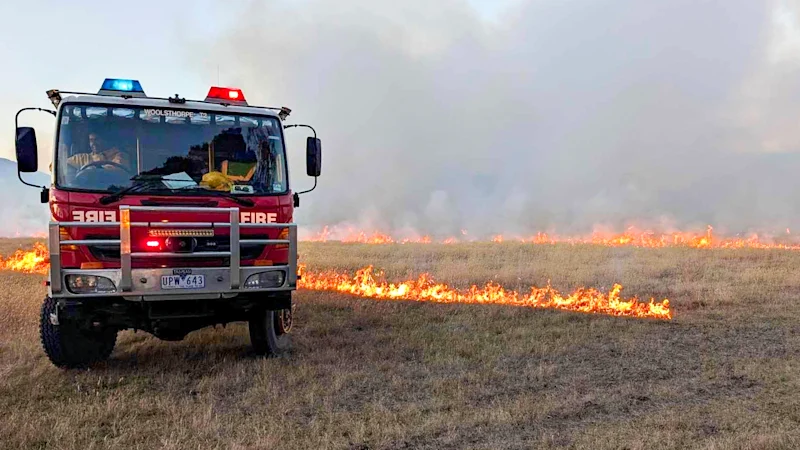
Victoria’s firefighting services face a $1.1 billion funding shortfall to replace ageing and damaged vehicles, with only $390.4 million currently identified towards the $1.5 billion required by 2034.
The warning comes as authorities prepare for a potentially difficult fire season, with forecasts pointing to heightened fire risk in parts of the state including the south-west, Central Highlands, far-east Gippsland and the western plains.
A report by Victoria’s auditor-general found that cracking had forced more than half of the Department of Energy, Environment and Climate Action’s firefighting fleet out of service during the last season. Maintenance of Fire Rescue Victoria vehicles had also doubled in three years, reducing availability.
Auditor-general Andrew Greaves said the Country Fire Authority, Fire Rescue Victoria and the environment department needed substantial and sustained investment to ensure their vehicles were safe, reliable and fit for purpose.
“Fire authorities collectively need around $1.5 billion from 2024-25 to 2033-34 to make sure their fire trucks are fit for purpose, reliable and safe,” he said. “But they only have around $390.4 million identified in current funding and future grants.”
Firefighting fleet faces ageing and cracking problems
The CFA has estimated that it needs $962.7 million to replace 1,657 trucks that will be beyond their expected working life during the decade, as well as carrying out other modifications.
Fire Rescue Victoria has put the cost of replacing 153 trucks more than 15 years old at $297.3 million. A further $216.6 million would be needed to replace 676 vehicles operated by the environment department, including trucks affected by cracking.
The auditor-general found that Fire Rescue Victoria reduced its initial funding request for the 2024-25 budget cycle from $158.9 million to $14.1 million after ministers were asked to scale back bids as the government sought to reduce debt and return to surplus.
The service has since prioritised replacing vehicles well beyond the recommended 15-year lifespan. Its request of $20.7 million this financial year would fund the replacement of 12 trucks, including one that is 31 years old.
Major repairs also restricted the availability of aerial appliances in 2025-26. The ladder-platform vehicles were available for an average of 57.3 per cent of the year, with electrical faults, delays in obtaining parts and repairs to cracking among the problems identified.
The environment department first identified cracks in G-Wagen fire trucks in 2017 and in Unimog vehicles from 2020. The issue became public at the end of 2025, after 54.4 per cent of the fleet had to be removed from service for the following fire season.
A programme of inspections and repairs allowed the department to meet its performance standards in January, although cracking continues to be found in both types of vehicle.
Emergency Management Victoria deputy commissioner Brett Boatman said preparations had been brought forward in response to the forecasts. CFA chief officer Garry Cook said recent rain had helped conditions but could lead to heavier vegetation growth and increased fuel loads.
“With fire, there will be a summer season,” Mr Cook said. “The length and breadth of that season will be determined by the weather itself, but we only need one bad day to have a bad summer.”
The government said it was spending $800 million on fire services, arguing that figure included commitments and equipment not measured in the auditor-general’s calculations.
Premier Ben Carroll said the report showed that further work was required. Labor has pledged $167 million for 150 new trucks by 2030 if returned to government in November, including 50 for Fire Rescue Victoria and 100 for the CFA.
“We have addressed a lot of what the Victorian Auditor-General’s Office has said by changing the manufacturing, changing the type of fleet [and] taking any unroadworthy vehicles off the road,” Mr Carroll said.
