


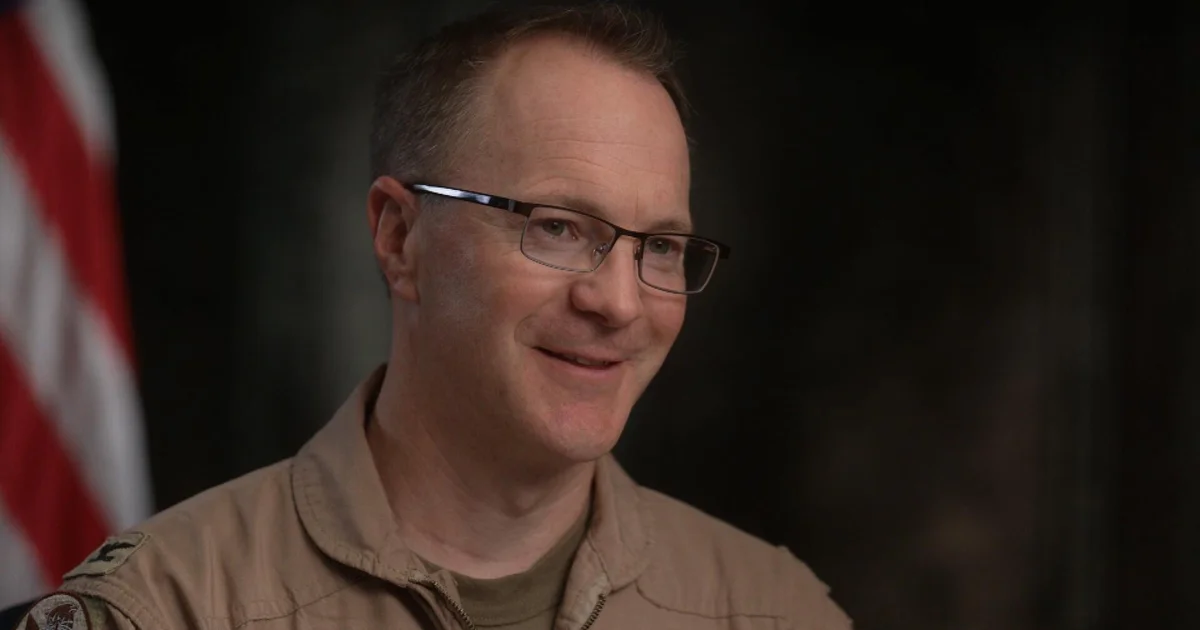
A US airman has described surviving a fighter jet crash, a broken back and a desperate climb through Iran’s mountains before being rescued in one of the country’s largest military search-and-rescue operations.
The two-man F-15E crew was shot down on 2 April while carrying out a strike against industrial facilities linked to Iran’s drone and missile programmes. The aircraft, known by the call sign DUDE 44, came down in a mountainous area south of Isfahan.
The pilot, identified as Alpha, and the weapons systems officer, known as Bravo, ejected and landed roughly five miles apart in rugged desert terrain. Bravo has spoken publicly for the first time, using his call sign because of security threats from Iran.
“I think the best way I’ve been able to describe that moment was getting hit by a freight train,” he said.
The $30 million aircraft was brought down by a shoulder-fired missile, according to the account. After the strike, the crew tried to save the jet but quickly concluded it could not be recovered.
“It was evident that that wasn’t possible. And soon thereafter, we ejected and found ourselves floating over the heart of Iran,” Bravo said.
The climb through Iran’s mountains
Alpha landed safely, but Bravo’s parachute was badly damaged. As he fell, he looked up and saw that there was no parachute above him.
He said he prayed before trying to release and straighten parts of the damaged canopy. Military professionals later estimated that he hit the ground at between 70 and 100mph.
The impact broke his back, arm and shoulder. He also suffered a sprained ankle and cuts to his head and face, but moved away from the landing site as quickly as he could.
Bravo said he believed the safest option was to gain height. Despite his injuries, he climbed towards a ridgeline about 7,000ft high, moving through valleys and around steep cliffs as daylight emerged.
When asked how he found the strength to keep going, he replied: “Never let a lack of motivation put you on Iranian TV.”
Iranian forces were searching for the airmen, after a news presenter announced a bounty for their capture. Videos posted online showed armed groups hunting for the downed crew, while US military sources said troops came within a few hundred metres of Bravo.
Gen Dan Caine, chairman of the Joint Chiefs of Staff and a former fighter pilot, said there had been “clear intent out of the Iranian ground force to come find those two guys”.
Adm Brad Cooper, the US commander in charge of the war, said about 1,500 Iranian forces were being tracked within a ten-mile radius of the crash site.
US rescue operation for the downed airman
Within six hours, American forces had located Alpha. Two helicopters were among 21 aircraft involved in a risky daylight raid to recover him, with the crews coming under fire during the operation.
“It was a gun fight all the way in and all the way out,” Defence Secretary Pete Hegseth said. Alpha was brought back safely, but Bravo remained missing.
As night fell, Bravo found a concealed position and managed to send a signal. His message included the words: “God is good.”
It also indicated that he was injured but moving, allowing commanders to continue planning a second rescue attempt.
That operation could not immediately go ahead. Hegseth said officials considered sending a rescue force on the Friday night but decided it was not possible, meaning Bravo had to spend another day exposed to the cold, wind and high-desert conditions with almost no food or water.
The Central Intelligence Agency helped run a campaign intended to confuse Iranian forces and used classified technology to establish Bravo’s precise location. American bombers and drones also struck nearby Revolutionary Guard positions before the rescue force moved in.
Nearly two days after the aircraft was shot down, about 92 special operators entered Iran. Several hundred personnel were in the air, while between 3,000 and 5,000 people supported the operation overall, according to Adm Cooper.
The force landed on a makeshift desert airstrip using two large search-and-rescue aircraft, then unloaded small “Little Bird” helicopters to reach Bravo on the ridgeline.
Declassified footage showed Bravo waiting on the mountain as two Air Force pararescue specialists approached him. The rescuers, known as PJs, took him from the ridgeline.
“The moment a PJ showed up to me on that ridgeline was one of the greatest moments of my life,” Bravo said. When asked what he told them, he replied: “Let’s go.”
The rescue was not yet complete. Back at the improvised airstrip, the landing gear of the aircraft carrying the team became stuck in the sand, leaving more than 90 special operators stranded inside Iran.
A clandestine US Air Force unit was brought in to help extract them. The military ultimately destroyed its own stranded aircraft to prevent its technology from falling into Iranian hands.
Bravo was finally taken out of Iran 50 hours after the shoot-down, at sunrise on Easter Sunday. Alpha has since returned to flying for the Air Force but declined to be interviewed because of security concerns.
Bravo said the mission was not primarily about his own ordeal, but about the training and co-ordination of those who went to recover him.
“This is not a story about what I went through,” he said. “Instead, it’s a story of the teamwork, the training, of the faith, of the decisions and the leadership to do something that will live in history as an example of what America’s willing to do in order to uphold our promise and leave no man behind.”
