


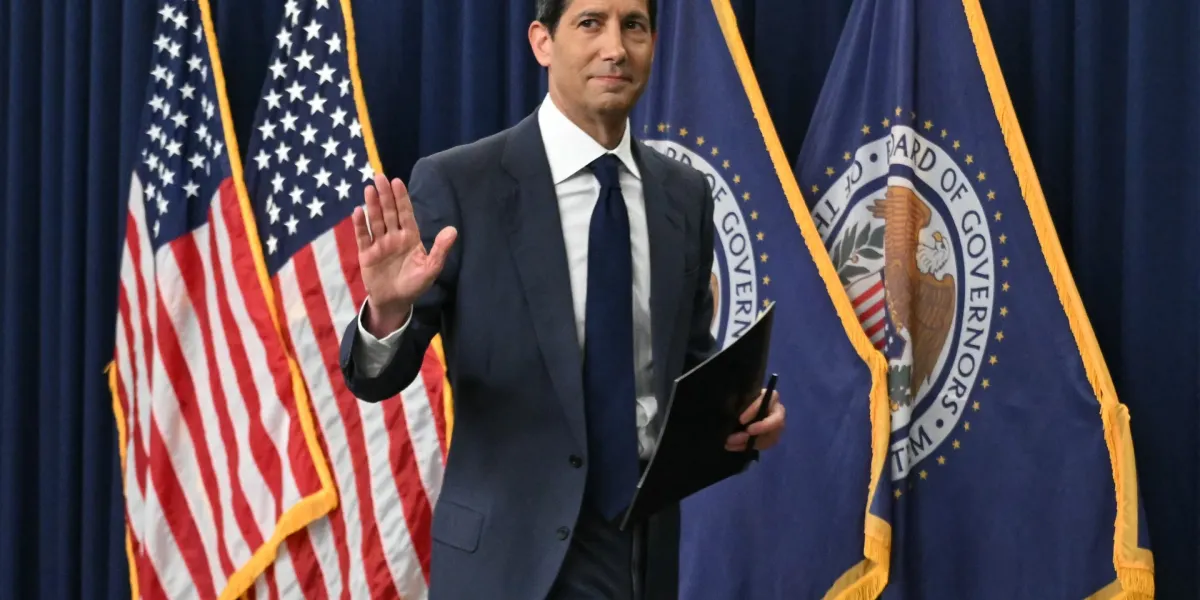
Federal Reserve chair Kevin Warsh may be less concerned with being seen as a hawk or a dove than with keeping long-term US borrowing costs under control, amid mounting concern over the country’s debt burden.
That is the view of Robin Brooks, a senior fellow at the Brookings Institution, who argues that the mixed signals from the central bank are best understood as yield-curve management rather than a clear shift towards tighter or looser monetary policy.
“We’re not in hawkish or dovish land. What’s happening is yield curve management, which itself is a function of how precarious the U.S. debt picture is,” Mr Brooks wrote in a Substack post.
Warsh, who was hand-picked by President Donald Trump to lead the Federal Reserve, had initially been expected to favour looser monetary policy. Yet he has also described inflation as a “choice”, a remark that suggested a tougher approach.
During the summer, he raised the possibility of using alternative measures of inflation and suggested that the bond market could carry out some of the Fed’s tightening work. He then delivered a hawkish speech at the Jackson Hole conference in August and led the central bank to a unanimous rate rise in September.
Last week, however, Warsh stopped short of supporting another increase despite inflation picking up again. His refusal to explain the decision or provide guidance on the next policy meeting had the effect of signalling a more dovish stance.
US debt costs intensify pressure on long-term yields
Mr Brooks argues that the shifts have more to do with long-term Treasury yields than with the latest economic data. Gross US debt has risen above $40 trillion, while debt held by the public is equivalent to 100 per cent of GDP.
Interest payments on federal debt exceeded $1 trillion in the 2026 fiscal year, which ended in September, surpassing defence spending.
“The bottom line is that inflation and other macro data are secondary,” Mr Brooks said. “The twists and turns in Fed policy are about what’s going on with long-term yields.”
He suspects the Federal Reserve and the Treasury Department are operating in a de facto agreement to prevent borrowing costs from becoming destabilising. Treasury Secretary Scott Bessent’s unexpected announcement of increased purchases of longer-term bonds briefly pushed yields lower.
Mr Bessent also intervened in currency markets to support the yen without Japan having to sell its US debt holdings, a move that could otherwise have put further upward pressure on yields.
The measures have not eliminated the pressure. Expectations that the war in Iran could escalate again have pushed oil prices and yields higher, while signs of a strong US economy have lifted forecasts for inflation and interest rates.
There have been countervailing developments. Concerns that the artificial intelligence boom, an important source of GDP growth, could falter have eased some pressure on yields. Political turmoil and fiscal problems in France have also raised fears of a debt crisis spreading across the eurozone, prompting investors to return to US Treasuries as a safe-haven asset.
The yield on the ten-year Treasury has since fallen back below 5 per cent. “Warsh is neither hawk nor dove,” Mr Brooks said. “Instead—like Bessent—he’s just trying to keep long-term yields manageable.”
Such an approach could risk moving the US towards so-called fiscal dominance, in which high debt and persistent deficits constrain the Federal Reserve’s ability to set monetary policy independently and combat inflation.
Higher yields threaten the US debt outlook
Economists have noted that the US can avoid a debt spiral while nominal GDP growth remains above interest rates, because the economy is expanding faster than borrowing costs accumulate.
But Treasury yields have risen sharply this year, moving above long-term estimates and prompting the Congressional Budget Office to assess scenarios in which rates are either 50 or 150 basis points higher than its 4.3 per cent baseline.
In the scenario where yields are 150 basis points higher, net interest costs would rise by $4.9 trillion over the next decade and publicly held debt would reach 133 per cent of GDP by 2036.
Bank of America analysts have estimated that, under that scenario, the effective interest rate on government debt would exceed long-term nominal GDP growth as early as the 2028 fiscal year, which begins in October 2027.
For now, nominal growth remains strong at 5.6 per cent in the third quarter, supported by the AI boom and high inflation. But Bank of America said both forces could prove temporary unless AI adoption produces substantial productivity gains, warning that it would be optimistic to assume the US can simply grow its way out of its rising debt burden.
