


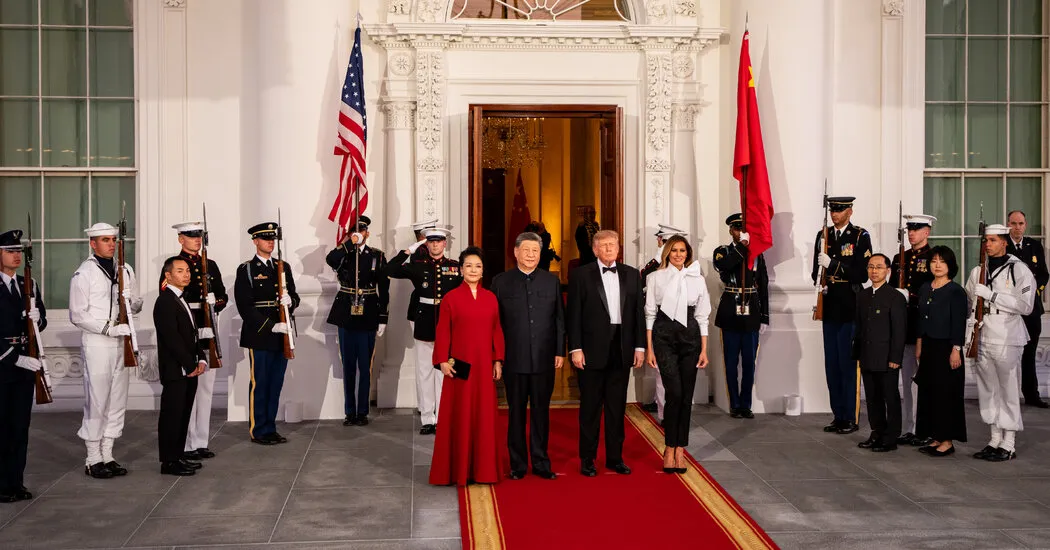
No prominent Chinese business leaders attended the White House state dinner during Donald Trump’s summit with Xi Jinping, highlighting the deep deterioration in commercial ties between the United States and China.
The absence was particularly notable because Xi’s 2015 state visit included a delegation of leading Chinese executives, among them Alibaba founder Jack Ma and Tencent’s Pony Ma. At the time, disputes over trade, cyberattacks and human rights had already strained relations, but companies in both countries still saw major opportunities in each other’s markets.
“It’s a rather depressing marker of how bad the relationship has gotten,” said Emily Kilcrease, a senior fellow and director at the Center for a New American Security who focuses on the US-China economic relationship.
Chinese officials had expected, until days before the summit, that they might bring a business delegation to Washington, according to two people familiar with the discussions. It was unclear which executives were being considered, although reports had mentioned Wang Chuanfu, founder of electric carmaker BYD, and Robin Zeng, chief executive of battery maker CATL.
Neither executive, nor any other prominent Chinese business leader, was invited to the official gathering. Several senior Chinese executives did travel to Washington shortly before the summit, but held meetings outside the state dinner.
“One of the highlights of this summit was supposed to be some level of announcement of commercial deals,” Ms Kilcrease said. “But it seems like we can’t even get to agreement on some of that.”
US-China business ties become increasingly one-sided
The deterioration follows years of tariffs and restrictions. During Mr Trump’s first term, Washington and Beijing imposed successive trade barriers, while the US limited Chinese access to advanced American technology and restricted some US investment in China’s high-tech sector.
The United States also imposed 100 per cent tariffs and other restrictions on internet-connected Chinese vehicles, making it financially unviable for Chinese electric vehicle manufacturers to enter the American market. Beijing responded with controls on exports of rare-earth metals and magnets used by US manufacturers.
Chinese companies have increasingly shifted from being potential customers and partners for American firms to becoming major competitors. Many of China’s most prominent entrepreneurs now operate in artificial intelligence, robotics and electric vehicles — industries at the centre of the strategic contest between Washington and Beijing.
Some Chinese companies also face direct political obstacles in the US. In June, the Department of Defense added Alibaba and BYD to an expanded list of companies it identified as Chinese military companies.
“It would actually be seen by some in Washington as provocative to bring these companies along,” said Ilaria Mazzocco, deputy director at the Center for Strategic and International Studies, where she specialises in Chinese business and economics.
Jeremy Chan, a senior China analyst at Eurasia Group and former American diplomat, said a number of Chinese chief executives had been in Washington awaiting a decision on whether they would be included.
“There are a number of important Chinese C.E.O.s in Washington, waiting on the sidelines, like: ‘Do I get tapped or not?’” he said. “The whole thing is crazy. It would be comical if it weren’t so tragic.”
The contrast was clear during Mr Trump’s visit to Beijing in May, when Apple chief executive Tim Cook, Tesla’s Elon Musk and other leading American executives appeared behind senior US officials at the Great Hall of the People.
At Thursday’s dinner, Mr Cook and Mr Musk were joined by Nvidia chief executive Jensen Huang, Meta’s Mark Zuckerberg, Amazon’s Jeff Bezos, OpenAI chief executive Sam Altman, Microsoft’s Satya Nadella and General Motors chief executive Mary Barra.
Xi said earlier in the day that China “welcomes American companies wanting to invest and do business there”. Referring to US restrictions on Chinese firms, he added: “We hope Chinese companies are treated fairly here in the United States.”
American companies have not abandoned China, despite growing competition from domestic firms including electric vehicle makers, Huawei and Chinese sportswear brands. An industry survey cited in the discussions found that 80 per cent of US companies still regarded the Chinese market as either “very important” or “important” because of its size and manufacturing ecosystem.
For Chinese companies, however, tariffs, political scrutiny, investment controls and national security rules have made expansion into the United States increasingly difficult, particularly in strategic industries.
Joerg Wuttke, a partner at Washington-based consultancy DGA-Albright Stonebridge Group, said the imbalance was reflected by the presence of so many American executives at the summit.
“Is there anybody from China interested in doing business in America?” he said. “No, because it’s not possible. So why should they waste their time?”
