


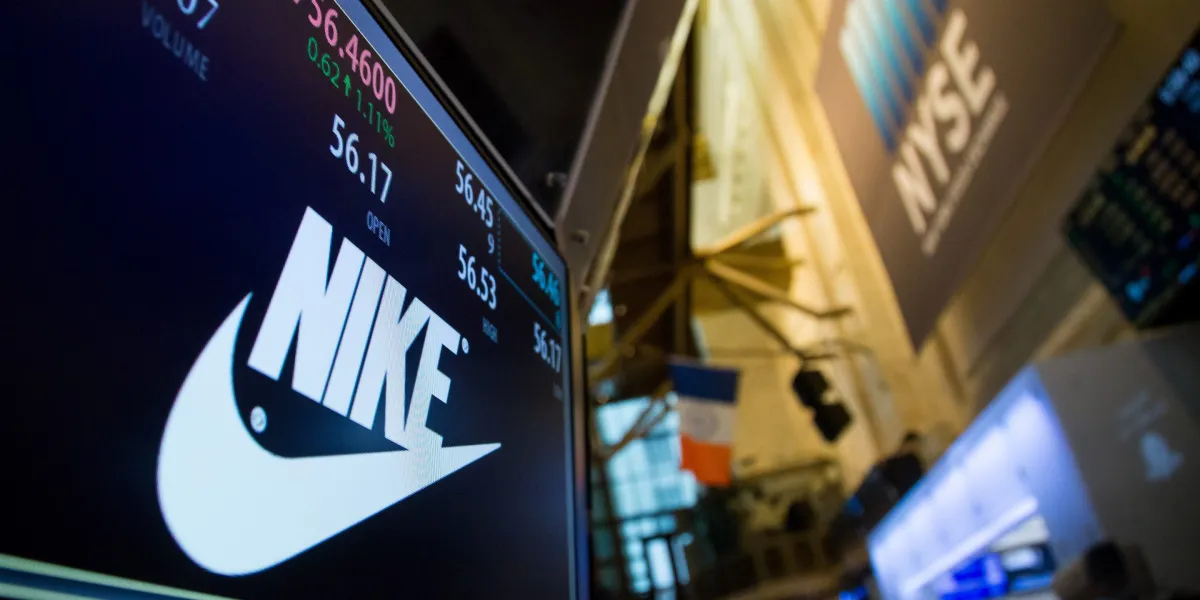
Nike is set to lose its place in the S&P 100 for the first time in almost 18 years, underlining the scale of the sportswear giant’s fall in market value since its 2021 peak.
The company will be removed from the index before trading begins on 21 September as part of a quarterly reshuffle by S&P Dow Jones Indices. Nike will remain a member of the wider S&P 500.
Nike’s market capitalisation has fallen from about $264bn in November 2021 to roughly $57bn, a decline of around 78 per cent. Its shares, which reached $179.10 at their peak, have recently traded at about $38.
Nike removed as technology companies join S&P 100
S&P Dow Jones Indices said the changes were intended to ensure that its benchmarks remained representative of their respective market-capitalisation ranges.
Dell Technologies, Palo Alto Networks, Arista Networks and SanDisk will join the S&P 100 in place of Nike, Honeywell Aerospace, Simon Property Group and Colgate-Palmolive.
The changes reflect the growing weight of information technology companies in the blue-chip index, while Nike’s removal follows a prolonged deterioration in its share price and business performance.
Nike’s stock has lost about 36 per cent of its market value in 2026 alone, according to the figures behind the index reshuffle.
Sales decline as Nike attempts turnaround
The company reported full-year fiscal 2026 revenue of $46.4bn, down 2 per cent on a currency-neutral basis. Revenue in Greater China fell 17 per cent in the fourth quarter ended 31 May, while full-year sales in the region declined 13 per cent on a currency-neutral basis.
Nike’s direct-to-consumer revenue fell 6 per cent to $17.7bn for the year, including a 12 per cent decline in digital sales. Wholesale revenue rose 6 per cent to $27.5bn as the company sought to rebuild relationships with retailers.
The turnaround, led by chief executive Elliott Hill, has focused on reducing excess stock, restoring wholesale distribution and placing greater emphasis on performance products.
“While we continue to face top-line headwinds, we’re encouraged by progress in performance product and are focused on consistent execution, improved profitability and scaling our wins to realize our full potential,” Mr Hill said in the company’s results statement.
China remains a particular challenge, with Nike facing sustained declines in sales and increased competition from domestic brands including Anta and Li Ning, as well as international rivals such as Hoka and On.
The company has also been moving to take greater control of its online distribution in China, including withdrawing online sales rights from some major retail partners.
