


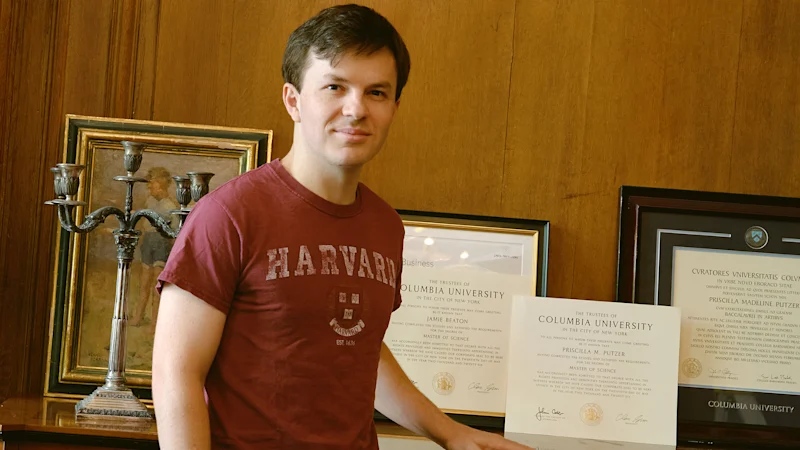
A 31-year-old New Zealander whose academic record already spans Harvard, Stanford, Yale and Oxford could become the world’s most educated person if he continues collecting degrees at his current pace.
Jamie Beaton has completed a master’s degree in applied mathematics at Harvard, an MBA at Stanford, a law degree at Yale and a doctorate in public policy at Oxford, where he was a Rhodes scholar. He achieved those qualifications before turning 28.
He has also gained master’s degrees in education entrepreneurship, education technology, finance, healthcare policy and economics, implementation science, war studies and global affairs. He is now studying for a master’s in data science at Brown University.
If he continues, Beaton could overtake Benjamin B Bolger, who has earned 16 degrees by the age of 50. He might even challenge Michael Nicholson, an octogenarian lifelong student who has accumulated more than 30 qualifications.
Beaton’s academic ambitions have developed alongside a successful business career. He founded Crimson Education, a college admissions counselling company valued at more than 600 million US dollars, which advises students seeking places at elite universities.
Families pay between 30,000 and 200,000 US dollars for a multi-year programme intended to improve their children’s chances of gaining admission. The company says 10,000 students have used its services, with more than 2,000 later accepted by an Ivy League university, Stanford or the Massachusetts Institute of Technology.
Beaton’s unusual CV has prompted questions about whether his pursuit of qualifications is a form of performance, or a marketing strategy for Crimson. He rejects that interpretation.
“The first five degrees had a clear skill acquisition component to them,” he said. “Since then, it’s really been about following different passions and curiosities.”
Jamie Beaton’s relentless academic path
Beaton was raised in Auckland by his mother, Paula, after his parents separated. His grandparents lived with them, and he describes a childhood in which education was treated as a central family value.
“Academics was our religion,” he said.
His mother arranged tutoring and academic coaching, while Beaton also played tennis and basketball, went camping, swam, kayaked and took up chess. In his final year of secondary school, he took more than twice the required number of courses and was admitted to 25 universities, including Harvard, Yale and Princeton.
Before leaving New Zealand, he co-founded the counselling service that later became Crimson Education. At Harvard, he joined 15 student organisations, including the debate club and the undergraduate economics association.
He also began working with Tiger Management, the hedge fund founded by Julian Robertson, after contacting Robertson as a student. Beaton spent two days a week at the firm’s New York office while continuing his studies. Robertson and his son Alex became mentors, and Tiger Management was an early investor in Crimson Education.
Alex Robertson once encouraged him to take a holiday in Cancun with friends. Beaton’s response was: “Honestly, Alex, I can’t think of anything worse than sitting on a beach for five days when I want to work.”
John Key, the former prime minister of New Zealand and chairman of Crimson Education, describes Beaton as the country’s second-brightest person after Ernest Rutherford.
“And I’m only saying that because it’s hard to take it away from the guy who split the atom,” Key said.
Lisa Belkin, an adjunct professor at Columbia University’s journalism school, first became aware of Beaton when he missed the beginning of her class in the 2025-26 academic year. He apologised, explaining that he had confused his timetable while teaching entrepreneurship at the University of Auckland.
Once he returned to New York, he attended the class and completed every assignment. Belkin said he often worked on his laptop during lessons, checking business emails or his investment portfolio, while still submitting his work on time.
“He was a joy to get to know,” she said. “But it was also the weirdest relationship I’ve ever had with a student.”
Amy Chua, who taught Beaton at Yale Law School, has written numerous recommendation letters for him. “He can’t stop applying to things,” she said.
Beaton has continued studying while travelling for work. During a recent trip to India, he submitted a project for his Brown University course. He says he aims for six hours of sleep each night and enjoys a tightly packed schedule.
“I love the action, and I love a jam-packed day,” he said. “It’s good fun.”
Crimson Education’s growing business
Crimson Education faced criticism in its early years over aggressive sales tactics and its use of university students as tutors and counsellors. Beaton said the company had since moved towards employing more full-time counsellors and now had 1,200 full-time staff.
Its fees and business model have also attracted wider criticism, with observers arguing that expensive private counselling is largely available to families whose children already have strong prospects of admission.
Jeff Selingo, a journalist who has written about university admissions, said private counsellors could help families who could afford them, but “it’s not going to get you into a place that you can’t get into otherwise”.
Hamish Coates, an education expert at the Australian National University and Beaton’s thesis adviser at Tsinghua University, praised his understanding of higher education while questioning whether such intense preparation was desirable for children.
Beaton said he did not accept the contrast between a pressure-filled education and a happy childhood. “The students who try harder in high school are often the happiest and most engaged,” he said.
He married Priscilla Beaton in April at a beach ceremony in Santa Monica, California. The couple live in New York, where Beaton continues to combine business commitments with his studies.
His longer-term plans remain unsettled. He says his current priorities are education, entrepreneurship and starting a family, although friends believe he could eventually enter politics. Key does not expect him to remain chief executive of Crimson Education indefinitely.
“If you said to me, ‘In 35 years’ time, Jamie will still be the CEO of Crimson’, I don’t see it,” Key said. “I think he’s got other, bigger things that he’s going to move on to.”
