


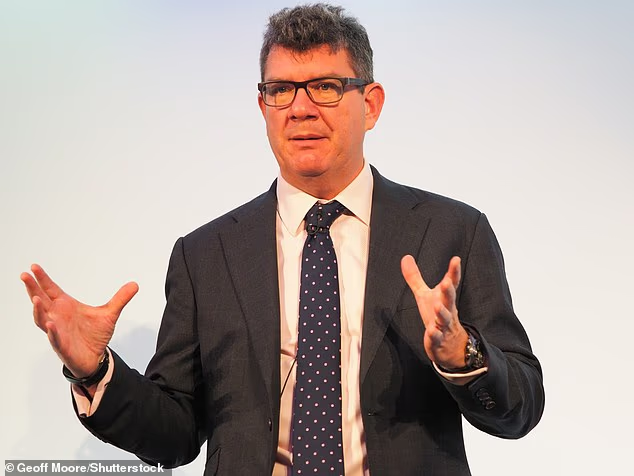
More than 1,000 flights were cancelled or disrupted across Britain after a technical failure in the National Air Traffic Services’ flight-processing system, prompting calls for chief executive Martin Rolfe to resign.
The breakdown caused widespread disruption at Heathrow, Gatwick, Manchester, Birmingham and other major airports on Tuesday, 8 September, leaving passengers facing lengthy delays, cancelled journeys and long queues in terminal buildings.
British Airways said it had cancelled or diverted more than 100 flights, affecting tens of thousands of customers. Some passengers were left waiting on aircraft for hours, including holidaymakers travelling from Heathrow to New York who were reportedly stranded on the runway for up to nine hours.
NATS later said the fault had been fixed and that normal operations were restarting, but warned that it would take time to clear the backlog. The organisation said safety had not been compromised and described the recovery as a complex process affecting the wider aviation network. ([live.euronext.com](https://live.euronext.com/en/financial-news/air-traffic-control-issue-disrupts-flights-major-uk-airports))
Heathrow said arrivals were suspended for the remainder of Tuesday evening, while departures gradually resumed. Airports including Stansted, London City, Luton, Bristol, East Midlands, Edinburgh and Aberdeen were also affected. ([live.euronext.com](https://live.euronext.com/en/financial-news/air-traffic-control-issue-disrupts-flights-major-uk-airports))
The precise cause of the failure remained unclear. Mr Rolfe apologised during an appearance on Sky News and said NATS had not yet completed its investigation into what had gone wrong.
“I am the CEO of a piece of critical infrastructure, so it is my job to take responsibility for that,” he said.
He added that his priority was to restore the service, support airlines and airports, and help passengers affected by the disruption.
The incident led to renewed criticism of the air traffic control provider, which is 49 per cent owned by the Government. Mr Rolfe is due to meet Transport Secretary Heidi Alexander on Wednesday morning.
Ryanair chief operating officer Neal McMahon called for Mr Rolfe to leave, saying more than 65,000 of the airline’s passengers had been affected and more than 50 of its flights cancelled.
“The UK Government, the CAA and the NATS Board must stop making excuses for repeated NATS failures and appoint a new leader capable of running the UK ATC system without repeated failures,” he said.
Wizz Air also criticised NATS, saying it was “extremely disappointed” that another technical fault had disrupted the aviation system.
“A critical national infrastructure provider should not repeatedly bring the aviation system to a standstill,” the airline said. “NATS is simply not fit for purpose in its current form.”
Shadow transport minister Greg Smith said passengers were once again being left “stuck on the tarmac” and demanded an explanation from the Government and NATS.
“The Government and NATS must explain what has happened and how they will make sure resilience is improved,” he said.
The disruption follows a major NATS failure in August 2023, when a problem processing flight plans affected hundreds of thousands of passengers. The Civil Aviation Authority subsequently said NATS should review its contingency arrangements for future outages and is expected to seek a full report on Tuesday’s incident. ([live.euronext.com](https://live.euronext.com/en/financial-news/air-traffic-control-issue-disrupts-flights-major-uk-airports))
There was also disruption last year after a malfunction left controllers at the Swanwick centre in Hampshire with only a limited view of the airspace.
Flight data showed hundreds of delays at the country’s busiest airports. Heathrow recorded 352 delayed flights, while Gatwick had 281, Manchester 249 and Birmingham 101, according to figures cited during the disruption.
NATS said passengers should check directly with their airline before travelling on Wednesday, as airlines worked to rearrange flights and return aircraft, pilots and cabin crew to their scheduled locations.
