


Household incomes face another squeeze as higher taxes and the Middle East crisis weigh on earnings, according to forecasts from the Office for Budget Responsibility (OBR).
The independent watchdog expects no growth in real earnings in 2027 and 2028. Its central forecast suggests annual growth will reach only 0.5 per cent by 2030.
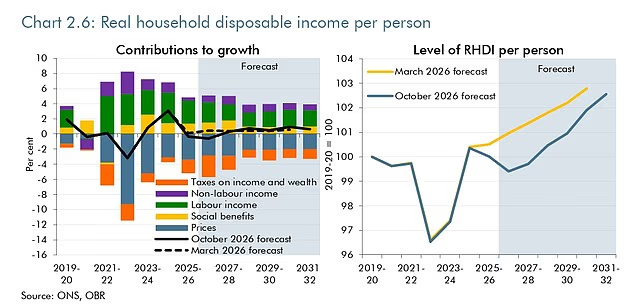
The outlook is also weak for real household disposable income (RHDI) per person, a measure of what remains after taxes, benefits and inflation. The measure was explicitly targeted by Sir Keir Starmer.
The OBR said this year’s gains from wage growth and benefits were being outweighed by higher prices, as well as taxes on income and wealth.
It said the inflation spike caused by the war involving Iran was expected to reduce real wage growth while increasing nominal wage growth. Frozen income tax thresholds then mean that effective tax rates rise as nominal earnings increase, the watchdog said.
The OBR also expects businesses to pass on Labour’s national insurance increases to workers gradually, rather than absorb the cost through lower profits.
Weak growth in household incomes
An anticipated easing in energy prices is expected to provide some relief, with real household disposable income per person forecast to rise by an average of 0.75 per cent a year up to 2030-31.
Even so, the level is still expected to be lower by then than forecast in March.
The OBR described the performance of household incomes since the 2008 credit crunch as “historically weak”, attributing the slowdown to lower productivity and weaker real wage growth.
Growth in real household disposable income per person averaged just a quarter of a percentage point a year in the decade to 2025-26, which the watchdog said was a historic low. It expects the rate to fall further in the near term.
By 2029-30, the central forecast is for growth over the preceding decade to have averaged less than 0.1 per cent a year. As a result, a decade after the onset of the pandemic, RHDI per person would be only 1 per cent higher than its pre-pandemic level.
David Miles, of the OBR, told a briefing: “It’s a pretty grim picture. If you go back to just before Covid… (it) is virtually no growth in per person real household disposable income.”
