


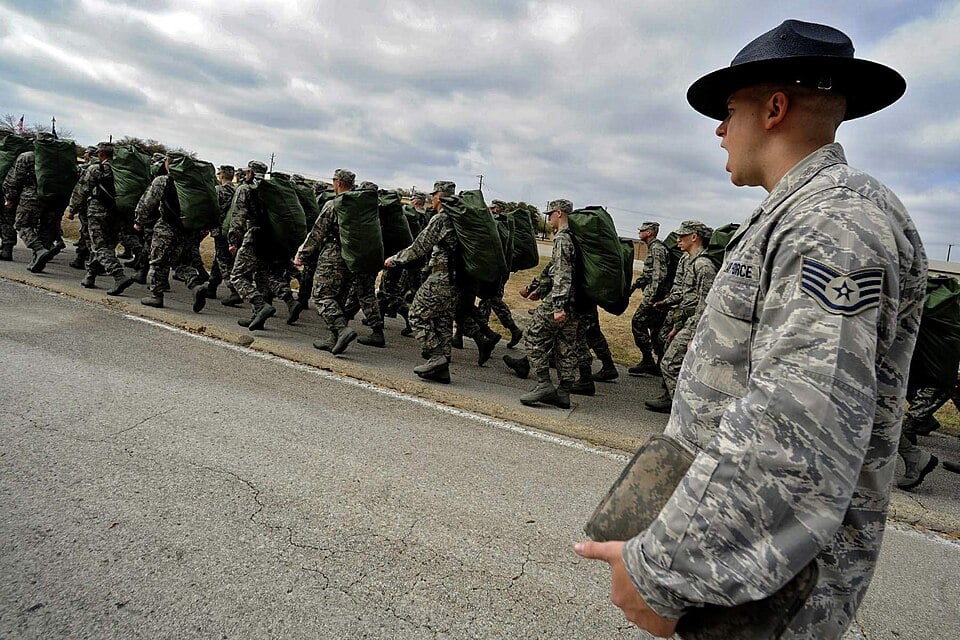
A US Air Force trainee has died in connection with a flu outbreak that has now infected 284 recruits at a Texas training base, according to a Democratic congressman, in a case that has intensified scrutiny of the Pentagon’s decision earlier this year to make flu vaccination optional for recruits.
Keon McDaniel, 26, from Grand Rapids, Michigan, was in his sixth week of basic training at Lackland Air Force Base, part of Joint Base San Antonio, when he suffered what the Air Force described as a “medical emergency” on 12 June. He was transferred to Brooke Army Medical Center, where he died four days later, on 16 June. The Air Force initially said his death was under medical review and did not publicly attribute it to influenza. However, Representative Joaquin Castro, whose district covers much of San Antonio, told reporters at a press conference on 30 June that the Air Force had since confirmed to him that McDaniel “died from the flu.” Castro said the wider outbreak had by then reached 284 confirmed cases and four hospitalisations, according to KSAT.
The outbreak has been traced back to a change in Pentagon policy. In April, Defense Secretary Pete Hegseth ended the flu vaccine requirement that had applied to US service members since 1945, making the shot voluntary across the active and reserve force. “Our new policy is simple: If you, an American warrior entrusted to defend this nation, believe that the flu vaccine is in your best interest, then you are free to take it. You should. But we will not force you,” Hegseth said at the time, according to The Hill, framing the change as a matter of “medical autonomy” and religious freedom. He had previously described the mandate as “absurd, overreaching” and a threat to the military’s “warfighting capabilities.” It is not the first time the policy has shifted: according to ABC News, the military briefly withdrew its flu vaccine mandate in 1949 after researchers noted its effectiveness fading, only for it to be reinstated in the early 1950s once the reasons for that decline became clearer.
Once the mandate was lifted, take-up fell sharply. An Air Force official said only around 40 per cent of trainees at Lackland had chosen to be vaccinated by the time the outbreak began in early June — down from the near-universal coverage the mandate had previously ensured. Cases climbed steadily over the following weeks, according to reporting from ABC News and The Hill: from 159 confirmed infections and two hospitalisations in mid-June, to 275 by 24 June, and 284 by the end of the month. In response, the Air Force, Army and Navy have all reinstated mandatory flu vaccination for basic trainees; the Air Force requirement was restored on 11 June, according to CNN, though Castro said it had taken the Pentagon roughly a month to approve Lackland’s request to bring the mandate back.
The political fallout has continued to build. Castro, joined by fellow Democratic representatives Chrissy Houlahan of Pennsylvania and Gil Cisneros of California, has called for the flu vaccine to be made compulsory again for all service members, not just recruits in training, and has pressed for a full Pentagon accounting of the outbreak and an investigation into the circumstances of McDaniel’s death. “This is a tragedy that could have been prevented were it not for the reckless actions of” Hegseth, Castro said. Houlahan, a former Air Force officer, said readiness “begins and ends with healthy troops,” while Cisneros, a Navy veteran who previously oversaw the Defense Health Agency, said vaccines were simply “part of readiness.” An amendment the three lawmakers co-sponsored to the National Defense Authorization Act, which would have written the flu vaccine requirement into law for all service members, was voted down by House Republicans last week. San Antonio Mayor Gina Ortiz Jones has also raised concern that recruits who fall ill can come into contact with civilians on the base, according to KSAT.
The Air Force has maintained that the outbreak has been contained to the training wing, with medical staff monitoring exposed trainees and offering antiviral medication to those in contact with confirmed cases. But the episode has drawn attention to a broader pattern documented in military health data. A 2026 Department of Defense study examining service records between 2010 and 2024 found that, unlike the general population — where flu hospitalisation risk tends to rise with age — the highest rates within the military occurred among recruits under 25 in basic training. Researchers linked this to what they described as recruits’ relative immune compromise, driven by the physical, environmental and psychological stress of training, combined with living conditions in crowded bays and open barracks where illness can spread quickly once introduced.
Although fatal flu cases remain rare, even among the young and healthy, the illness can turn dangerous when it damages the lining of the airways and lungs, leaving the body vulnerable to secondary bacterial infections such as pneumonia, in which the lungs fill with fluid and the body struggles to take in enough oxygen. In rarer cases, the virus can inflame the heart muscle, a condition called myocarditis, weakening the heart’s ability to pump blood and, in the most severe cases, leading to potentially fatal cardiogenic shock. For recruits already under strain from intense physical training, sleep deprivation and stress, doctors say those risks are magnified.
The cause of McDaniel’s medical emergency remains formally under investigation, the Air Force has said, as part of what it has called a comprehensive review of the case.
