


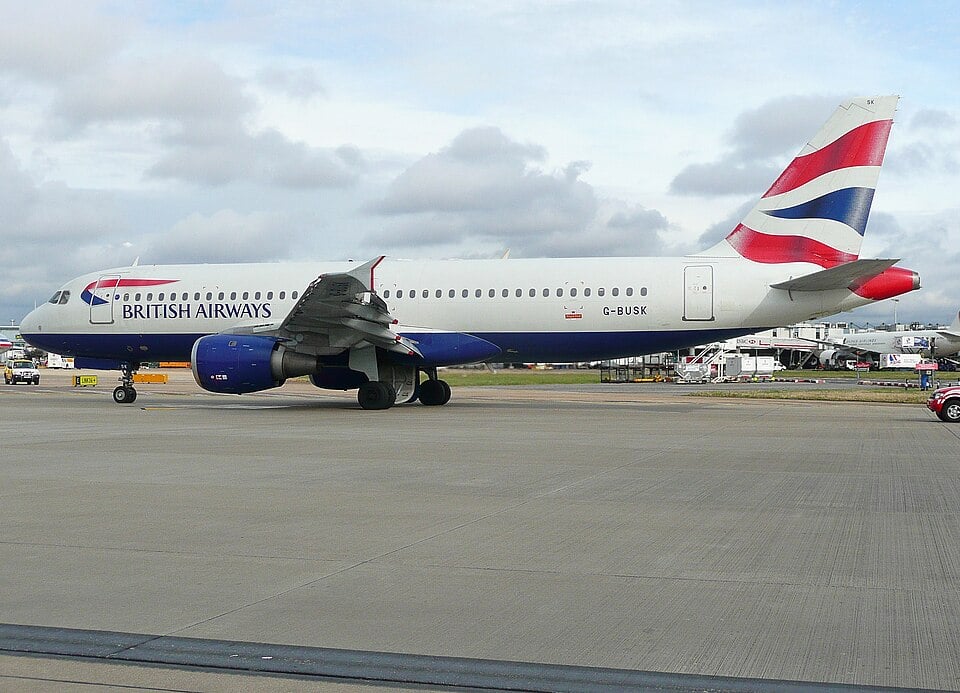
A British Airways service from London Heathrow to Washington was grounded on Saturday after a crew member accidentally deployed the aircraft’s emergency evacuation slide moments before departure, leaving around 336 passengers facing a lengthy delay.
The slide inflated onto the tarmac just seconds before the transatlantic flight was due to push back from its gate, according to the Daily Mail. Emergency services attended the aircraft as a precaution, and passengers were kept in their seats for roughly three hours before being allowed to disembark.
The disruption did not end there. Aviation news outlets, including the tracking site AIRLIVE, reported that the flight — identified as BA217, operated by a Boeing 777-200ER — eventually left Heathrow’s Terminal 5 several hours behind its scheduled lunchtime departure. By those accounts, the aircraft was not airborne until the early evening and reached Washington Dulles late at night, leaving the overall delay at around six hours.
A source who spoke to The Sun described the incident as “a brainless act”, saying the mistake had held up the flight and was thought to have cost the airline in the region of £100,000. The expense reflects how disruptive such errors are. Once an emergency slide is deployed at the gate, the aircraft cannot fly until the equipment is removed, inspected and either replaced or the door formally cleared for service — a process that is both time-consuming and costly, and which takes the jet out of an airline’s schedule for the rest of the day.
Reports in the aviation press suggested the error was made by a newly recruited member of cabin crew who had only recently completed initial training and was on one of their first flights. According to coverage by the specialist site Paddle Your Own Kanoo, the crew member became confused by the standard pre-departure command “doors to automatic”, which instructs cabin staff to arm the evacuation slides so they activate automatically if a door is opened.
Such mishaps are known within the industry as inadvertent slide deployments. They are uncommon relative to the number of flights operated each day, but far from unheard of. Paddle Your Own Kanoo noted that the manufacturer Airbus estimates around three occur somewhere in the world daily, most often when crew open a door on arrival without first disarming the slide. Each one matters because it removes an aircraft from service, disrupts tightly scheduled operations at a congested hub such as Heathrow, and leaves hundreds of passengers stranded.
For British Airways, the latest incident adds to a run of similar errors in recent years. Last year, the Daily Mail reported, a member of staff activated the emergency slide on an Airbus A321 preparing to fly from Heathrow to Brussels. That flight was grounded and ultimately cancelled, with travellers facing a comparable three-hour wait while a replacement aircraft was found for the short hop to Belgium, which would have lasted little over an hour. Emergency services again attended as a precaution. On that occasion, the pilot was said to have failed to disarm the door before opening it to pass paperwork to crew.
The recurrence of these incidents has prompted the airline to rethink how cabin crew handle aircraft doors. Paddle Your Own Kanoo reported that British Airways has adopted a Japanese workplace technique known as Shisa Kanko, or “pointing and calling”, under which crew physically point at a door and say aloud whether it is armed or disarmed before operating it — a method developed on Japan’s railways to reduce human error.
In response to Saturday’s delay, a British Airways spokesperson said the airline had apologised to customers for the disruption to their journey and that its teams had worked to get them on their way as quickly as possible.
