


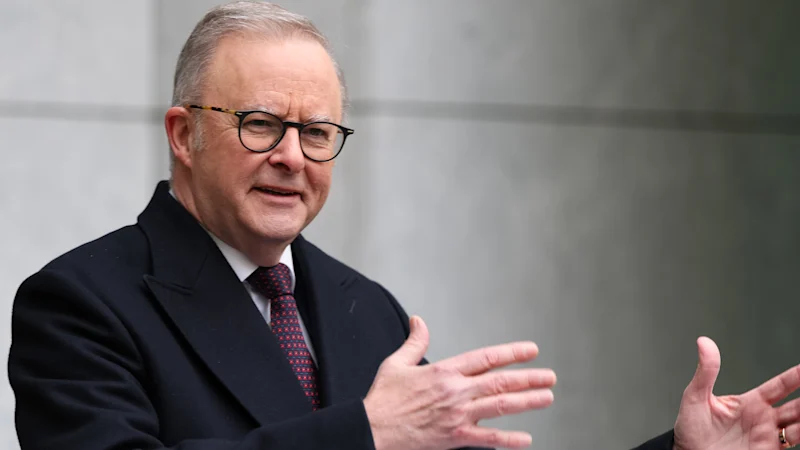
Anthony Albanese has backed plans to give Australians greater control over social-media algorithms, while the Labor government has rejected calls for an immediate ban on camera-equipped smart glasses that can secretly record people.
The prime minister said ministers were examining “the best and most practical options to protect people” as the government prepares a wider package of online-safety measures.
His intervention came after Social Services Minister Tanya Plibersek proposed allowing users to opt out of algorithmically recommended content. She said algorithms were playing a significant role in exposing young people to sexual violence and extremist material.
Labor is expected to favour an opt-out system rather than requiring users to switch algorithms on, with the proposal likely to form part of the government’s digital duty of care legislation.
Independent senator David Pocock said the setting should be switched off by default, with users required to choose to activate personalised recommendations.
Government resists smart-glasses ban
At the same time, Attorney-General Michelle Rowland said the government was not considering an outright ban on smart glasses, despite mounting concern about their use to film unsuspecting people.
The devices resemble ordinary spectacles but can capture photographs and video, and in some cases record audio, with little obvious indication to bystanders. Low-cost versions have been sold in Australia for less than $100, including an $89 pair marketed by Kmart.
Privacy Commissioner Carly Kind said all options should remain under consideration, warning that public concern about the technology was unprecedented. She said existing privacy law might not be the best mechanism for imposing a ban, but urged ministers to ensure their response matched the scale of the concern.
Rowland said the government did not want to play “whack-a-mole” by banning individual emerging technologies as they appeared. She also warned that an import ban could have consequences for trade, foreign affairs and Australia’s international legal obligations.
Instead, she said, responsibility for deciding whether to restrict smart glasses would largely fall to operators of places such as public swimming pools, childcare centres and small businesses.
Brisbane City Council has already prohibited the devices at its public pools, a move Rowland praised while encouraging other councils to consider similar restrictions at council-run facilities.
Campaigners have argued that the glasses make covert filming easier, particularly in places such as gyms, beaches, workplaces and streets. A petition calling for Kmart to remove its version from sale has attracted more than 56,000 signatures, according to ABC reporting.
The Greens are also preparing a Senate bill seeking a temporary 12-month import ban on smart glasses and other wearable recording devices, with exemptions for legitimate uses such as assistive technology.
David Shoebridge, the Greens’ digital rights spokesman, said the government’s approach failed to require a visible light, sound or other recognisable signal when the devices were recording.
Shadow attorney-general Michaelia Cash said the Coalition was particularly concerned that the proposed privacy legislation did not address the use of smart glasses.
Privacy law reforms released for consultation
The government’s broader privacy package would introduce a “fair and reasonable” test aimed at preventing companies from collecting more personal information than they need.
It would also create a right to erasure, allowing people to request that large digital platforms and search services delete their personal data. Companies would face stronger consent requirements, including restrictions on hidden terms and take-it-or-leave-it conditions.
Businesses would need clear permission before buying or trading information such as customers’ shopping habits, online interests and location data.
The Attorney-General’s Department said the reforms were designed to address risks posed by artificial intelligence and wearable technology, while improving the powers and efficiency of the privacy regulator.
Public consultation on the proposals is due to close on 18 September, with the government expected to use the feedback to shape legislation alongside its planned digital duty of care laws.
The proposals come as Labor seeks to make online safety a central part of its policy agenda, including ahead of Mr Albanese’s planned appearance at the United Nations, where he is expected to promote Australia’s approach to technology regulation.
Sexual-consent campaigner Chanel Contos is due to address the National Press Club this week on the risks posed by algorithm-driven content, adding to pressure on ministers to act.
