


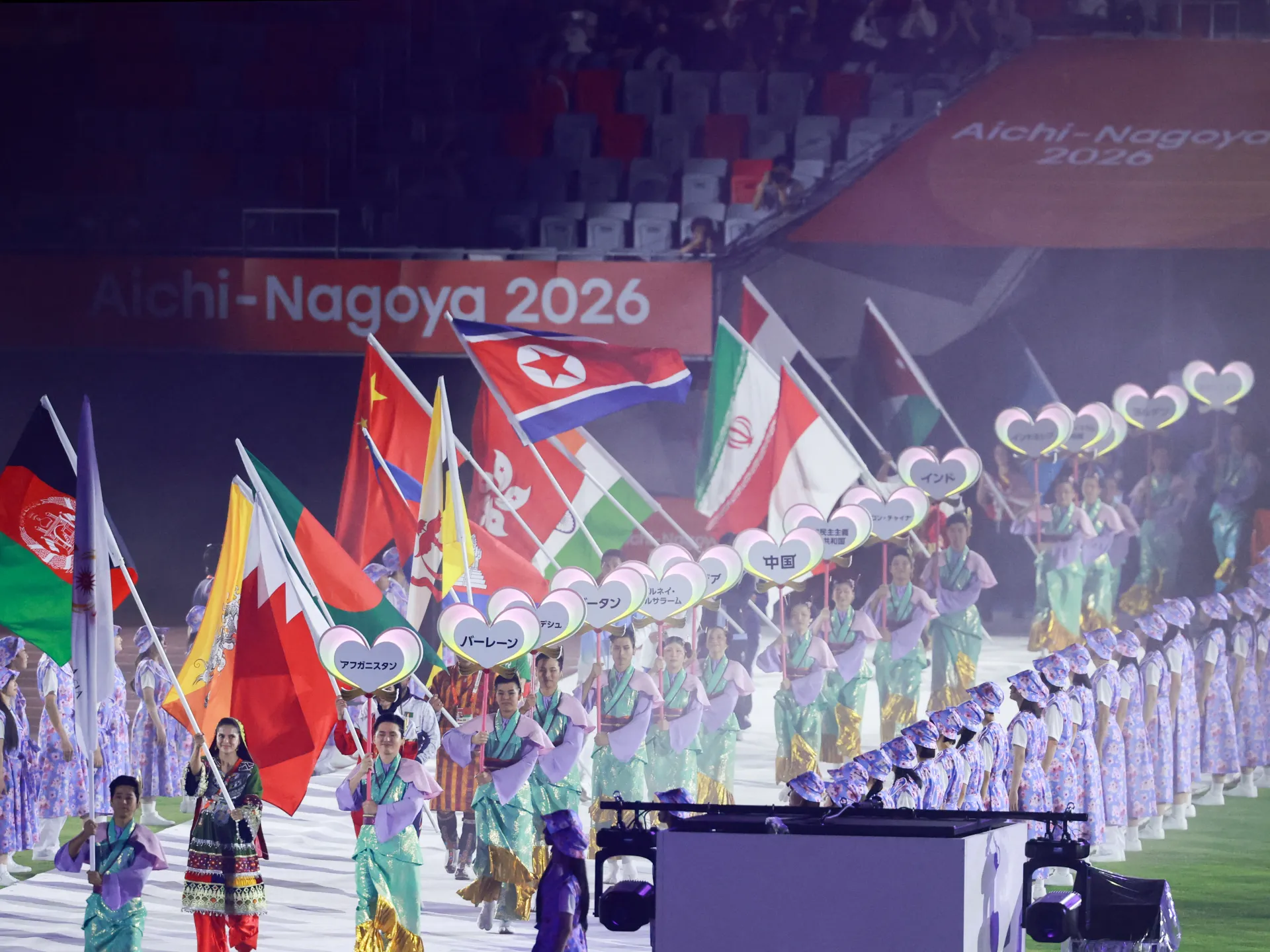
The Asian Games in Japan have closed after two weeks of outstanding performances by teenage athletes were set against organisational problems, transport failures and poor public attendances.
Sheikh Joaan bin Hamad Al Thani, president of the Olympic Council of Asia (OCA), formally brought the Aichi-Nagoya Games to an end at Mizuho Park Athletic Stadium on Sunday. The ceremonial handover now turns attention to Doha, which is due to host the next edition in 2030.
About 17,000 athletes and officials took part in 469 medal events across venues stretching from Tokyo to Osaka, a larger field than at the Paris Olympics. Organisers had promised a simple and functional event, but their cost-cutting arrangements were repeatedly tested by the scale of the competition.
Asian Games close after organisational problems
Instead of building a dedicated athletes’ village, organisers housed competitors and officials in hotels, wooden container units and a cruise ship. They had budgeted for 15,000 people, around 2,000 fewer than the final number of registrations.
Some delegations waited as long as 12 hours to complete registration. Others discovered that rooms had been double-booked or assigned to the wrong team-mates.
Transport difficulties persisted throughout the Games, with shuttle buses failing to arrive or taking athletes to incorrect venues. Several events were delayed as a result.
“Accommodation, transport and other issues — it seems a lot of teams were affected,” said Wong Po-kee, the Hong Kong team’s chef de mission.
South Korea’s delegation gave the organisation the lowest possible grade, an “F”. Its men’s football team later found that their national flag was unavailable for the medal ceremony after they defeated Japan in Saturday’s final, while North Korea’s anthem was mistakenly played for South Korea’s men’s hockey team.
The Games also struggled to attract spectators. Fewer than 1,000 people attended a women’s football semi-final between Japan and South Korea at a stadium with a capacity of 50,000, while smaller venues were often sparsely occupied.
Naoko Toda, a Nagoya resident who attended several events, said: “If I had to say, well, I don’t think it was a success.” The OCA nevertheless declared Aichi-Nagoya a success and praised its frugal approach.
Teenage stars provide a sporting highlight
The competition itself was energised by a series of remarkable performances from young athletes, led by China’s 13-year-old swimmer Yu Zidi.
Yu won three individual gold medals in the pool and was named the Games’ female Most Valuable Player. Her victory in the 200 metres individual medley came in the second-fastest time recorded, setting up the prospect of a future contest with Canada’s world-record holder, Summer McIntosh.
Yu’s Chinese team-mate Zhang Zhanshuo, 19, became the first swimmer to win seven gold medals at the Asian Games. Japan’s 17-year-old Shin Ohashi meanwhile broke the world record in the 200m breaststroke.
On the athletics track, China’s 18-year-old Yan Ziyi won the women’s javelin with a world-class throw. Thailand’s Puripol Boonson, 20, took gold in both the 100m and 200m and was named the men’s MVP.
China finished top of the medal table with 341 medals, including 169 golds, its strongest haul at an Asian Games held overseas. Japan won 83 golds among its 269 medals, surpassing its previous best total at Hiroshima in 1994.
The 43-sport programme also included debuts for padel, mixed martial arts, teqball and surfing. Doha may host the next Games in 2030, although the OCA could delay the event by a year so it can act as the continent’s Olympic qualifying competition before Brisbane 2032.
