


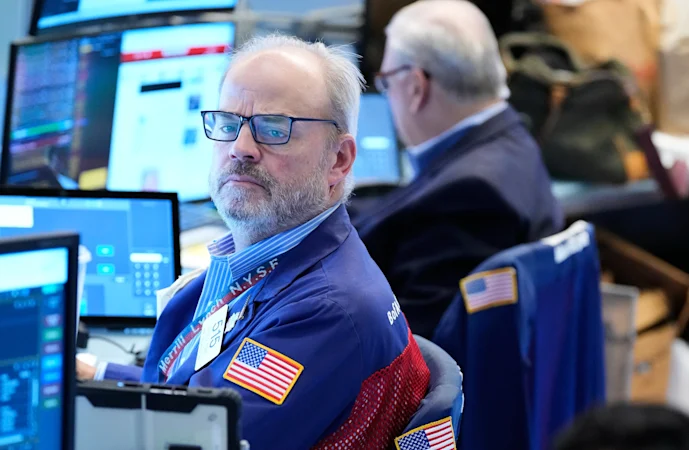
Australian shares fell in early trading after Wall Street suffered its worst session since July, with worsening US inflation raising expectations that the Federal Reserve could increase interest rates again.
The S&P/ASX 200 was down 53.9 points, or 0.6 per cent, at 8,674. The index also lost 0.6 per cent on Wednesday, while the Australian dollar weakened to US69.66 cents.
US consumer prices rose 3.7 per cent in the year to September, accelerating from 3.4 per cent in August and exceeding economists’ expectations of 3.6 per cent.
The figures prompted a sharp rise in Treasury yields and led traders to lift their expectations of another Federal Reserve rate increase at its meeting in two weeks. Market pricing put the chance of a rise at 39 per cent, up from 22 per cent a day earlier.
The yield on the benchmark 10-year US Treasury briefly climbed above 5.32 per cent, compared with less than 5.17 per cent before the inflation data was released, although it later surrendered much of the increase.
Wall Street hit by higher yields
The S&P 500 fell 1.1 per cent to 7,718.94, marking its fifth decline in six sessions since reaching a record high. The Nasdaq composite dropped 1.9 per cent, while the Dow Jones Industrial Average slipped 48 points, or 0.1 per cent, to 51,621.48.
Technology companies linked to the artificial intelligence boom were among the biggest fallers as higher borrowing costs threatened to make it more expensive to fund data centres and buy AI chips.
Nvidia fell 3.2 per cent, Broadcom lost 3.1 per cent and Advanced Micro Devices dropped 5.7 per cent. CoreWeave, which provides cloud-based AI computing power, plunged 15.5 per cent, while Oracle fell 8.8 per cent.
GE Vernova, which is seeking to supply power to energy-intensive data centres, declined 6.2 per cent. The Russell 2000 index of smaller US companies, which are often more reliant on borrowing to expand, fell 1.9 per cent.
Fuel prices have added to inflationary pressure, with Brent crude rising 0.4 per cent on Wednesday to 106.06 US dollars a barrel amid the war with Iran. Persistent government debt concerns and signs that the US economy is still expanding have also pushed bond yields higher.
“Patience will be required,” said Adam Schickling, a senior economist at Vanguard, arguing that inflation should eventually ease as consumers become more price-sensitive and worker productivity improves.
The Federal Reserve recently increased its key interest rate for the first time in three years in an effort to curb inflation. Higher rates make borrowing more expensive and are intended to slow economic activity.
Several companies also came under pressure after disappointing results. Bank of America dropped 4.8 per cent after reporting weaker-than-expected summer profit and revenue, while State Street fell 4.1 per cent despite posting profit slightly above forecasts.
Netflix edged 0.2 per cent higher after announcing plans to cut about 6 per cent of its workforce, or nearly 1,000 jobs, as part of wider organisational changes. Its product, technology, legal and human resources divisions are expected to be most affected.
