


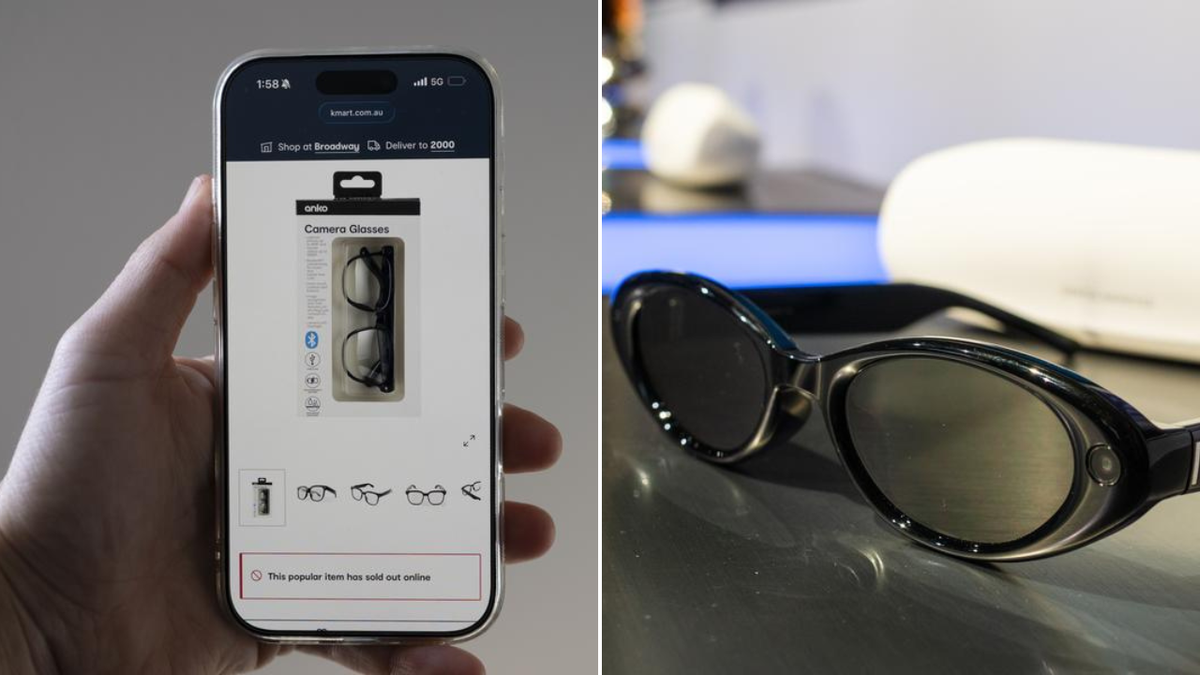
Robert Fletcher fears a proposed crackdown on AI smart glasses could strip away the independence he regained after losing almost all of his sight.
The Melbourne man lost his central vision and most of his peripheral vision within eight weeks when he was 41. He was left with around 4 per cent vision and unable to read, write, watch television or recognise faces.
Now, as Australia considers tighter restrictions on camera-enabled wearable devices, Mr Fletcher says a blanket ban would feel like losing his eyesight for a second time.
“It would be like going up to you and saying, ‘Can I take your eyesight off you?’ And you’d say, ‘Absolutely not’,” he said.
How AI smart glasses help people with vision impairment
Mr Fletcher discovered Meta’s AI-powered glasses about three-and-a-half years ago through an international network for people with low vision. He arranged for a friend in the United States to buy him a pair before they became available in Australia.
The glasses use a camera and voice-controlled artificial intelligence to interpret the world around the wearer. Mr Fletcher can ask questions about what is in front of him and receive answers through the device.
He said the technology did not replace his lost sight, but gave him access to information that he would otherwise have needed to obtain from another person.
“Even if it gives me 15 per cent or 20 per cent of the information that was void before, it’s empowering to actually then be able to make a decision on my own without having to go and ask another person to assist me,” he said.
Mr Fletcher remains active, walking about 20,000 steps a day with his Seeing Eye Dog, Hamish, and travelling around Melbourne for public speaking engagements and blind tennis.
At Flinders Street station, he can ask the glasses to read departure boards, identify the correct platform and confirm the station at which he needs to get off. They can also read street signs and help him check that he is travelling in the right direction.
In supermarkets, the glasses can identify products and describe where they are placed on shelves. They can also recognise banknotes, helping him check the cash he is carrying or whether he has received the correct change.
“Other people when you ask them for help, in all their best intentions, decide what information they give you is important,” he said.
“These things empower us to be given everything, and then it’s up to us to make that decision as to what’s important to us.”
Sydney architectural design consultant Seyed Farbod Motahari, who was born with low vision caused by albinism, has also described the technology as a “game changer”.
He uses the glasses to read signs, understand his surroundings and identify products while shopping, reducing the need to rely on strangers for assistance.
Mr Motahari said the technology remained imperfect, but added: “It’s just the beginning of it.”
Travel and technology
Before his sight deteriorated, Mr Fletcher had visited between 70 and 80 countries and taken more than 750 flights. He said travelling without vision had caused him to lose the passion for travel that had once defined his life.
The glasses helped restore some of that confidence. During a trip to Spain last year, they translated Spanish into English and enabled him to explore tourist attractions more independently.
At Madrid’s Prado Museum, he asked the device to describe paintings and provide further information about their artists, subjects and styles.
“Just because I’m blind doesn’t mean I’m stupid,” he said.
“I’ve been to most major art galleries in the world. I’d like to know a little bit more about this painting.”
The glasses also translated spoken conversations through his earpiece, helping him communicate while abroad.
Mr Fletcher said the experience was a significant improvement on relying on another person for a brief description of an artwork or location.
“All of a sudden I realised that I can just do this at my pace. I can ask for as much information as I want,” he said.
Privacy concerns and proposed restrictions
The technology has come under growing scrutiny because the glasses can record video and audio without being immediately obvious to people nearby.
Some Australian councils and businesses have introduced restrictions in places including swimming pools. The Australian Greens have also proposed a 12-month ban on imports of camera-enabled wearable devices, with an exemption for genuine disability aids.
The proposal would cover devices such as Meta’s smart glasses and would seek to strengthen privacy rules around filming, storing or sharing footage without consent.
The federal government has rejected calls for an immediate nationwide import ban, but Attorney-General Michelle Rowland has opened consultation on privacy risks linked to artificial intelligence and wearable technology.
Draft reforms released by the government do not include an import ban, although the consultation specifically examines wearable information-processing devices such as smart glasses. Submissions are due by September 18.
Ms Rowland has said ministers are trying to address privacy concerns without unfairly discriminating against people with disabilities who use the technology to participate more fully in society.
“We’ve had Vision Australia and other disability advocacy groups saying that this type of technology has been a game-changer for them,” she said.
Mr Fletcher said he supported safeguards against covert recording, but objected to treating every person wearing the glasses as though they intended to film others secretly.
He said Meta’s glasses displayed a visible light when taking a photograph or recording video, and he would have no objection to someone approaching him if they were concerned about how the device was being used.
But he warned that describing all users as potential threats could stigmatise people with low vision and encourage confrontations with those using the glasses as an accessibility aid.
“I’m not asking for a lot,” he said.
“I’m only asking for access to information that a genetic condition took away from me, and I don’t think that’s really getting across to the public.”
