


Three years after the October 7 attacks, the British Jewish community is described as feeling “under siege”, with the trauma of the Hamas assault compounded by fears of growing hostility towards Jews in Britain.
The account links the events in southern Israel with the experience of a family who survived Auschwitz and Bergen-Belsen before finding safety in the UK. It warns that the country once regarded by Holocaust survivors as a place of tolerance is now viewed with increasing anxiety.
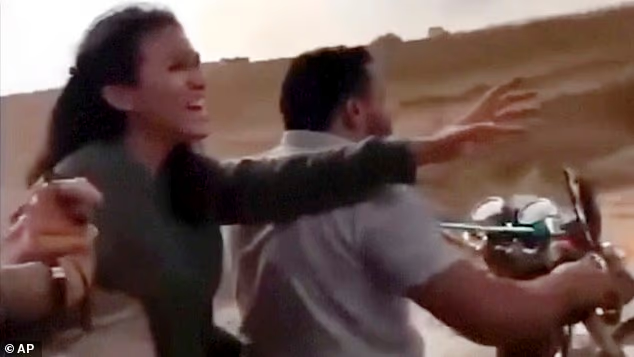
The October 7 assault left about 1,200 people dead, after Hamas fighters attacked communities and a music festival in southern Israel. British-Israeli hostage Emily Damari was among those seized from Kibbutz Kfar Aza.
The writer recalls visiting Kfar Aza and the nearby site of the Nova festival shortly after the attacks, describing burnt-out cars and a bus shelter where families, including children, had sought refuge.
Evidence of rape, gang rape and sexualised torture inflicted on hostages was also found by the United Nations, the account says. It argues that the brutality of the attack has since been obscured by support for Hamas and other violent Iranian-backed Palestinian factions among sections of the political Left.
In Britain, the writer criticises a resolution passed at the Green Party conference declaring that “Zionism is Racism”. The account describes the resolution as an “abomination” and argues that it ignores Israel’s diverse population, including more than 2.1 million Palestinian citizens with voting rights.
It also challenges the description of Israel as a racist state by pointing to the role of Arab doctors, pharmacists, nurses and care workers in its health system.
The writer further attacks the decision by Andy Burnham to impose sanctions on Israel, claiming this was motivated by political advantage and the desire to strengthen support among Labour members and Muslim voters.
Ed Miliband’s use of the terms “ethnic cleansing” in relation to the West Bank and “horrific” to describe Israeli policies in Gaza is also criticised. The account says the Foreign Secretary’s language caused anger within Britain’s Jewish community, including among those who oppose the right-wing government led by Benjamin Netanyahu.
Auschwitz survivor’s journey to Britain
The warning is rooted in the story of the writer’s aunt Sussie, who died recently aged 98. She was among a generation of Holocaust survivors who viewed Britain with deep respect because of its resistance to Nazi Germany during the Second World War.
Sussie, whose birth name was Margrit, was the youngest of nine children born to Farni and Sandor in Tiszaujlak, a rural town on the Hungarian border with Ukraine.
Her brother Michael, the writer’s father, escaped to Britain in 1938 as Nazi influence spread across Europe. He had been beaten by fascists at a railway station shortly before leaving Hungary.
After reaching London, he was helped by an English woman who found him in the women’s waiting room at Victoria station, escorted him across the capital and put him on a train to Liverpool. The experience shaped his lifelong admiration for British kindness.
Sussie and her sisters Rosie and Sheindy remained in Hungary. In 1944, the family was rounded up by Hungarian Arrow Cross militias acting on Nazi orders and locked inside the local synagogue.
They were later forced on to a cattle truck bound for the death camps. After several days without sanitation, they arrived at Auschwitz, where Sandor and his wife were separated from the three girls.
As the family was divided, their mother told Sussie and Sheindy: “If they ask your age, say you are 16 years old.” The advice helped save them from being sent immediately to the gas chambers, according to the account.
Their parents were killed at Auschwitz. The three girls were sent to Kivioli in Estonia, where they worked in a factory and survived on watery soup. As Soviet forces advanced, they were moved through other camps, including Stutthof, before reaching Bergen-Belsen.
At Belsen, they encountered severe starvation, disease and bodies piled around the camp. Their ordeal ended when they were taken by train to Copenhagen and cared for by the Swedish Red Cross.
After treatment in Malmo, the sisters told the Red Cross that they had relatives in Brighton. Their family had believed they died alongside their parents, but a telegram brought news that they had survived.
The three women eventually travelled to Britain, where they were met by Michael. They married, rebuilt their lives and expanded the family, retaining a lasting affection for the country that had offered them security.
Two older members of the family had disappeared after being taken from their homes by the Arrow Cross in 1942. Letters, food parcels and clothing were exchanged for a time, before contact stopped and they were never heard from again.
The writer says Sussie’s story carries a particular significance as the number of Holocaust survivors able to give first-hand testimony continues to diminish.
It also raises the question of whether refugees fleeing persecution would receive the same welcome in Britain today. The account concludes that the promise of “never again”, held by Holocaust survivors and those who learned of the death camps, is being seriously eroded.
