


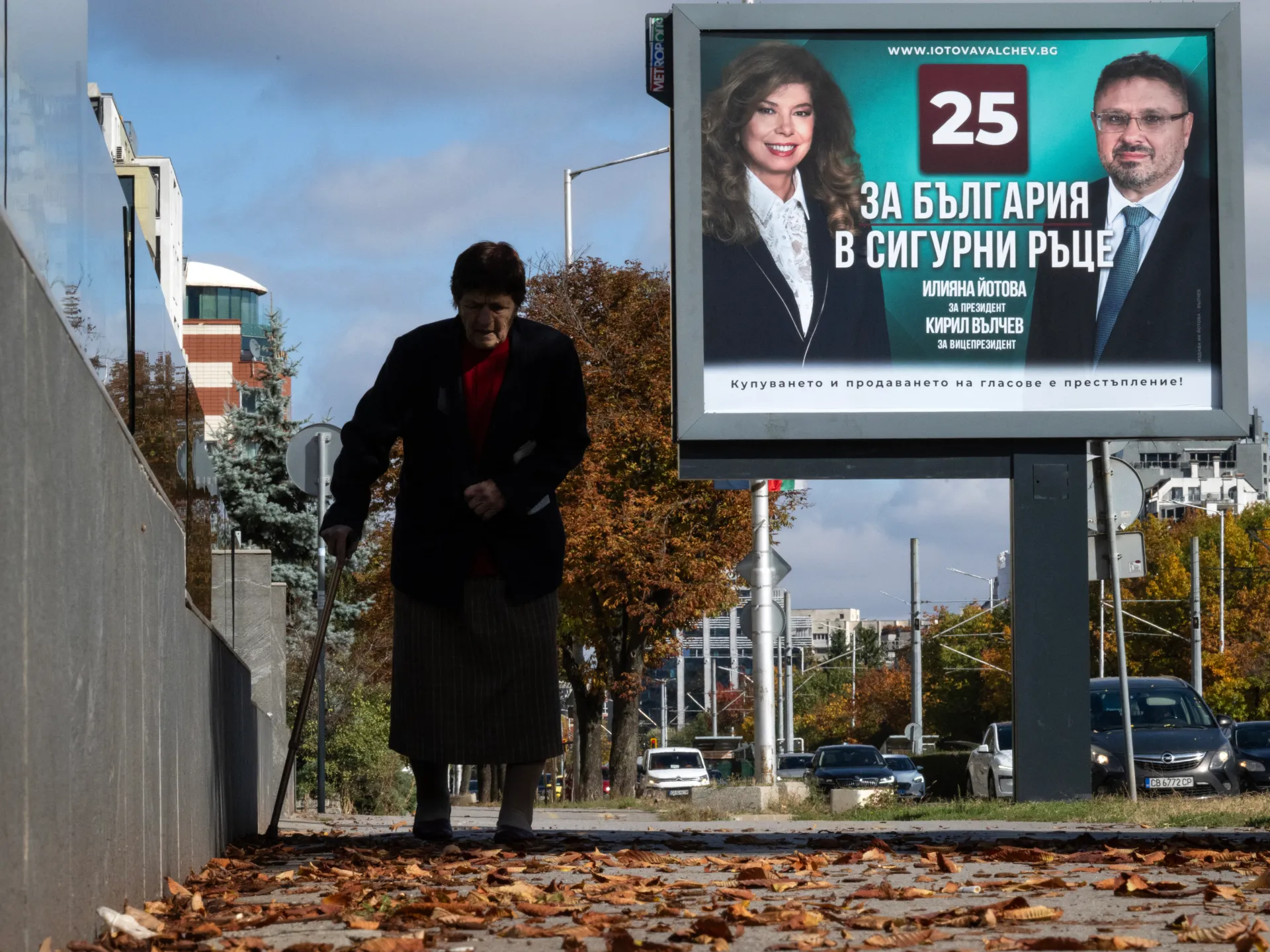
Bulgarians are voting in a presidential election shaped by Russia’s war in Ukraine and a series of deadly drone strikes on merchant ships in the Black Sea off the country’s coast.
President Iliana Iotova, 61, and former caretaker prime minister Andrey Gyurov, 50, are the leading candidates in a field of 27. Both have condemned the attacks, but they hold markedly different positions on the wider conflict.
The presidency is largely ceremonial, although the directly elected office carries significant political influence. The president leads the armed forces, can veto legislation, sign international treaties and appoint ambassadors, while major policies require parliamentary approval.
The maritime attacks are believed to have killed about two dozen international seafarers. They have prompted international condemnation and led Bulgaria to seek allied help in strengthening security in its Black Sea waters.
The Bulgarian government has stopped short of directly accusing Russia of carrying out the strikes. Rumen Radev, who supports Iotova, has said their outcome “benefits the Russian Federation”.
Ukraine war divides presidential candidates
Gyurov, who served as caretaker prime minister this year, is backed by pro-Western reformist parties and has consistently supported Ukraine. During his time as premier, he signed a security co-operation agreement with Kyiv.
“I want Bulgaria to have a voice of its own in Europe, a reliable NATO ally that defends its interests through preparedness, strong diplomacy and a clear position,” Gyurov told supporters at a rally on Thursday.
Iotova, a former vice-president, became acting president in January after Radev resigned to enter the parliamentary race, which he won on a platform widely viewed by political analysts as friendly towards the Kremlin.
Radev and Iotova have called for a diplomatic end to the war. “My opponents argue that there must be a war of attrition,” Iotova said at her own rally on Thursday. “The truth is, we are all the ones who are most exhausted.”
Although parliamentary parties broadly support Bulgaria’s pro-Western direction, traditional historical and cultural ties with Russia have fuelled pro-Russian sentiment and deepened divisions since Moscow’s full-scale invasion of Ukraine.
Dobromir Zhivkov, managing director of the Market Links polling agency, said Iotova was among those calling for a more neutral position. “They call for an end to aid for Ukraine and a halt to arms deliveries to Ukraine; we often hear them use Kremlin rhetoric and terminology borrowed directly from Kremlin propaganda,” he said.
Run-off expected after first round
The candidates have also focused on rising energy prices and inflation, with many people in rural areas struggling to make ends meet.
Polls by Alpha Research put Iotova on 41 per cent and Gyurov on 28 per cent. Analysts expect neither to win the outright majority required in the first round.
Voting began at 7am and is due to close at 8pm. A run-off is expected on November 1, with turnout forecast to remain below 40 per cent among the 6.6 million registered voters, well below the 50 per cent threshold.
