


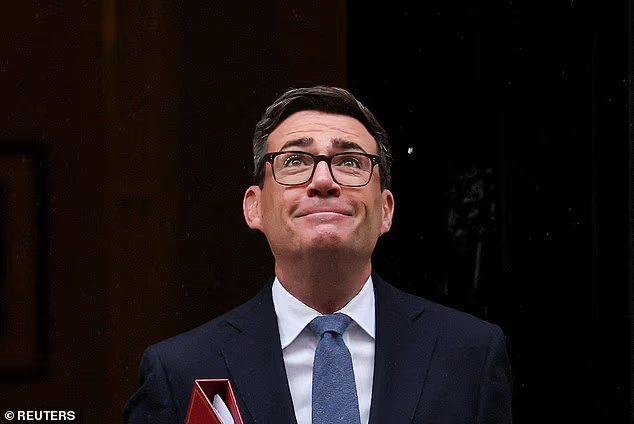
Andy Burnham’s first Prime Minister’s Questions as Prime Minister exposed the central political gamble of his new government: presenting an unapologetically interventionist Labour programme while trying to reassure markets and voters that the state can afford it.
The exchange with Conservative leader Kemi Badenoch on Wednesday 2 September centred on public spending, borrowing costs and whether Mr Burnham is prepared to make difficult choices ahead of his first Budget on 28 October.
Ms Badenoch accused him of being a “spendthrift Prime Minister” who “wants to say yes to everyone”, arguing that his approach amounted to the “same old Labour politics of tax and spend”. The attack was designed to exploit the Prime Minister’s record of promising action on household bills, rough sleeping, social care, defence and the high street.
Mr Burnham performed strongly in the Commons, according to MPs from across the political divide, and rejected comparisons with the market turmoil that brought down Liz Truss. He insisted that his government would follow its fiscal rules and take action to reduce debt, while continuing to ease pressure on families.
But the warning from the Conservative leader came as the bond market placed renewed pressure on the Government. The yield on the ten-year gilt reached 5.294 per cent on 2 September, its highest level since August 2007, according to Reuters.
The rise has intensified scrutiny of Chancellor John Healey, who will set out the Government’s tax and spending plans next month. Any attempt to fund a series of ambitious commitments without convincing investors that the public finances are under control risks pushing up the cost of government borrowing still further.
Andy Burnham’s spending plans face a fiscal test
Mr Burnham has made clear that he intends to govern as a traditional Labour leader rather than dilute his politics in an attempt to occupy the centre ground.
In his first speech outside Downing Street, he pledged to bring essential services under stronger public control, rebuild council housing, support young people into work and begin a national drive to end long-term rough sleeping. The programme was initially backed by an additional £340 million, including funding for 1,200 homes and intensive support for at least 3,000 people.
His government has also removed VAT from domestic electricity bills from 1 October. The immediate cost of the measure is being funded by cancelling the £1.8 billion digital identity programme, but ministers have acknowledged that longer-term measures will have to be settled at the Budget.
Other early decisions include a planned 20 per cent cut in business rates for pubs, social clubs and live music venues in England from April next year, alongside the restoration of a £2 bus fare cap. The Prime Minister has also committed to a substantial increase in defence spending and promised comprehensive reform of social care.
The cumulative effect has left the Government facing a difficult calculation. It can raise more money from businesses, risking further damage to weak economic growth; increase taxes on working people, potentially repeating the collapse in public support suffered by Sir Keir Starmer; or scale back the promises that helped Mr Burnham seize control of Labour.
For now, the Prime Minister is betting that a more overtly left-wing platform will strengthen Labour against threats from the Greens, Jeremy Corbyn’s Your Party and pro-Palestinian splinter groups, while also appealing to working-class voters in former industrial areas.
His supporters believe the strategy is suited to the current electoral map. Labour does not necessarily need the broad coalition pursued by Tony Blair if the Conservatives and Reform remain divided, they argue. Instead, it can concentrate on winning back enough voters in the so-called Red Wall to secure another majority.
That calculation depends heavily on Mr Burnham’s ability to make his promises appear both credible and affordable. His decision to attack the legacy of Margaret Thatcher and advocate greater public ownership has surprised some Westminster figures, but his allies believe voters are more concerned about private water companies polluting rivers and energy firms pushing up household costs than about the state ownership debates of the 1980s.
The difficulty is that the Government’s political message is colliding with a far less accommodating economic reality. The Prime Minister can promise action on living costs, welfare, housing and public services, but the Treasury must still find the money without alarming investors or imposing further pressure on taxpayers.
Mr Burnham’s response to Ms Badenoch at PMQs was politically effective. His claim that he had already cut VAT on electricity bills gave him a direct answer to the charge that he had identified nothing to cut.
Yet the broader question remains unresolved. A Prime Minister who has built his appeal around saying yes to demands from voters, public services and Labour’s left will eventually have to decide which promises take priority.
Mr Burnham has so far chosen to be open about his politics, rather than disguise them as previous Labour leaders have done. The test now is whether that honesty can survive the pressure of the markets, the Budget and an electorate that may ultimately demand restraint.
