


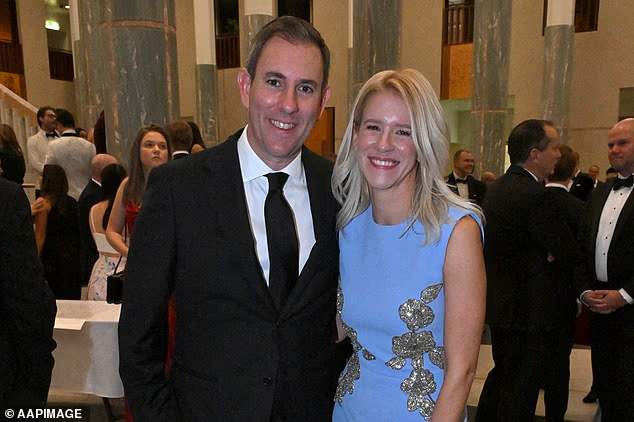
Jim Chalmers has been urged to show greater independence from Anthony Albanese and pursue the kind of ambitious economic reform associated with former treasurer and prime minister Paul Keating.
The criticism centres on the argument that Australia’s treasurer has the education and personal background to understand economic disadvantage, but has not shown enough willingness to challenge the assumptions he brought into office.
Chalmers grew up in Logan, Brisbane, and represents the area in federal Parliament. He holds degrees in commerce and arts, first-class honours in public policy and a doctorate examining Keating’s leadership.
His lack of an economics degree should not, in itself, be held against him. Keating and Peter Costello did not study economics at university either, while Chalmers has spent much of his career inside the Labor political system.
Jim Chalmers and the case for economic reform
The central question is whether Chalmers can move beyond the political institutions and assumptions that shaped his career, and build an economy capable of delivering higher living standards rather than relying primarily on government support.
Keating’s approach under Bob Hawke involved politically difficult changes, including floating the Australian dollar, opening up the financial system, reducing tariff barriers and reshaping taxation. The reforms were driven by the belief that Labor’s social ambitions depended on a stronger and more productive economy.
Chalmers studied Keating’s career, but his critics argue that he has absorbed more of the political caution associated with his former chief of staff, Wayne Swan, than Keating’s readiness to reconsider established positions.
Swan received credit for helping Australia through the global financial crisis, but managing an emergency is different from creating a lasting economic settlement. Chalmers has been accused of being fluent in the language of fairness, inclusion and investment without demonstrating that his policies make it easier for businesses to produce, compete, employ and take risks.
The expanded five per cent home deposit scheme has been cited as an example. Removing income caps, making places unlimited and raising property price limits may allow more people to bid for homes, but the concern is that prices could rise before housing supply catches up.
Helping buyers overcome a deposit barrier, the criticism runs, is not necessarily the same as making housing more affordable.
A separate dispute followed a ban on credit card surcharges. The Australian Taxation Office then decided to stop accepting credit card payments, creating difficulties for small businesses that relied on the facility to manage their cash flow.
Chalmers subsequently announced taxpayer funding to keep the payments system operating until the end of the financial year. The episode was presented as an example of a policy whose political appeal had run ahead of consideration of how it would work in practice.
There have also been measures aimed at supporting business, including making the $20,000 instant asset write-off permanent and seeking to streamline approvals and reduce regulatory duplication. However, these initiatives have been characterised as limited rather than part of a coherent economic strategy.
With productivity weak and the Reserve Bank raising interest rates again in September, the test for the government is whether its policies expand productive capacity while limiting inflationary pressure. Global shocks may complicate that task, but they do not remove the need for domestic discipline.
Pressure from Anthony Albanese
Chalmers also faces a political constraint in the Prime Minister’s office. The argument is that Albanese’s instinct is to manage Labor’s constituencies, while the treasurer’s responsibility is sometimes to resist demands that conflict with the national interest.
Former prime minister John Howard has described the relationship between a prime minister and treasurer as requiring “constructive tension”. A treasurer’s value, on that view, cannot be judged by how rarely he creates difficulties for the prime minister.
Chalmers is not Labor’s deputy leader, and his influence within the party is complicated by the strength of the Left and divisions between factions. But the uncertainty over his future leadership prospects has been used to argue that he should take greater risks, rather than fewer, during his time at Treasury.
His critics say he should make the case for reform more forcefully, build support beyond his Queensland Right faction and distinguish between policies that reinforce Labor’s political identity and those that improve Australians’ economic prospects.
Chalmers has the education, intelligence and personal history to become a significant treasurer. The unresolved issue is whether he will use that position to challenge his political inheritance and pursue the wider economic reform associated with Keating.
