


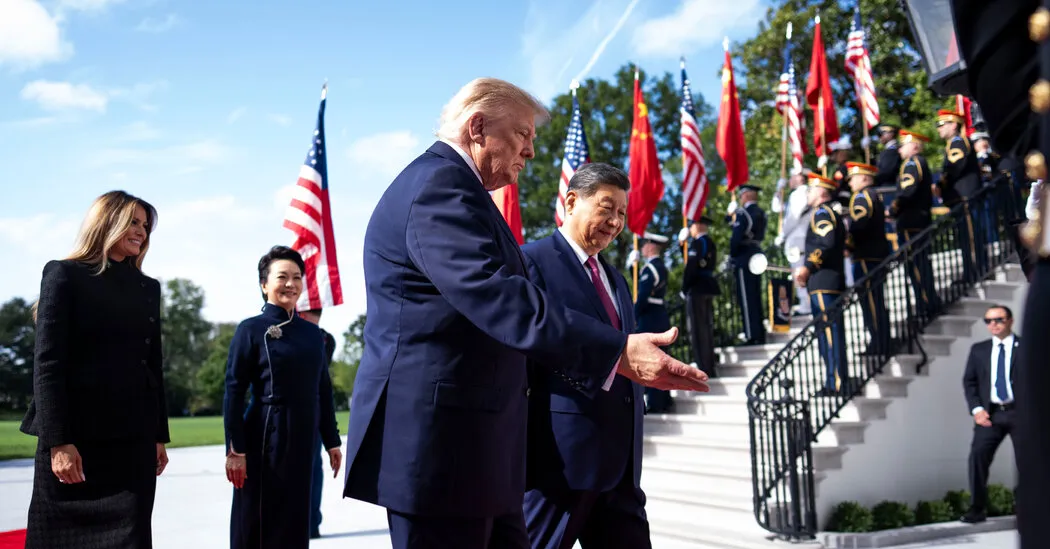
A relatively calm summit between Donald Trump and Xi Jinping has given China’s leader valuable time to tackle mounting domestic problems, strengthen economic self-reliance and prepare for next year’s Communist Party congress.
The meeting in Washington also saw China and the United States extend their trade truce, easing the immediate threat of the steep tariffs Mr Trump had once threatened to impose on Chinese goods.
For Beijing, the breathing space comes as the country grapples with a housing market crash, falling local-government revenues and weak consumer spending. China’s property downturn has eroded household savings and undermined a major source of income for local authorities.
“By trying to stabilise relations with the US, China can better concentrate on its own priorities,” said Wu Xinbo, an American studies scholar at Fudan University in Shanghai.
The outcome marks a significant shift from the early months of Mr Trump’s return to office. He had campaigned on imposing heavy tariffs on Chinese imports and, three months after taking office, briefly raised them to 145 per cent.
His administration also introduced stringent restrictions on technology trade with China. But Beijing responded with measures of its own, most notably curbs on exports of rare-earth metals and magnets used in cars, electronics and weapons.
Washington subsequently pulled back from some of its most aggressive steps. Tariffs fell from their peak, certain export controls were eased and the two countries began negotiating temporary agreements to contain the dispute.
Competition remains intense in industries including artificial intelligence and robotics. However, the relationship has moved away from the sharp escalation seen at the start of Mr Trump’s second term, with China demonstrating that it can impose significant economic costs on the US.
China seeks time to build a more self-reliant economy
Some American China experts believe the Trump administration is now pursuing a less confrontational approach than many senior figures in both US political parties would prefer.
“I see the current policy as far too weak and contrary to the views of senior leaders in both parties,” said R Nicholas Burns, who served as ambassador to China under President Joseph R Biden Jr and held senior roles under President George W Bush.
Beijing has continued its long-term effort to reduce reliance on foreign technology and energy. Over two decades, that strategy has helped China become a leading producer of batteries, solar panels, telecommunications equipment and electric vehicles.
“They want time and stability because it helps them build a more resilient, more self-reliant economy,” said Evan Medeiros, a Georgetown University professor and former senior Asia director on the National Security Council under President Barack Obama. “It gives them time to reduce their exposure to the US.”
China has also invested heavily in electric vehicles, wind and solar power and its national electricity grid. Those measures have reduced its dependence on imported fossil fuels and helped shield the economy from high oil prices and shortages linked to the war in Iran.
At the same time, Chinese exporters have expanded into south-east Asia, Latin America and other markets. China’s overall trade surplus has surged since Mr Trump returned to office and is on course to match or exceed last year’s record of about 1.2 trillion US dollars.
Scott Bessent, the US Treasury Secretary, said at the start of the summit that the trade truce had been extended until January 10. China’s Ministry of Commerce confirmed an extension but did not specify how long it would last.
The relatively short extension could allow Beijing to reassess its position after the US midterm elections. Mr Medeiros said China’s negotiating leverage could increase if the Republican Party suffered heavy losses.
“Suddenly, the negotiation price changes because Trump will be on his back foot, he’ll be weak against China, and he’ll need China even more than he does today,” he said.
The summit also allowed Mr Xi to present himself domestically as a powerful and respected international leader. Mr Trump welcomed him as he left his plane, while Mr Xi had sent Vice-President Han Zheng to receive the American president when he arrived in Beijing in May.
That display of status is particularly useful before next autumn’s Communist Party congress, which will select a new group of senior leaders to serve under Mr Xi. He is widely expected to remain in charge, but the congress will still involve negotiations over appointments and policy priorities.
Maintaining stability in China’s most important foreign relationship could give Mr Xi greater freedom to focus on those internal manoeuvres, as well as the country’s economic difficulties.
The property crisis has already pushed families to cut spending, leaving restaurants, shopping centres and car dealerships struggling. With domestic demand weak, China has become increasingly dependent on exports to support growth.
For Mr Xi, avoiding the severe American tariffs once threatened against Chinese exports may therefore prove the most significant result of the summit.
