


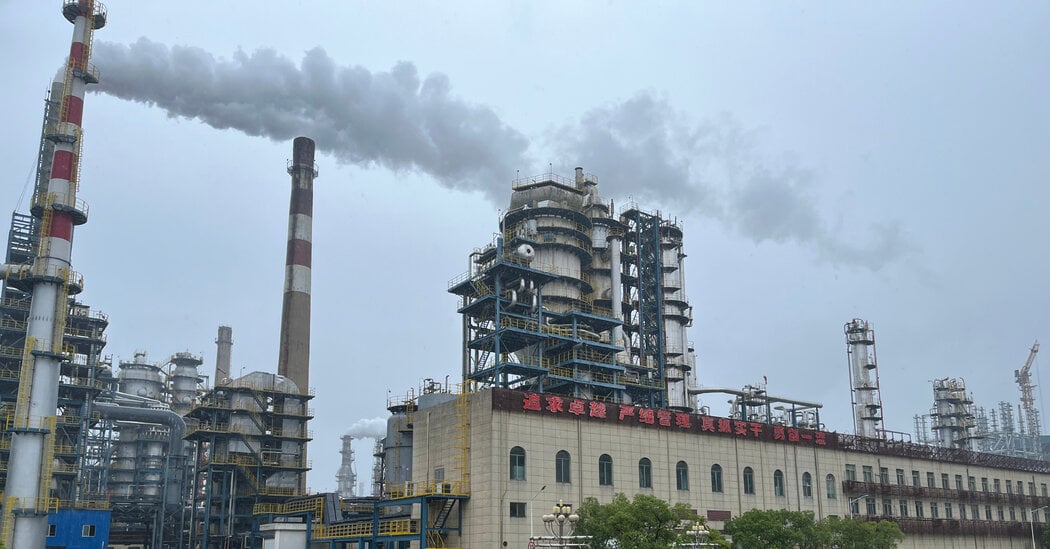
China’s growing oil power has emerged as one of the unexpected consequences of the war with Iran, as Beijing uses vast reserves, extensive refining capacity and alternative energy sources to reduce its exposure to disrupted supplies.
The shift has given China new influence over global energy markets and raised questions about whether the threat of an oil blockade would still deter its leaders from taking more aggressive action abroad, including a possible move against Taiwan.
China remains heavily dependent on imported crude, but its stockpiles and ability to switch between oil, coal and other energy sources allowed it to cut crude purchases by 23 per cent in the first six months of the conflict compared with the same period a year earlier, customs data show.
Other countries reliant on Middle Eastern oil had fewer options, leaving them facing higher prices or the need to reduce energy use. China’s decision to buy less crude also helped limit the rise in global oil prices after Iran severely restricted shipping through the Strait of Hormuz.
By late August, crude was estimated to be about 10 dollars a barrel cheaper than it would have been had China continued buying at pre-war levels, according to Daan Struyven, who leads oil research at Goldman Sachs.
“This is a power that nobody thought China had,” said Erica Downs, a senior research scholar at Columbia University’s Center on Global Energy Policy. “Going forward, it’s going to be really interesting to see: What does China do with this newfound power?”
China uses fuel exports as a political tool
Beijing demonstrated the reach of that power by imposing sharp restrictions on exports of petrol, diesel and aviation fuel early in the war. The measures were intended both to protect domestic supplies and to penalise countries whose foreign policies conflicted with China’s.
The limited fuel that China exported during the spring supply squeeze went mainly to countries with close ties to Beijing, including Vietnam and Thailand. Australia and the Philippines, which have been at odds with China over its territorial claims in the South China Sea, were among those that received less.
Broader exports resumed in early July, but Tom Reed, a specialist in China’s oil industry at Argus Media, said Beijing could impose another ban. Removing more diesel from the international market could push prices higher, with US diesel prices already at a record 6.40 dollars a gallon.
China’s influence differs from that of traditional oil powers because it is a major importer rather than a leading producer. Its purchasing decisions can lift prices when it is building reserves and ease them when it reduces buying, Goldman Sachs analysts said.
“Have they fully wrested control? No,” Dr Downs said. “But are they a force for OPEC to reckon with? Yes.”
The decline in Chinese imports reflects both the end of a recent stockpiling drive and a fall in refinery output. Domestic oil demand has weakened to such an extent that consumption may have peaked last year, according to Sinopec, China’s largest refiner.
Electric vehicles now account for about 14 per cent of passenger cars on Chinese roads. The International Energy Agency estimates that their growth reduced the country’s oil use by 1.5 million barrels a day in the second quarter compared with a transport system reliant solely on petrol and diesel vehicles, cutting more than 1 per cent from global demand.
China’s high-speed rail network and its ability to use coal rather than oil in the production of chemicals have further reduced its vulnerability. The precise combination of measures remains difficult to establish because Beijing releases limited information.
China began building its government oil reserves after becoming a net importer in 1993, later accelerating the effort under President Xi Jinping. Its stockpiles are now estimated to represent roughly a third of known oil inventories worldwide.
The strategy was driven partly by concerns that foreign navies could obstruct oil shipments travelling from the Middle East through the Strait of Malacca. Low interest rates following China’s housing crisis also helped make the recent purchases and storage of crude less costly.
The next test will be how much oil China buys while the global benchmark remains close to 103 dollars a barrel, and how much of that crude it converts into diesel and other fuels for export. Imports rose by 6 per cent in August from July, but remained well below pre-war levels.
Meghan O’Sullivan, a former US deputy national security adviser, said China could acquire an influence over demand comparable to the leverage Saudi Arabia has gained from its ability to adjust production.
“If China has that ability on the demand side, then they become an actor that the U.S. and others will go to and ask them for that behavior in exchange for potentially something else,” she said.
A scheduled meeting between Donald Trump and Xi Jinping at the White House next week may offer an indication of how Beijing intends to use its growing influence over oil and refined fuels.
