


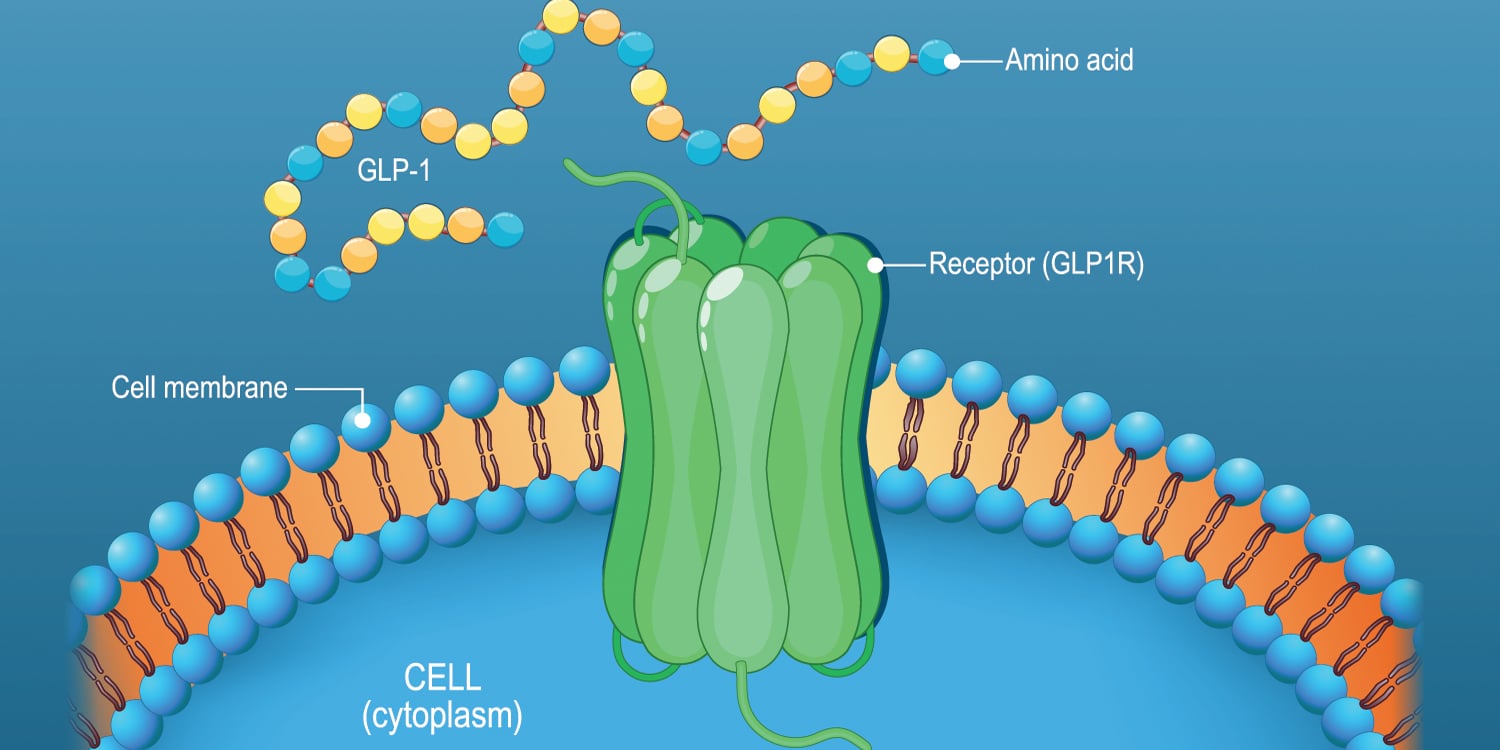
A large genetic study has found that activating the GLP-1 receptor—the target of widely used weight-loss and diabetes medicines—appears linked to better mental health and a lower risk of conditions such as depression and bipolar disorder, with hints of protection against substance use disorders. The research, conducted by Guoyi Yang and colleagues, was published in Translational Psychiatry.
GLP-1 receptor activation and mental health
The GLP-1 receptor is a protein present on the surface of cells throughout the body, including the pancreas and the brain. When activated, it helps regulate blood sugar and signals fullness to the brain, reducing appetite. GLP-1 receptor agonists have transformed the management of type 2 diabetes and obesity, and scientists have increasingly explored whether they might also influence mental health because these drugs act on the central nervous system.
Early clinical work hinted at psychiatric benefits. A 2016 study suggested that liraglutide could improve cognitive problems in mood disorders, and a 2017 experimental study reported brain changes in mood-regulating areas after GLP-1 treatment. A 2023 clinical-trials review indicated that GLP-1 drugs can reliably reduce depressive symptoms.
To determine whether activating GLP-1 receptors directly protects against psychiatric and substance-use disorders—or if improvements merely reflect weight loss—Yang’s team used a genetic approach that mimics the drug target. “GLP-1R agonists, such as semaglutide, have transformed how we treat obesity and type 2 diabetes,” the UPenn researcher said, explaining that their aim was to see whether the biological mechanism, not the weight loss, influenced mental health outcomes.
Our research uses genetics as a tool to predict the impact of GLP-1R activation – we aren’t saying that GLP-1R activation is only relevant to people with a certain genetic background,” Yang explained. “We hypothesize that the genetic variants that we consider in this paper affect the same mechanism that the drug affects – and so the genetic variants tell us what happens if you intervene on this target using the drug.”
The team identified two sets of genetic proxies for GLP-1R activation: one linked to lower body mass index (BMI) and another linked to lower glycated haemoglobin (HbA1c). They analysed data from large genetic databases, including the UK Biobank, comprising hundreds of thousands of people of European ancestry, to examine how these GLP-1-activating variants related to a wide range of mental health outcomes.
The mental health outcomes studied encompassed general well-being measures—life satisfaction, positive affect, neuroticism, and depressive symptoms—as well as diagnosed disorders such as major depressive disorder, bipolar disorder, schizophrenia, and ADHD. The researchers also looked at the risk of substance use disorders, including alcohol dependence and cannabis use disorder, and compared the GLP-1 proxies with general genome-wide variants that simply lower BMI or blood sugar.
The findings show that genetically predicted GLP-1 receptor activation via the BMI pathway was associated with broad mental health benefits. Specifically, for every 1-unit decrease in BMI driven by GLP-1R activation, individuals experienced a 0.06 standard deviation improvement in overall mental well-being, alongside higher life satisfaction and lower neuroticism and depressive symptoms. For psychiatric disorders, a 1 BMI unit reduction via the GLP-1 pathway corresponded with an odds ratio of 0.82 for major depressive disorder and 0.61 for bipolar disorder, with suggestive evidence for ADHD and postpartum depression.
“We were surprised by just how broadly GLP-1R activation seems to benefit mental health, extending to depression, bipolar disorder, and potentially substance use disorders,” Yang said. “The effect on bipolar disorder was striking, showing almost a 40% lower risk (odds ratio of 0.61). These results highlight GLP-1R agonists as promising candidates for future psychiatric therapies.”
Notably, these psychiatric benefits were stronger than those arising from general BMI-lowering variants, suggesting the brain’s GLP-1 receptor may contribute to mood regulation beyond weight loss alone. Variants that mimicked glucose-lowering effects of GLP-1 did not show the same broad mental health benefits.
The study also found suggestive evidence that GLP-1 receptor activation is linked to a lower risk of substance use disorders and fewer alcohol-related problems, aligning with earlier PsyPost coverage of related work using prescription records and hospital data. The findings are also broadly consistent with a 2026 Mendelian-randomization study that reported no increased risk of major psychiatric conditions from GLP-1 receptor activation.
Limitations of the approach are recognised. Mendelian randomisation assumes that the selected genetic variants influence outcomes only through the GLP-1 receptor, but the possibility that nearby genes contribute cannot be completely ruled out. The researchers employed statistical checks, yet clinical trials are needed to confirm whether these psychiatric benefits translate to patients.
“A key limitation of this method (Mendelian randomization) is that it relies on rigorous assumptions that cannot be verified,” Yang cautioned. “While we carefully selected genetic variants in or near GLP1R to mimic the drug target, we cannot rule out the possibility that nearby genes might also play a role. Clinical trials are needed to determine whether these psychiatric benefits directly translate to patients.”
Another caveat is that the study reflects lifelong exposure to slightly altered GLP-1 receptor activity, which differs from the shorter courses of medication typical in clinical use. “The effect size reflects the lifelong genetic effect of GLP-1R activation in the general population,” Yang noted. “In contrast, patients in the real world usually take GLP-1R agonists for shorter periods. Therefore, our numbers should not be viewed as the exact risk reduction patients will experience when taking these medications.”
Looking ahead, the researchers intend to probe the biological mechanisms underlying these psychiatric effects and, in the long term, to map the multifaceted roles of GLP-1R agonists across organs to identify new, genetically validated drug targets for cardiovascular, kidney, and metabolic diseases. “Our immediate next step is to understand the biological mechanisms underlying these psychiatric effects of GLP-1R activation,” Yang said. “In the long term, our goal is to define the multifaceted effects of GLP-1R agonists across organs and to identify novel, genetically validated drug targets for cardiovascular, kidney, and metabolic diseases.”
You can follow Yang’s work on X (formerly Twitter) at @yanggy_hku.
The study, Glucagon-like peptide-1 receptor activation and mental health: a drug-target Mendelian randomization study, was authored by Guoyi Yang, Stephen Burgess, and C. Mary Schooling.
