


Lindsay Clancy’s defence has argued that there is no evidence she killed her three children, asking a Massachusetts judge to dismiss the case after her murder trial ended in a mistrial.
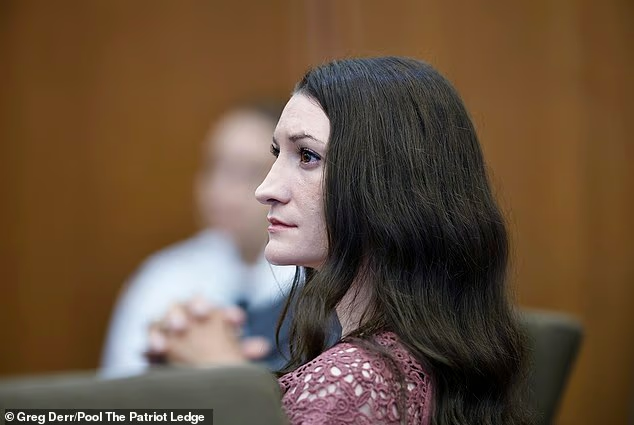
Clancy appeared in Plymouth County Superior Court on Tuesday for the first time since jurors failed to reach a unanimous verdict earlier this month. The former nurse, who is paralysed from the waist down, sat in a wheelchair at the defence table as lawyers debated whether she should face a second trial.
Defence attorney Kevin Reddington told Judge William Sullivan that the prosecution’s case was based on speculation and had failed to establish that Clancy was responsible for the deaths of Cora, five, Dawson, three, and eight-month-old Callan.
“This entire case is based on speculation. Where is the admission? Where did she say that she did this?” he asked.
Reddington also attacked the police investigation, arguing that Clancy had no blood on her socks after cutting herself and jumping from a second-floor window. He said she had no memory of killing her children when she awoke from a coma and had instead been told by police what had happened.
“It wasn’t even a horrendous investigation. There was no investigation,” he told the court.
The lawyer said the state had not shown probable cause that Clancy was the perpetrator, or sufficient evidence to prove beyond reasonable doubt that she was criminally responsible for the killings.
Clancy has pleaded not guilty by reason of insanity. Her defence says she was suffering from severe postpartum depression and psychosis at the time of the children’s deaths.
Under Massachusetts law, prosecutors in an insanity case must establish that a defendant was not suffering from a mental defect or disease, or that despite such an illness they could control their actions and conform to the law, Reddington argued.
Prosecutor Shanan Buckingham described the defence argument as “laughable” and said it was the first time the claim had been made. She argued that a person with mental illness can still commit crimes and remain criminally responsible.
Judge Sullivan said he would consider the lawyers’ submissions before ruling on the request for a required finding of not guilty.
The future of the Lindsay Clancy case
The hearing also began to establish the next steps following the mistrial, although no date was set for a retrial. Reddington said he would not be available until June, while both sides asked for the matter to be delayed.
A further hearing was scheduled for November 2, when the court is expected to consider the defence’s request to dismiss the case on double-jeopardy grounds, arguments over the conduct of a juror and a prosecution application for a gag order against Reddington.
The defence claims Judge Sullivan should have questioned the juror more thoroughly before declaring the mistrial. Reddington said the jury foreperson’s complaints about the juror’s conduct should have been investigated and that a second trial would breach double-jeopardy protections.
The jury had deliberated for 38 hours before the mistrial was declared on September 4. The foreperson had sent two messages to the judge about an unidentified juror who allegedly expressed reasonable doubt but refused to apply it to the law.
That juror was later identified as Michael Desronvil, who has said through his lawyer that he has “zero doubt” about Clancy’s guilt, based on what he described as “mountains of evidence”.
Several fellow jurors subsequently criticised Desronvil’s conduct, including claims that he refused to follow the law on reasonable doubt and used his phone during deliberations. It also emerged that he had been arrested for domestic violence in 2021, although the case was later dropped.
Desronvil’s lawyer, Heather O’Connor, appeared in court on Tuesday and said jurors should not fear being publicly identified because they had taken a position different from other members of the panel.
“He’s the only one being targeted here because his decision and his vote was different than everyone else’s,” she said. “People should not have to worry – just as the commonwealth said – jurors should not have to worry about coming in and having them outed because they take a stance different than everyone else.”
Martin Weinberg, a recent addition to Clancy’s legal team, separately argued that notes from the jury’s final deliberations and private discussions should be made public. Prosecutor Jennifer Sprague opposed the request, warning it could have a “chilling effect” on future jurors.
Clancy was charged with three counts of first-degree murder after the children were found dead at the family home in Duxbury, Massachusetts, on January 24, 2023. Prosecutors allege she strangled them with exercise bands after sending her husband, Patrick Clancy, out to run errands.
She then cut her wrists and neck and jumped from the bedroom window. Clancy survived and remains at Tewksbury Hospital, where she receives round-the-clock care and is on suicide watch.
The prosecution has not confirmed whether it will seek a retrial, or whether any new case would involve the same charges or lesser offences. Plymouth County District Attorney Tim Cruz said outside court that his office was still deciding its next course of action.
Clancy is due to return to court on November 2.
