


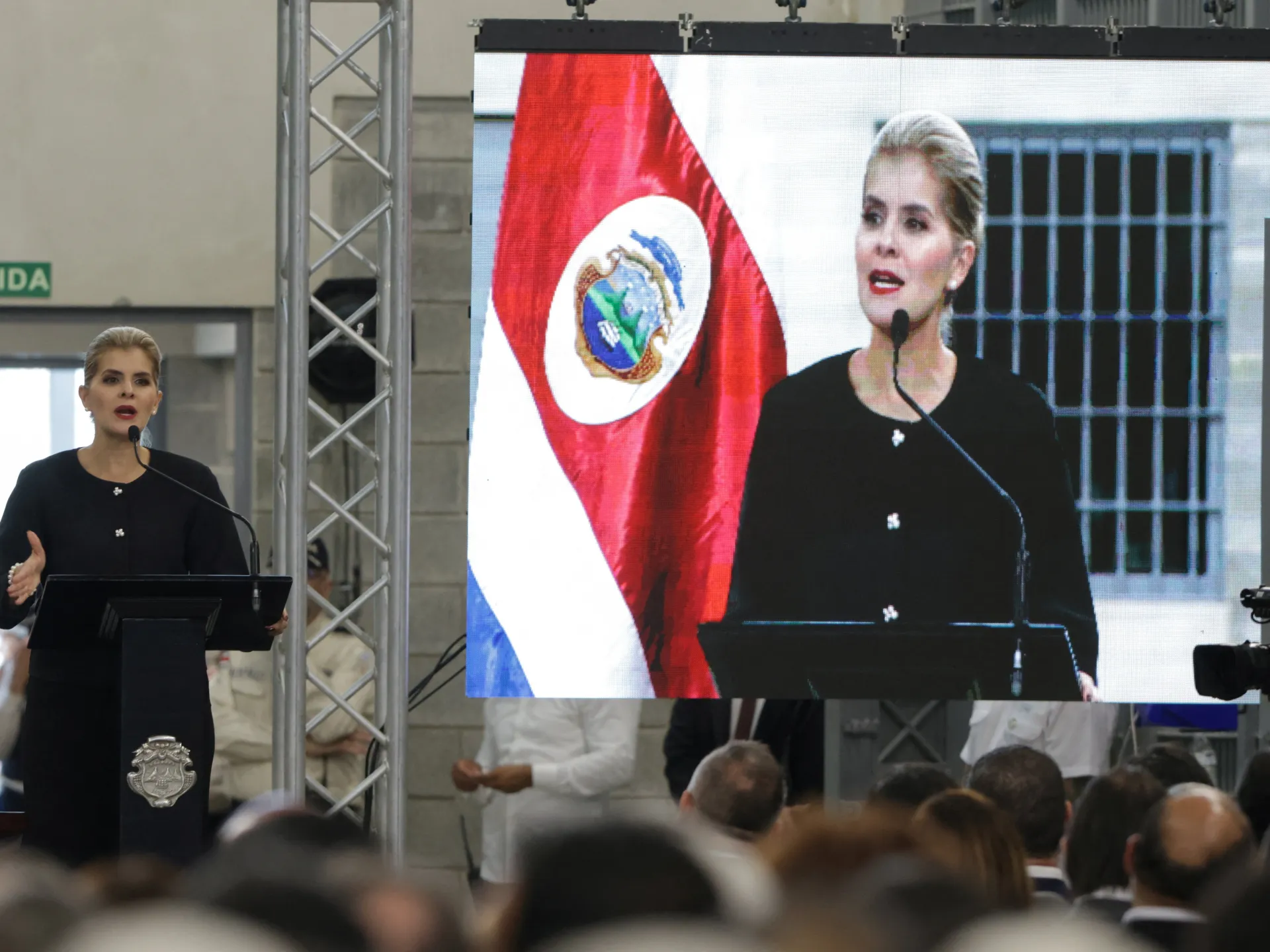
Costa Rica has opened a mega-prison for organised crime as homicide levels approach record highs and governments across Latin America adopt the tough-on-crime approach associated with El Salvador’s president, Nayib Bukele.
President Laura Fernandez inaugurated the High-Containment Centre Against Organised Crime, known as CACCO, on Wednesday. The facility will accommodate up to 5,100 people – about 20 per cent of Costa Rica’s current prison population.
“The CACCO will force criminals to face a new model – a tough-on-crime model. Costa Rica will become a global benchmark for prison security,” Ms Fernandez said at the ceremony.
The first prisoners are due to be transferred at the end of October. Justice Minister Gabriel Aguilar said the centre would help the government regain control of the prison system and reduce the infiltration of organised crime.
Costa Rica recorded 905 homicides in 2023, its highest figure on record, followed by 876 in 2024 and 873 in 2025. Analysts have partly attributed the rise to growing conflict between criminal groups competing for lucrative drug routes.
Latin American leaders embrace mega-prison model
The prison marks Costa Rica’s adoption of a model increasingly promoted by right-wing leaders across the region. They are seeking to replicate policies introduced by Mr Bukele, whose mass-arrest campaign and suspension of basic rights have proved popular in El Salvador.
El Salvador declared a state of exception in 2022, extending police and military powers. The measure has been credited with a sharp fall in homicides, but rights groups say it has also brought serious abuses and been used against critics of the government.
Mass arrests and mass trials have followed, with decisions delivered against hundreds of defendants at a time. Some people have been held without charge, while the emergency powers have been repeatedly extended.
Critics have also warned that conditions in mega-prisons can be poor, citing overcrowding, violations of due process and alleged torture in facilities including El Salvador’s Terrorism Confinement Centre, or CECOT.
Peru’s president, Keiko Fujimori, who took office in July, has announced plans to visit CECOT ahead of a possible similar project in her country. The Salvadoran facility has capacity for about 40,000 people.
In Colombia, newly elected president Abelardo de la Espriella campaigned on a pledge to build 10 mega-prisons and took office in August. Brazil’s right-wing Senator Flavio Bolsonaro has also reached the final round of the country’s presidential election with a platform that includes plans for five such facilities.
