


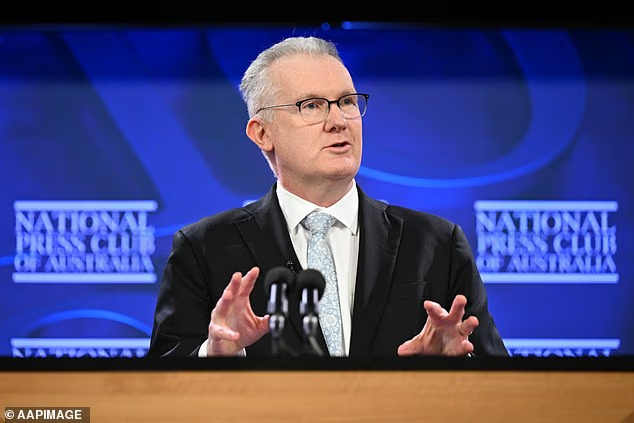
Australia’s Immigration Minister Tony Burke has rejected claims that the country is experiencing mass immigration, as he unveiled changes intended to reduce migration demand and curb the repeated switching of visas.
Speaking at the National Press Club, Mr Burke described it as “absurd” to suggest Australia was a mass immigration country. The response has focused on whether the minister’s characterisation is consistent with population growth, migration figures and pressure on housing and infrastructure.
Australia’s population passed 28 million in June this year, according to figures cited in the criticism of Mr Burke’s position. That is 1.6 million higher than the largest population projected by the Australian Bureau of Statistics in 1998 for 2051.
At the time, Australia had a population of 18.5 million. The ABS’s lowest projection put the 2051 population at 23.5 million, while its highest assumed annual net overseas migration of 90,000 and projected a population of 26.4 million.
The country reached that higher figure 25 years earlier than expected. Critics argue that the acceleration is evidence of mass immigration, rather than a matter of terminology.
Migration figures and population growth
World Bank data cited in the debate shows Australia’s population increased by about 45 per cent between 2000 and 2025. Across the Organisation for Economic Co-operation and Development, the increase was around 17 per cent.
The United States grew by about 21 per cent and Britain by roughly 18 per cent over the same period, while Canada and New Zealand recorded slower growth than Australia, according to the figures presented.
Net overseas migration was 292,000 in the year to March, equivalent to just over 1 per cent of Australia’s population in a single year. That was more than three times the high annual migration assumption used in the ABS’s 1998 projections.
Almost three-quarters of Australia’s population growth in the latest ABS figures came from net overseas migration. The argument that this has added to demand for housing does not necessarily amount to opposition to immigration, but reflects concerns over the scale of arrivals and whether construction and infrastructure have kept pace.
Mr Burke has pointed to declining household sizes as another factor contributing to housing demand. However, his proposed measures also acknowledge a link between migration and housing, with the minister saying that reducing migration demand while prioritising construction workers would help ease pressure.
The minister’s speech cited a forecast that Australia’s population in 2030-31 would be 700,000 lower than projected before the pandemic. Critics have argued that the comparison is misleading because Australia’s international border was closed for two years during Covid, temporarily reducing population growth.
Questions have also been raised about the government’s forecasting record. The October 2022 Budget forecast net overseas migration of 235,000 for 2022-23, but the actual figure was 518,000 — a difference of 283,000 and more than twice the forecast.
Mr Burke’s overhaul includes measures to restrict “visa hopping”, prevent visitor visas becoming routes into migration, limit repeated moves between student courses and require overstayers to leave. The changes are also expected to reduce access to extended working holiday visas and make it harder for temporary migrants to remain by repeatedly changing their visa status.
The measures are intended to meet Labor’s existing migration targets of 245,000 this financial year and 225,000 thereafter, rather than establish a new lower target.
The dispute has consequently centred not only on the projected size of future migration, but also on public trust in the government’s forecasts and descriptions of the current situation. While reasonable disagreement remains over the appropriate level and composition of immigration, critics say the scale of Australia’s recent population growth cannot be dismissed as imaginary.
