


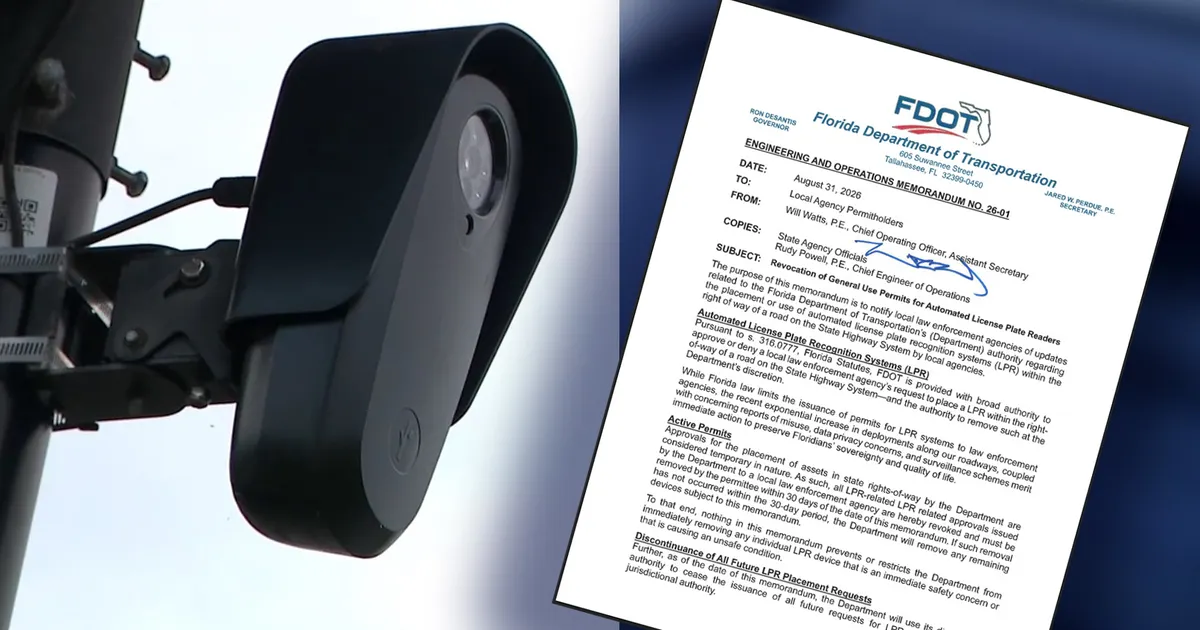
Florida authorities have ordered locally operated automated licence plate reader cameras to be removed from state roads within 30 days, after Governor Ron DeSantis warned that the expanding surveillance networks were “out of control”.
The Florida Department of Transportation revoked existing approvals for the systems in a memorandum issued on Monday, 31 August, and said it would no longer consider applications for new installations on the State Highway System.
FDOT said the decision followed an “exponential increase” in deployments, as well as reports of misuse, data-privacy concerns and what it described as surveillance schemes. Any cameras left in place after the deadline can be removed by the department. ([flvoicenews.com](https://flvoicenews.com/fdot-cracks-down-on-license-plate-readers-orders-flock-cameras-removed-from-state-roads/))
Florida licence plate reader cameras face removal
The order applies to cameras installed by local law enforcement agencies within the rights of way of state highways. It does not cover devices on city or county roads, private land or mobile readers used by agencies such as the Florida Highway Patrol. ([flvoicenews.com](https://flvoicenews.com/fdot-cracks-down-on-license-plate-readers-orders-flock-cameras-removed-from-state-roads/))
Flock Safety operates one of the largest networks of the technology, although the directive also covers systems made by other companies. The cameras photograph passing vehicles and record details including registration numbers, vehicle descriptions and the time and location of sightings.
Police departments can search the resulting databases to help locate suspects, stolen vehicles and missing people. Several Florida agencies have credited the systems with helping solve crimes, including the recovery of an Amber Alert child and the identification of a suspect in a fatal shooting.
But concerns about the technology have intensified after cases in which officers were accused of using licence plate databases for personal reasons. In Haines City, an officer was arrested after investigators alleged that he searched data for his estranged wife’s vehicle more than 700 times between September 2024 and June 2026.
A former Sumter County detective was also dismissed and charged over allegations that she used Flock and other databases to obtain information about her husband’s former wife. Privacy campaigners say known cases may account for only a portion of improper searches.
DeSantis says Florida must avoid a ‘surveillance state’
DeSantis, speaking at Florida International University in Miami on 26 August, said he supported giving police tools to investigate serious offences but did not want Florida to become “a surveillance state”.
“I think these cameras, the licence plate readers, I think it’s out of control,” he said. The governor has called for lawmakers to consider tighter rules and renewed his support for an artificial intelligence bill of rights.
Flock chief executive Garrett Langley has argued that stronger safeguards would be preferable to an outright ban. The company has made its system for auditing suspicious searches mandatory for law enforcement customers and plans to require most searches to be linked to a case code by the end of the year.
Flock has also said it will reduce the default period for retaining data from 30 days to seven, although agencies will still be able to choose longer periods. Privacy advocates argue that such measures do not resolve wider concerns about creating searchable records of people’s movements.
Some local agencies have already begun withdrawing from the technology. Jacksonville Sheriff T.K. Waters said the cameras had been “an enormously valuable investigative tool”, but announced that the force would discontinue their use following the state decision and concerns raised by residents. Nassau and Clay counties also said they would stop using licence plate readers, while Putnam County ordered its 18 cameras to be disconnected and removed within 30 days. ([jaxtoday.org](https://jaxtoday.org/2026/08/31/florida-blocks-flock-cameras/))
FDOT’s memorandum means that local agencies with permitted readers on state roads must now arrange their removal, with the department warning that it will intervene if they fail to meet the deadline.
