


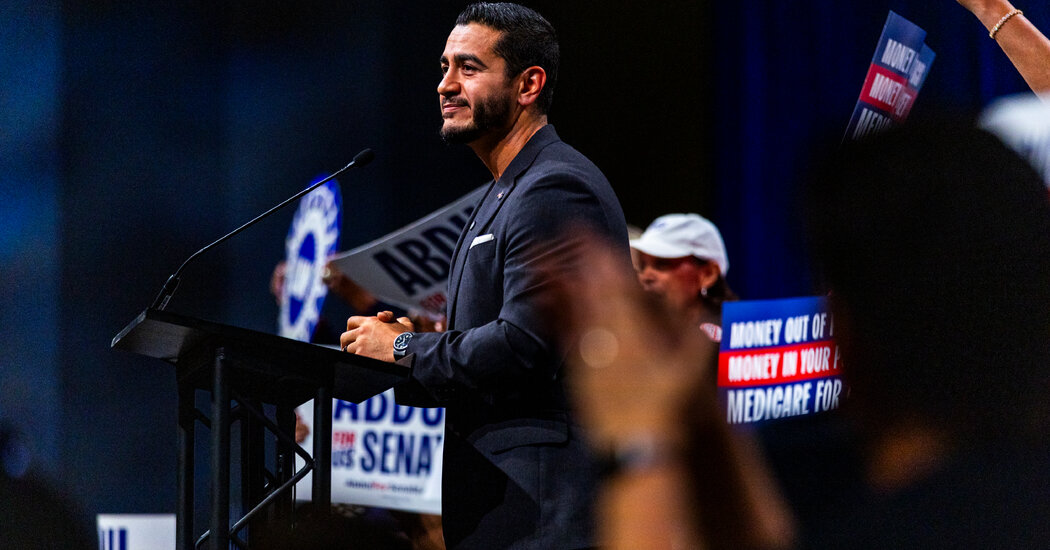
Abdul El-Sayed’s efforts to repair relations with Jewish Democrats in Michigan have produced a mixed response, with some saying his apologies for comments about a synagogue attack did not go far enough.
The Democratic Senate nominee spent two days meeting members of the Michigan Jewish Democratic Caucus, seeking to calm tensions left by a bitter primary contest and build support for his general-election battle against Republican Mike Rogers.
Mr El-Sayed apologised on Saturday at the Michigan Democratic Party’s convention in Lansing, and again on Sunday at a private fundraising event hosted by the caucus. But critics said he appeared to regret the timing of his remarks rather than their substance.
Zach Nessel, secretary of the Michigan Jewish Democratic Caucus, said the candidate had “apologised for when he said what he said, but not what he said”. He added that Mr El-Sayed had not done enough to win the group’s full support or an endorsement.
The controversy dates back to March, when a man drove a vehicle into Temple Israel in West Bloomfield Township, a Detroit suburb, and opened fire on a security guard. The guard was injured and the attacker was killed in a firefight.
Mr El-Sayed condemned the assault but also referred to reports that the attacker had lost relatives in an Israeli airstrike in Lebanon the previous week. “Hurt people hurt people,” he said, prompting accusations that he was offering an explanation that risked excusing the attack.
Speaking to Jewish Democrats at the weekend, Mr El-Sayed said he had been trying to provide context but recognised that the moment called for an unequivocal focus on the victims’ pain.
“There’s opportunity for context later on, but when you give the right medicine at the wrong time, it’s the wrong medicine,” he said at Sunday’s gathering. “And I gave it at the wrong time. Folks didn’t need to hear it, didn’t want to hear it. It was not the right thing to say.”
In a subsequent interview, Mr El-Sayed said he was “deeply committed to the safety of the Jewish community” and had apologised because he did not want to cause people pain, rather than to win political advantage.
Decky Alexander, chair of the Michigan Jewish Democratic Caucus, said the meetings had helped ease tensions for some members and exposed the range of views among Jewish Democrats in the state. She did not say whether the organisation would endorse Mr El-Sayed.
The candidate’s position on Israel remains a further source of concern. He has described the Israeli government as “evil”, called its actions in Gaza a “genocide” and opposed US aid to Israel. His association with Hasan Piker, a controversial political streamer who campaigned for him during the primary, has also drawn criticism.
Mr El-Sayed has distanced himself from Mr Piker’s comments suggesting that Jewish Americans could face threats because of their views on Israel, saying Americans should be able to express political opinions without fear of violence. However, he has stopped short of directly denouncing the streamer and said he would not campaign with him during the general election.
“This is not a campaign that is about a Twitch streamer in California,” Mr El-Sayed told reporters. “This is about affordability in Michigan.”
Mr Rogers has sought to make the dispute central to his campaign, presenting himself as a defender of Israel and courting Jewish voters who have traditionally leaned Democratic. He has campaigned alongside Rabbi Asher Lopatin of Ann Arbor and circulated the names of hundreds of Jewish Michiganders who say they support his candidacy.
Vice-President JD Vance also attacked Mr El-Sayed during a visit to the Detroit area on Monday, meeting the rabbi of Temple Israel and the security guard injured in the assault. He called the Democratic candidate “very, very evil” and urged voters to reject what he described as rising hatred by electing Mr Rogers.
Stacy Gittleman, a Democrat backing Mr Rogers, said Mr El-Sayed’s apology had not resolved her concerns about the direction of the Democratic Party. She said Jewish Democrats should not feel obliged to set aside their support for Israel in order to remain accepted within the party.
Other Jewish voters continue to support Mr El-Sayed, arguing that criticism of the Israeli government should not be confused with hostility towards Jewish people and that his comments after the attack had been misinterpreted. Some also say his Arab heritage and Muslim faith have contributed to a presumption that he cannot be trusted.
The divisions present a serious challenge for Mr El-Sayed as he attempts to consolidate Democrats after defeating Representative Haley Stevens by fewer than 18,000 votes. With just over two months until the November election, the dispute over Israel and the synagogue attack threatens to complicate his efforts to assemble the coalition needed in a closely watched Senate contest.
