


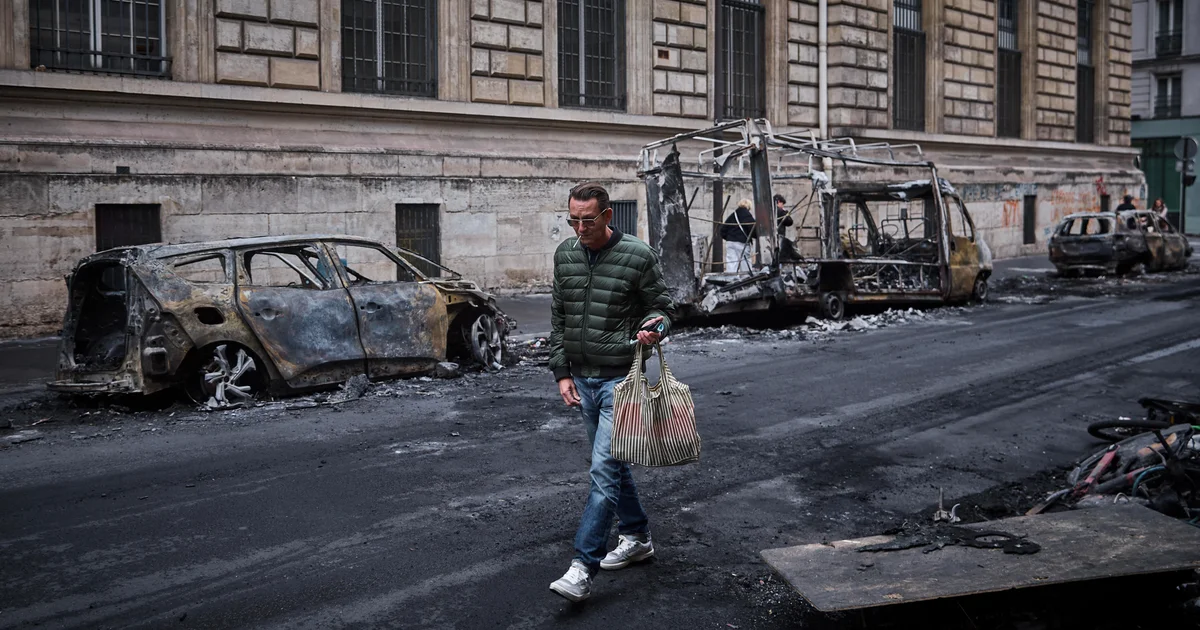
France has imposed local curfews and restricted public gatherings after nationwide protests over the cost of living and deteriorating public services descended into violence, leaving historic buildings damaged and more than 2,500 people arrested.
Paris police banned gatherings after 8pm and introduced a curfew from 11pm on Monday until 6am on Tuesday in the Place de la République and Les Halles areas. Similar restrictions were announced in Nice and Lyon, while large gatherings were prohibited in Marseille.
The unrest spread across the country over the weekend, with masked groups looting shops, setting fire to vehicles and buildings, and clashing with police. More than 500,000 people took part in demonstrations on Saturday, when the violence reached its peak.
In Limoges, a 19th-century town hall was destroyed by fire. Footage showed the clock tower of the historic building collapsing in flames after standing for nearly 150 years.
Buildings in other cities were also targeted. Vandals set fire to the tourist office in Lyon, while Marseille’s city hall, which dates back to the 1600s, was stormed and covered in graffiti.
Paris residents awoke to streets strewn with debris and burned-out vehicles. Hundreds of protesters later gathered outside the Louvre in support of the school students who had begun the demonstrations.
French government vows to restore order
President Emmanuel Macron said on Sunday that “those who sought to bring down the republic will be held accountable”.
Prime Minister Sébastien Lecornu said the government was prepared to introduce a nationwide state of emergency “if needed”. He called on regional authorities to impose “partial” and “localized” curfews to protect businesses ahead of a further demonstration planned for Saturday.
Mr Lecornu blamed at least some of the violence on “an ultra-left movement intent on orchestrating profound disorder in the country leading up to the presidential election” in April.
He said police “had lost control” during the unrest and claimed an “entire network” could be mobilised to challenge the election timetable and whether the presidential election would be held.
“There is no way we will allow violent minorities to impose an agenda of violence and, quite obviously, prevent us from holding this election,” he said.
Mr Lecornu acknowledged that high school students had legitimate grievances over classroom conditions, but said “the freedom to demonstrate is being undermined”.
Protests began over schools and living costs
The demonstrations began more than a month ago, when students took to the streets over crumbling school buildings, overcrowded classrooms and a shortage of teachers.
They later widened into a broader protest against rising living costs, stagnant salaries and declining public services. Some demonstrators said they were also angry at growing inequality and a lack of secure prospects.
Kamil Alahyan, 18, told AFP: “The politicians who lie, the ultra-rich who’ve been raking in more and more wealth over the last 10 years … everyone has a different reason.”
A 24-year-old student in Grenoble, identified as Anae, said she had completed her studies but had no income or secure future. “Our planet is burning. And we’ve got a government that’s making a joke out of us!” she said.
