


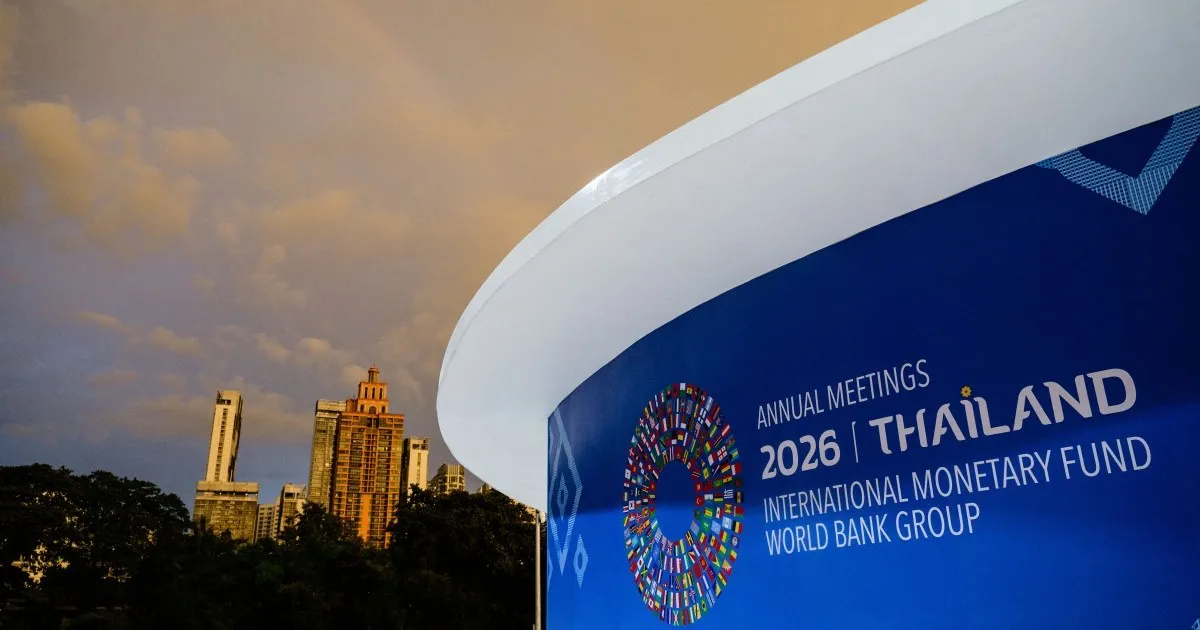
G20 finance ministers and central bank governors are meeting in Bangkok as the economic consequences of the US-Israel war on Iran intensify, with rising energy prices, inflation and disrupted shipping weighing on the global outlook.
The talks in the Thai capital are being held alongside the annual meetings of the International Monetary Fund (IMF) and the World Bank, which run from October 12 to 18.
Attacks across the Middle East have disrupted economic activity, while interruptions to shipping through the Strait of Hormuz have pushed up energy prices worldwide. Crude oil has remained above 100 US dollars a barrel for much of the past eight months, increasing pressure on government finances and household budgets, particularly in the Gulf and across Asia.
Australia’s Treasurer Jim Chalmers said he would use the discussions to call for an end to the conflicts in the Middle East and the reopening of the Strait of Hormuz.
“The war in the Middle East is having a devastating economic impact and is pushing up fuel prices, inflation and interest rates around the world,” Mr Chalmers said.
G20 finance ministers weigh war fallout and rising debt
Rising government debt is also expected to feature prominently, with debt levels exceeding 100 per cent of gross domestic product in the United States, Canada, Japan, Italy and France.
IMF managing director Kristalina Georgieva warned on Wednesday that mounting debt posed a threat to the global economy. She said there was no “magic” formula that would allow governments to avoid tax rises or spending cuts.
Most G20 finance ministers and central bank governors are expected to attend, alongside Ms Georgieva and World Bank Group president Ajay Banga.
US Treasury Secretary Scott Bessent will be absent, despite the United States holding the G20 presidency. US officials cited “domestic engagements” for his decision to skip the meetings. Washington will instead be represented by deputy secretary Francis Brooke and undersecretary for international affairs Erin Browne.
The Bangkok meeting is one of several gatherings of G20 finance ministers held during the year and will help set the agenda for the group’s leaders’ summit in Miami, Florida, on December 14 and 15.
The G20 brings together 19 major economies, including the US, China, the UK, Australia, Brazil, India, Japan, Indonesia and Saudi Arabia, as well as the European Union and the African Union. Its members account for about 85 per cent of global GDP and three-quarters of global trade.
Trade tensions are likely to complicate efforts to reach agreement. The US has repeatedly raised concerns about global imbalances, particularly China’s state-driven industrial model, which it says has enabled exporters to sell cheap goods in overseas markets.
Mr Bessent called on the IMF to strengthen its analysis of the role played by non-market policies, practices and exchange rates in creating external imbalances.
“Policymakers around the world are having difficult discussions about how to sustain market-based systems amid distortionary policies from some economies that skew competition and hurt employment,” he said in a statement to the IMF.
Prospects for a coordinated response remain uncertain. At the previous G20 finance ministers’ meeting in Asheville, North Carolina, in August and September, members failed to issue a joint communique after China objected to wording on trade.
