


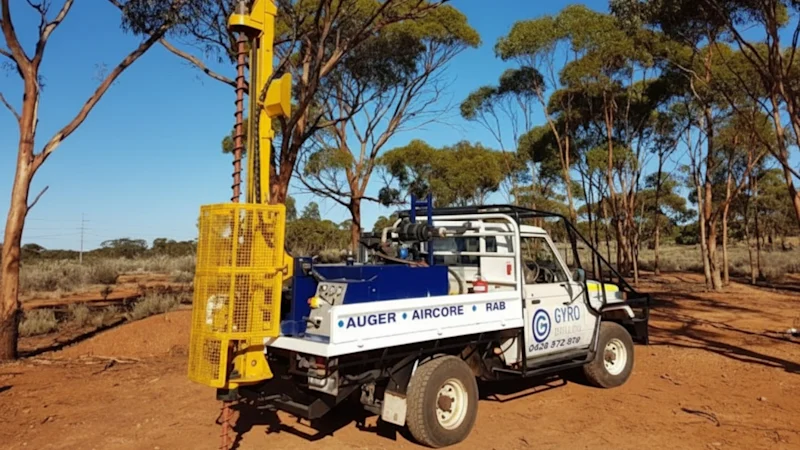
Golden Dragon Mining has identified a 2.2-kilometre gold-in-soil anomaly at its Stella Range project near Laverton in Western Australia, creating an untested target for deeper drilling.
The northwest-trending anomaly was outlined through recent auger drilling and is supported by copper and tellurium, which the company describes as key pathfinder elements.
Stella Range lies 120 kilometres south-east of the Laverton goldfield and 12 kilometres along strike from Brightstar Resources’ Lord Byron deposit. Lord Byron hosts 5.39 million tonnes grading 1.5 grams of gold per tonne, equivalent to 267,000 ounces.
Golden Dragon said the main anomaly sits within a magnetic low resembling the geological setting at Lord Byron. It is also interpreted to lie along the same northwest-trending magnetic corridor, raising the possibility of a similar gold-bearing system beneath the surface.
The area had previously been explored by companies including BHP for large komatiite-style nickel sulphide deposits. Golden Dragon revisited the historical work with a focus on its potential for gold.
Simon Buswell-Smith, the company’s managing director, said: “These results are an exciting development for the Company and highlight the significant exploration potential of our Stella Range gold project. The identification of a coherent gold anomaly extending over 2.2 kilometres of strike, supported by associated copper and tellurium pathfinder elements, provides us with a compelling target for further exploration.”
The anomaly has not yet been tested by drilling. Golden Dragon plans to carry out infill and extensional auger sampling before finalising targets for a maiden drilling campaign.
The company is also awaiting results from a 2,833-metre reverse-circulation drilling programme at its Behring Bore and Coodardy prospects within the Cue gold project in the Murchison province.
Earlier drilling at Cue produced a four-metre intersection grading 17.6 grams of gold per tonne and another four-metre intersection grading 21.37 grams per tonne.
