


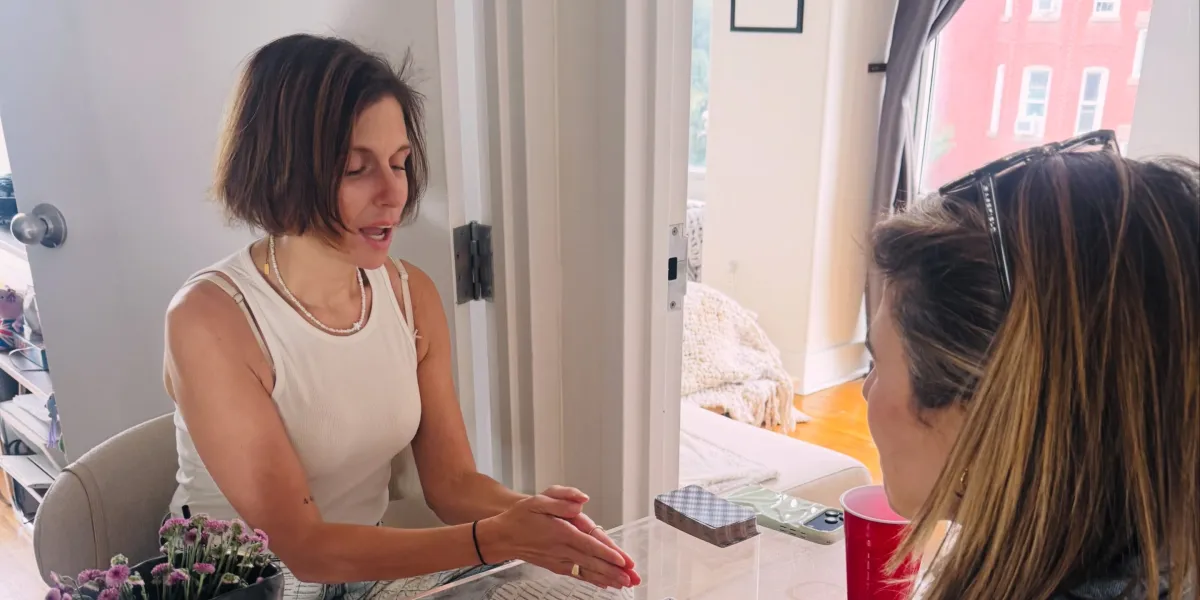
A new marketplace for tarot readings, spell work and other spiritual services is tapping into growing demand from younger consumers seeking personalised guidance about relationships, careers, money and the future.
Divina was launched on 1 September by Brooke Bekoff, a former growth product manager at TaskRabbit and Robinhood. The platform allows practitioners to set their own prices, with Divina taking 10 per cent of each booking.
Bekoff said the idea came to her at a wedding this summer, when a bride hired an Etsy witch to cast a spell for clear skies as torrential rain threatened the ceremony.
The rain continued while the bride prepared, but the clouds parted as the bridal party went outside. Sunlight replaced the downpour and the ceremony remained dry before the rain returned afterwards.
Bekoff recalled that five or six of the approximately eight bridesmaids had also recently paid Etsy witches for services of their own. The group included Gen Z consumers and millennials living in different parts of the US.
“I remember that being like, ‘Wait a minute, this is such an interesting opportunity,’” Bekoff said. “There’s really something here culturally.”
Why people pay for tarot and astrology
Free horoscopes, tarot videos and astrology explainers are widely available online. But consumers are paying for practitioners to interpret those ideas in relation to their own circumstances.
Kaidong Yu, a marketing researcher at City University of Macau, said the value of a paid service was often interpretation rather than information.
“There is already an enormous amount of free mystical content online, so scarcity of information is probably not the main source of value,” he said. Instead, customers want to know: “What does this mean for me, in my situation, right now?”
Yu said a reading could provide the feeling of being heard, validate an intuition or turn an uncertain situation into a manageable set of possibilities. Customers did not necessarily have to believe that the practice would change events.
“The practice does not have to eliminate uncertainty,” he said. “It can simply make uncertainty more psychologically manageable.”
The US psychic-services industry generated $2.3 billion in revenue in 2025, according to an IBISWorld report. It grew by an annualised 5.5 per cent over the five years to 2025, while nearly half of women aged 18 to 49 consulted astrology or a horoscope at least once a year.
Divina marketplace attracts more than 100 practitioners
Bekoff initially expected to spend the first month recruiting practitioners. Instead, Divina grew organically from two or three providers to more than 100, with more than 200 listings.
The platform has recorded over $1,000 in bookings and is receiving a handful of orders each day, Bekoff said. Services include written tarot readings, photographs of card spreads and “womb readings” for expectant parents.
Some practitioners have sought an alternative to Etsy, whose policy prohibits spellcasting and services promising outcomes such as love, wealth or employment. Tarot and psychic readings are permitted when the customer receives something tangible, such as written results or a recording.
Sellers have said Etsy recently removed shops that had operated openly for years and built up thousands of reviews. Etsy did not respond to a request for comment.
Divina requires practitioners to undergo identity verification, and Bekoff said she reviews every application. Customers have 72 hours after receiving a service to report a problem before payment is released.
Customers must also acknowledge that they are paying for the service itself, rather than a guaranteed outcome. A person seeking clear skies or a dream job is not promised that the result will happen.
Gen Z builds its own spiritual mix
The interest in paid psychic services forms part of a broader mix of practices among young adults. Harris Poll data found that half of Gen Z respondents practised manifestation or used vision boards, while three in 10 practised astrology or tarot.
Some 57 per cent said they had turned to spirituality to feel greater control over their futures. Libby Rodney, chief strategy officer at The Harris Poll, described the combination as “the Faith Stack”.
“Church AND manifestation AND tarot,” she wrote. “Not as contradiction. As construction.”
The same data found that 33 per cent of Gen Z identified as religious, compared with 18 per cent of baby boomers, 22 per cent of Gen X and 19 per cent of millennials.
Yu cautioned that reassurance could become harmful if it replaced a person’s own ability to make decisions. But he said symbolic action could give someone who felt powerless a place to begin.
For Bekoff, the wedding that inspired Divina remains an example of why customers may be willing to pay, regardless of whether the spell changed the weather.
“Who knows if it was the Etsy witch? Who knows what it was?” she said. “I guess that’s what faith is.”
