


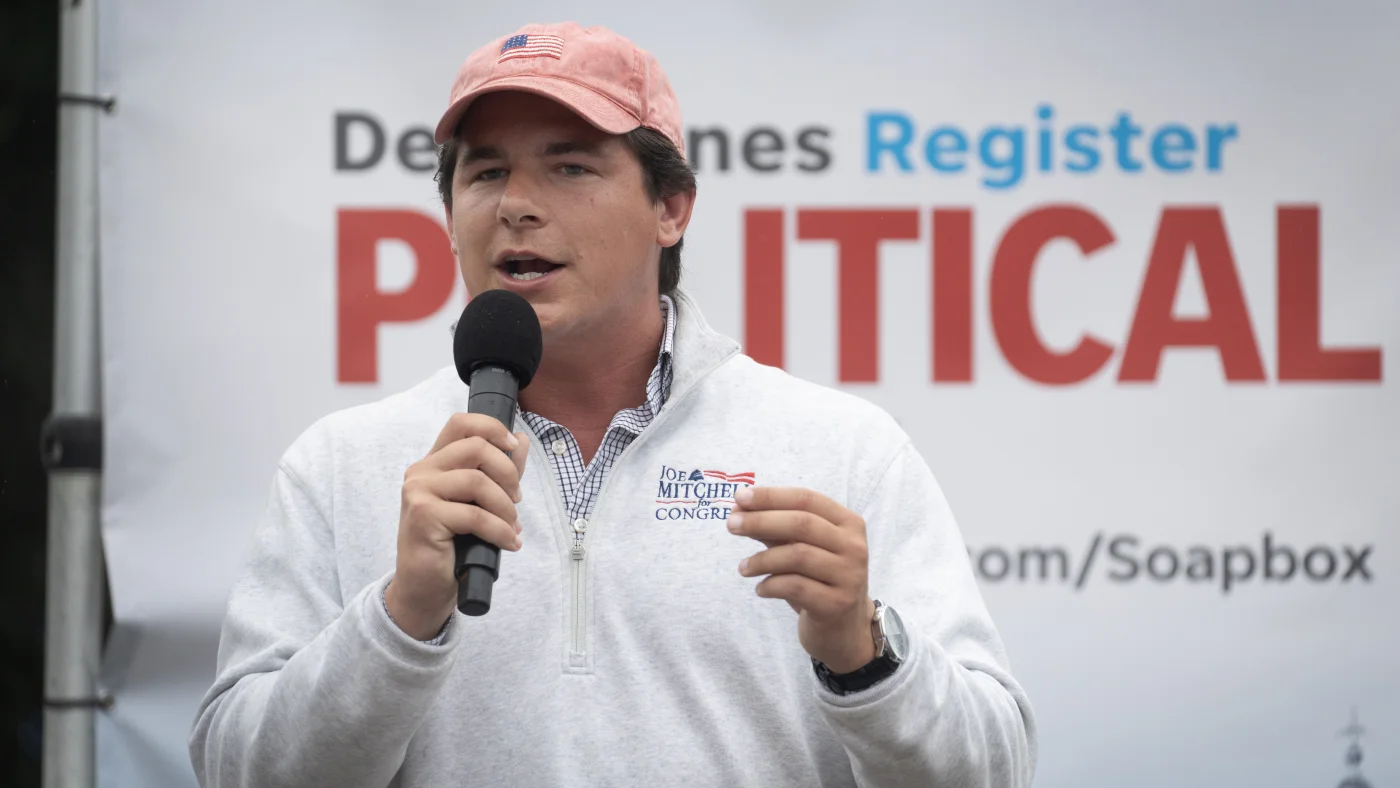
Gen Z Republicans are seeking a foothold in Congress, with 29-year-old Joe Mitchell at the centre of one of the few competitive House races likely to determine whether the party gains its first members from the generation.
Mitchell, the Republican nominee in Iowa’s second congressional district, has been endorsed by President Trump and is campaigning on an anti-corruption platform that includes term limits and a ban on congressional stock trading. He has also rejected donations from corporate political action committees.
The race in north-east Iowa is regarded as a toss-up, as voters turn against Mr Trump and Democrats see a growing possibility of taking control of Congress. If he wins, Mitchell would become part of what could be the first class of Gen Z Republicans in the House.
“I think people are looking for hope, regardless of what party they’re in,” Mitchell said. “They want to see young people get involved, and I hear that everywhere we go.”
His proposals include limiting House members to six terms. Mitchell argues that younger voters are particularly frustrated by institutions and their economic prospects.
“I just think that young people — on both sides of the aisle or no party affiliates — are frustrated with the system,” he said. “They’re frustrated and they should be.”
Young Republicans remain rare in House races
Only a small number of Gen Z Republicans are running for the House this election. Mitchell is the main candidate in a competitive contest, while one is seeking a reliably Republican seat and others are challenging Democrats in districts considered safe for the party.
At present, the House has just one Gen Z member: 29-year-old Florida Democrat Maxwell Frost. Two more candidates are expected to win on Tuesday, including Democratic socialist Melat Kiros in Colorado’s reliably Democratic first district and Republican Michael Alfonso in Wisconsin’s heavily Republican seventh district.
Alfonso, 26, has been endorsed by Mr Trump and is married to the daughter of Transportation Secretary Sean Duffy, who represented the district from 2011 to 2019. If elected, Alfonso would be the first person born in the 2000s to serve in Congress.
He has described his age as his “greatest advantage”, while saying his values are shared by voters in the district: “Hard work, faith and family.”
Young candidates remain unusual across American politics. Gen Z, whose oldest members turn 30 next year, has only recently become eligible for the House, where the minimum age is 25. Just 4% of congressional candidates in this election cycle belonged to the generation, and it was the least likely of any generation to progress beyond the primary, according to Future Caucus.
Most Gen Z candidates ran as Democrats, while fewer than a third stood as Republicans. A further 16% were unaffiliated or chose a third party.
Republican organisers seek a new generation of candidates
Conservative groups say they are trying to develop a stronger pipeline of young candidates at local, state and federal level. Run Gen Z, an organisation that supports young conservatives seeking office, announced endorsements for more than 220 Gen Z and millennial candidates in late October.
Adam Pennings, the organisation’s executive director, said young people needed a place in government but should not be expected to immediately dominate it.
“We need to be building up young people who are ready to lead in the future when some of these more, you know, long-term serving people retire,” he said.
Among those backed by the group is 28-year-old Riley Owen, a Republican running in Utah’s newly redrawn first district, which heavily favours Democrats. He acknowledged the difficulty of the contest but said voters wanted “new faces, fresh ideas, and a grassroots campaign”.
The candidates are also using their campaigns to argue over the future direction of the Republican Party. Mitchell describes that future as an “America First party”, focused on whether policies benefit ordinary Americans.
That message has become contested within the conservative movement, particularly over the US war with Iran. Mitchell has said Iran must not obtain a nuclear weapon, while adding that he does not support “endless wars”.
Asked whether Mr Trump’s agenda matched his understanding of America First, Mitchell said it did, but added: “Like any definition, people can have a number of ways to interpret it.”
