


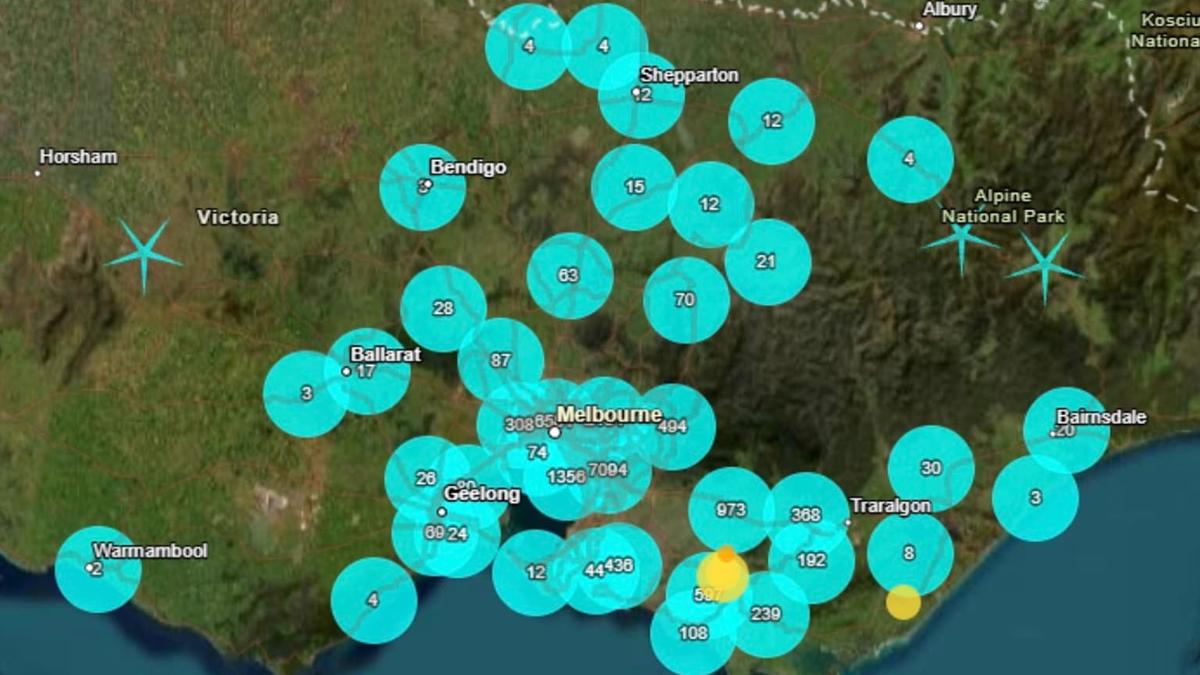
Victoria’s Gippsland region has experienced nine earthquakes in nine days, prompting more than 21,000 reports from people who felt the ground shaking across Victoria, New South Wales and the Australian Capital Territory.
The sequence began with a magnitude 4.9 earthquake near Leongatha, south-east of Melbourne, at about 2am last Saturday. Geoscience identified six aftershocks following the main tremor, with the latest measuring 1.6 at about 2.49pm on Thursday.
Seismologist Michelle Salmon said aftershocks could continue for months, although they were expected to become smaller over time.
“We don’t know when or where we are going to get a large event,” she said.
Ms Salmon said Gippsland was not Australia’s most seismically active region, but its proximity to Melbourne meant tremors were noticed by more people.
Experts warn earthquakes can strike without warning
Geoscience senior seismologist Hadi Ghasemi said moderate to large earthquakes could happen anywhere across Australia without warning.
“On average, Australia experiences an earthquake of this size two or three times a year,” he said. “It is important to note that it is not possible to predict precisely when or how large these earthquakes may be, or when the sequence will diminish to a point where they are no longer detectable.”
Dr Ghasemi said Australia was not close to a tectonic plate boundary. Earthquakes on the continent were caused by stress transferred into the continental crust as the Australian plate moved and collided with the Pacific and Eurasian plates.
The National Seismic Hazard Assessment identifies Gippsland as an area with a higher likelihood of earthquakes, although Dr Ghasemi said tremors could occur elsewhere. He also named south-western Western Australia and the area around Darwin in the Northern Territory as regions with a higher likelihood of earthquake activity.
Ms Salmon urged people to use the Great Shakeout next Thursday as a reminder to practise earthquake safety. “It’s always good to remember that you need to drop, cover, and hold on,” she said.
She said Australia had recorded a magnitude 6.7 earthquake, which produced 100 times more shaking than the magnitude 4.9 tremor near Leongatha. Each increase of one magnitude represents 10 times more shaking, she added.
Geoscience is asking people to lodge felt reports after earthquakes to help establish how strongly tremors were experienced in different locations.
