


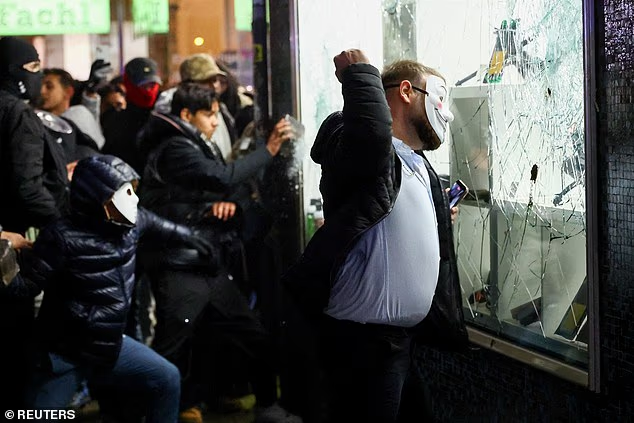
Violent protests across Europe on Halloween saw police attacked with petrol bombs, fireworks and bottles, while shops were targeted amid demonstrations over education funding, living costs, public services and military conscription.
Berlin was the latest capital to experience clashes, as more than 3,500 demonstrators took to the streets. Some wore Halloween costumes, while flares, fireworks and glass bottles were thrown towards riot police.
At least 56 people were arrested in the German capital after protesters occupied tram lines, blocked roads and continued marching into the evening. Police used pepper spray and threatened to deploy water cannon, with 27 officers reported injured.
Clashes during Berlin demonstrations
An afternoon gathering near the Brandenburg Gate was largely peaceful, but disorder broke out during a separate evening march involving several groups, including large numbers of pro-Palestinian demonstrators.
The protest was held under the slogan ‘Gen-Z has had enough!’. Placards read ‘Time for resistance’ and ‘Merz must go’, referring to Chancellor Friedrich Merz. Chants included ‘free Palestine’ and calls for ‘anti-fascism’, amid concern over the rise of the far-Right Alternative for Germany party.
Police said by 7.30pm that anyone refusing to leave would face water cannon and arrest. Protesters responded with chants including ‘shame on you’ and abuse directed at officers.
The Gen-Z Regelt! group, which had called demonstrations in 34 German cities, said around 120,000 people took part nationwide. It said the main protests were intended to be peaceful and explicitly rejected violence, stating: ‘Extremist groups, anti-constitutional symbols, racism and hate speech have no place with us – no matter from which side.’
Further clashes were reported in several German cities. Police used water cannon in Frankfurt after officers were pelted with stones and firecrackers, and one officer was injured. One person was arrested and two weapons were seized after the windows of a gun shop were smashed.
Police in Cologne reportedly arrested about 50 people, while water cannon were also used in Hamburg and pepper spray was deployed in Leipzig. An officer in Bonn suffered minor injuries, and a march in Bremen descended into disorder after pyrotechnics were set off and officers were insulted.
Andreas Rosskopf, an official from the police union, said officers had intervened ‘very decisively and also forcefully’ when violence broke out. He added that property damage had largely been avoided by the evening.
France sees attacks on police and attempted looting
In Paris, a police officer was engulfed in flames after being struck by a Molotov cocktail. France’s interior minister, Laurent Nuñez, described the attack as ‘attempted murder’ and warned that officers were prepared for further confrontation.
Nuñez said about 150 demonstrations had passed peacefully, but police had faced an ‘extraordinary’ level of violence from some rioters.
French police arrested five people accused of trying to loot a Foot Locker shop in Marseille. Officers from the Bouches-du-Rhône prefecture said the suspects had been caught attempting to enter the store’s storerooms.
In Marseille, protesters erected barricades in side streets and clashed with police. The unrest followed demonstrations that began with high-school students demanding the equivalent of about £9 billion for education, before widening to include trade unions and Black Bloc anarchists.
More than 320,000 protesters are said to have joined marches across France in recent weeks. The demonstrations have focused on education funding but have expanded into a broader movement.
Albania protests demand prime minister’s resignation
In Albania, student anger over high living costs and underfunded education merged with demands for Prime Minister Edi Rama to resign. Demonstrations in the capital, Tirana, became increasingly violent, with paving stones, flares and petrol bombs thrown at police.
Footage from the city showed police taking cover as protesters hurled petrol bombs. The unrest formed part of a wider movement over education funding and living costs, with repeated demonstrations descending into violence.
The protests have also spread to countries including Italy, Portugal and Poland, although the grievances have varied between locations.
