


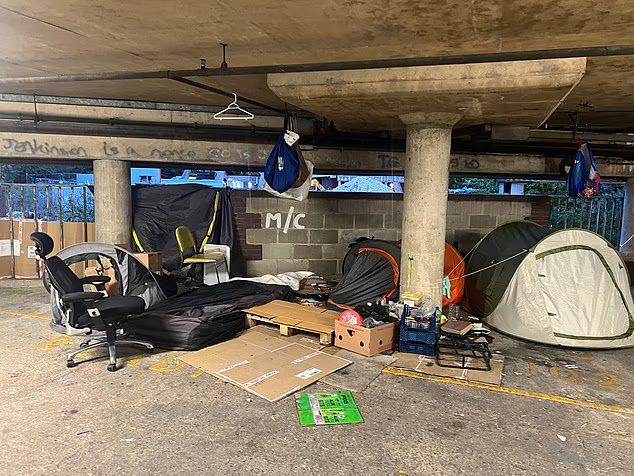
At least a dozen homeless men have made tents and makeshift shelters among the concrete pillars of Reading’s Civic B Car Park, where shoppers and court users are being forced to share the space with rough sleepers and people using drugs.
The men are living across two floors of the dilapidated brutalist building, directly beneath Reading Magistrates’ Court. Tents, blankets, clothing and personal belongings have been placed on urine-soaked floors, while waste and discarded underwear are lying close to parked cars.
A visit to the council-run car park found men sleeping on both the upper and ground levels. Some were seen injecting heroin in secluded corners, while rats were seen scurrying across the floor upstairs.
The encampment has grown despite posters put up by Reading Borough Council warning that the car park is “not suitable” for living in. The facility has 170 spaces and is used by hundreds of shoppers, barristers and other court visitors each day.
One-hour parking recently increased from £2.10 to £4.30, while motorists have raised concerns about security, lighting and the apparent lack of visible CCTV.
Residents describe violence and addiction
Richard Okine, 33, who came to Britain from Ghana six years ago, has lived at the car park for almost three years after losing his savings in a romance scam.
He said he slept beneath a blanket rather than inside a tent because he feared being attacked while asleep.
“Living here is very tough,” Mr Okine said. “One of the biggest problems I’ve faced is having the blankets we sleep on taken away.”
He added: “I don’t use a tent. I just sleep with a blanket because I don’t feel safe inside a tent. Someone could come inside and do anything to you, and nobody outside would know what was happening.”
Mr Okine said there had been violent incidents at the site, including one in which a man’s ear was almost cut off. He also said people smoked heroin and crack cocaine and sometimes became involved in arguments and fights.
He said he had been permitted to remain in the UK on a family visa and had previously worked at Sainsbury’s in Newbury and as a cleaner. He said his pre-settled status meant he understood that he was not eligible for housing or public funds until he obtained indefinite status.
“I can work, and I’ve worked before,” he said. “But when you’re homeless, you’re dirty. Sometimes you can’t even take a shower. I haven’t had a shower for about eight months.”
Mr Okine said he became addicted to drugs after discovering that a woman he had met on Facebook in Ghana had been living with another man. He said he had sent her money, rented and furnished a home for her and paid for her education.
“After the relationship, I started taking drugs,” he said. “I began with weed, then moved on to crack and heroin. Now I’m an addict, although I’m on medication.”
He said people in similar circumstances needed support, including work that they could begin despite struggling with addiction.
“So many people are stuck in situations like mine, and they need a way out,” he said.
Another resident, James Johnson, 41, said he had moved to Reading from west London after getting into trouble. He described the conditions as “horrible” but said the car park made it easy to obtain drugs.
Mr Johnson said he would move if there were somewhere better to go, but claimed rough sleepers were only offered a few weeks of shelter around Christmas.
Drivers raise concerns over car park security
Motorists have also complained about the condition of Civic B and alleged incidents of vandalism and attempted break-ins.
Danny Chilvers said someone tried to break into his Audi with a concrete block while it was parked at the site. He shared an image showing deep scratches on the vehicle and said police had been contacted.
“Be a bit cautious parking here,” he said, adding that he intended to ask whether the council could be held liable if it knew about a persistent problem and failed to take measures.
Other drivers have described smashed glass from apparent break-ins, poor lighting and a lack of visible CCTV. Some said they used Riverside car park instead because it felt safer, despite being more expensive.
A local resident blamed the “tent people living by the entrance” for the situation, although the claims about responsibility for damage have not been established.
The use of car parks as makeshift camps has also been reported in Nottingham and Gloucester. Their central locations and shelter from the weather are understood to make them attractive to people sleeping rough.
Government figures cited in the material show that 4,793 people were estimated to have slept rough in England on a single night last autumn, a 171 per cent increase since 2010. Separate figures put the number who slept rough at some point during June at 8,748.
In Reading, the council recorded 43 rough sleepers during its latest annual count in November 2025, compared with 42 the previous year.
Reading council says support is available
A Reading Borough Council spokesman said its outreach team, commissioned from St Mungo’s, regularly visited the car park to check on people’s welfare and direct them towards accommodation and support.
The council said it also provided a Rough Sleeping Initiatives Team, winter shelters operated by the charity FAITH between January and March, and seven supported accommodation projects offering more than 270 bed spaces for single people and couples sleeping rough or at risk of doing so.
Emergency accommodation is activated under the council’s Severe Weather Emergency Protocol when temperatures reach zero degrees or below for three consecutive nights, the spokesman said. That support is available to anyone sleeping rough, regardless of local connection or access to public funds.
However, the council said accommodation and support were not always accepted by people sleeping rough. It said it continued to engage with those at the site and aimed to help them move into safe, stable accommodation.
“We do not advocate a dedicated area for people rough sleeping in tents due to the associated safety risks and the adverse effect of normalising rough sleeping,” the spokesman said.
