


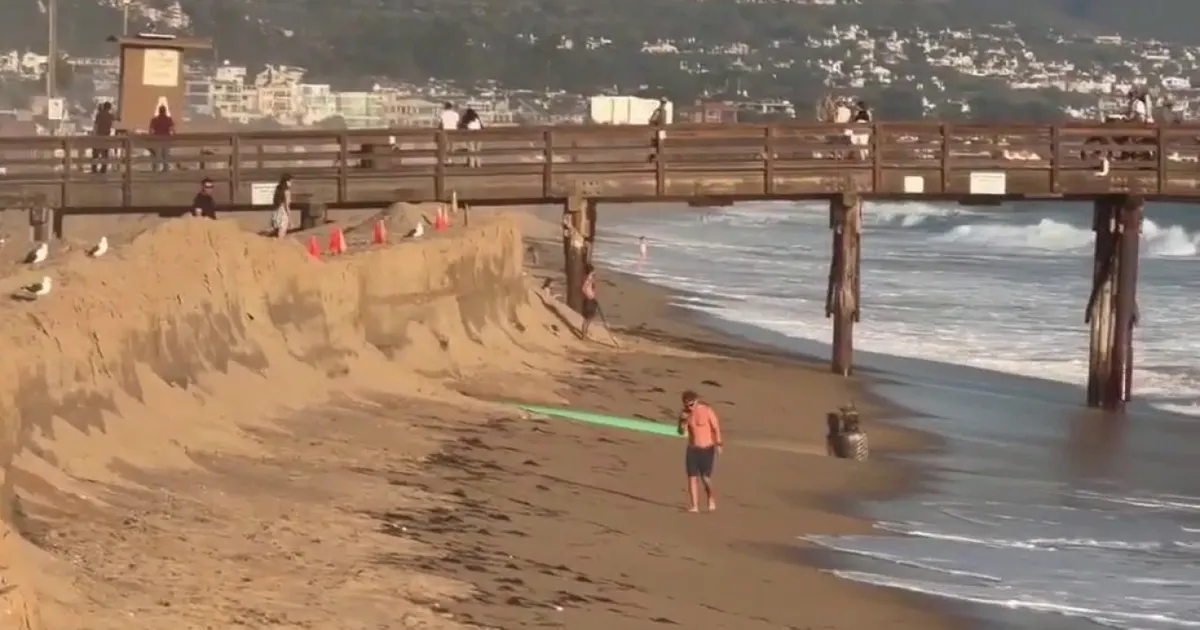
Hurricane Marie’s swell dramatically reshaped the coastline at Newport Beach, California, stripping away huge quantities of sand and exposing debris believed to have been buried for decades.
At the Wedge, a renowned surfing spot at the end of the Balboa Peninsula, the retreating beach revealed rocks, wires, asphalt, a pipe and sections of an old pier. Some areas were cordoned off amid concerns that more sand could collapse.
“That’s crazy. I’ve been coming here my whole life. I didn’t even know that was there,” Dominique, a surfer at the Wedge, said.
The damage followed an exceptionally powerful southerly swell generated by Hurricane Marie in August 2014. The National Weather Service recorded surf of 15 to 18ft along parts of the Orange County coast, while sets at the Wedge reached between 25ft and 30ft.
Marie did not make landfall in Southern California, but its distant storm system sent large waves crashing into the coast. The swell caused flooding, damaged coastal infrastructure and removed substantial amounts of sand from beaches across the region.
Near Balboa Pier, the erosion left a sharply cut sandbank several feet high, creating a difficult and potentially hazardous route to the water. Some beachgoers managed to climb down the steep face, while others were unable to reach the shoreline at all.
“I can’t. Not at my age. I can’t go down that cliff and try to get back up again,” Joanne, a local resident, said when asked whether she could make the descent.
Joanne, who has lived in the area since 1957, said she had witnessed beach erosion before but could not recall anything on the same scale.
“We have erosion often. This is the most we’ve had for a long time,” she said.
The extreme conditions also placed pressure on Newport Beach’s lifeguards. More than 170 rescues were carried out in the area during the height of the swell, including 73 at the Wedge, as surfers, swimmers and spectators were caught in powerful waves and strong currents.
“To have so much sand and now none, it’s Mother Nature letting you know who she is,” Michael Manfredi, a skimboarder near Balboa Pier, said.
The newly exposed material was described by a visiting reporter as a “time capsule” beneath the beach. In places, the exposed wall of sand was estimated to be between 8ft and 10ft high.
“Pretty remarkable to see this up close,” Matthew Seedorff said. “All this erosion is uncovering, essentially, a time capsule of things below.”
The storm-driven changes were not confined to Newport Beach. Southern California beaches experienced coastal flooding and severe erosion, while exposed infrastructure and debris became visible in areas that had previously been covered by sand.
Newport Beach officials were asked what action would be taken to restore the shoreline and whether replacement sand would be brought in. No plan had been announced at the time, leaving residents uncertain about how long the altered beach would remain in place.
“Now you’ve got boulders and rocks out there. I don’t even know what they’ll do to fix it,” one resident near the Wedge said.
