


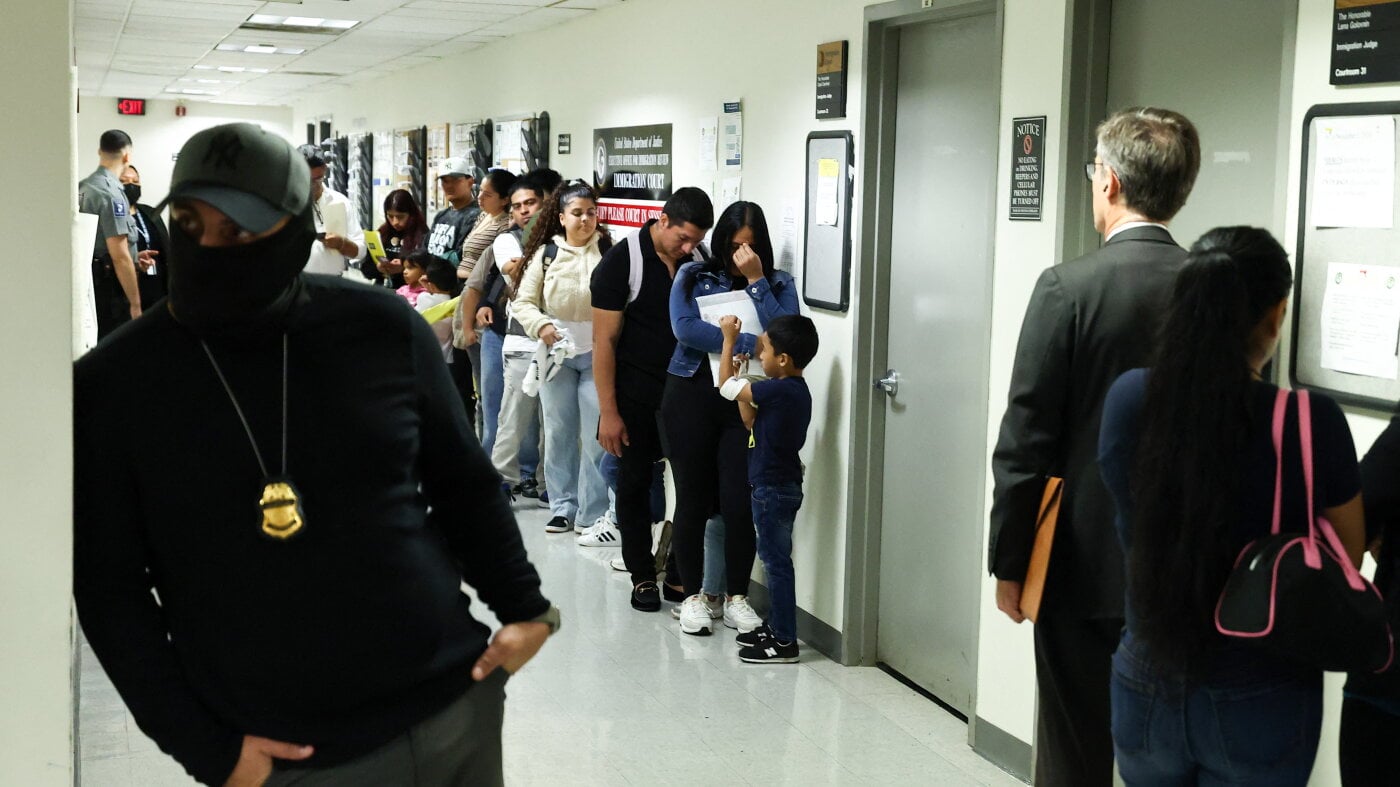
Immigrants in the United States are being ordered to attend hearings at previously undisclosed locations, sometimes with only days’ notice and in at least two cases with no notice at all, lawyers say.
The hearings have been moved from established immigration courts in Hyattsville and Baltimore, Maryland, and Sterling, Virginia, to buildings in Washington DC and Falls Church, Virginia, which were not previously operating as regular public immigration courtrooms.
Immigration attorneys who have reviewed hearing notices or attended proceedings say the changes are creating a serious risk that people will miss their hearings and face deportation orders in their absence.
The moves appear to form part of a wider effort by the Trump administration to accelerate immigration proceedings and removals while limiting the time available for migrants to prepare their cases.
Kel White, an officer of the Washington DC chapter of the American Immigration Lawyers Association, attended a hearing at the Falls Church site on Wednesday, September 2. She said the immigrant appeared in person while the judge and the government prosecutor took part remotely.
White described the arrangement as “the most unusual thing I’ve ever seen” in more than 15 years of legal practice. She said people should receive at least 10 days’ notice of a change to a hearing, citing Justice Department guidance.
“My concern about these hidden tribunals is that essentially people are not getting notice of them or that the mail would not arrive in time for them to even know that they need to go to court,” she said.
Hearings moved to unfamiliar buildings
The Falls Church hearings are taking place inside a government building on Leesburg Pike that houses the headquarters of the Executive Office for Immigration Review and the Board of Immigration Appeals. Lawyers said the site had previously been used for some remote proceedings and occasional appellate arguments, but not as a regular venue for in-person immigration hearings.
One lawyer said the waiting area contained two conference rooms, with the judge and a Department of Homeland Security attorney appearing on screens. Several people were ordered removed after failing to attend their scheduled hearings, according to White.
The other location, Federal Center Plaza at 400 C Street SW in Washington DC, is not listed as an immigration court or an EOIR facility. The building is associated with the Federal Emergency Management Agency and was due to host hearings from September 9.
The General Services Administration, which manages federal buildings, did not respond to questions about the Justice Department’s use of the space.
The Executive Office for Immigration Review said it was continuing to add immigration judges and would make scheduling changes, including opening new hearing locations when necessary, “to ensure all cases are handled in a timely and lawful manner”. It did not explain why people were being sent to the two buildings or clarify whether they were newly established immigration courts.
Officials have been seeking additional space for the immigration court system, with a request for lease proposals understood to have identified 18 possible sites capable of accommodating at least 10 courtrooms. No formal public announcement has been made about the creation of the Washington DC or Falls Church venues.
Migrants warned of deportation orders
The changes have particularly affected people without lawyers, who make up the majority of immigrants trying to challenge their removal from the United States.
One person whose case was moved from Sterling to Falls Church said they never received a letter about the change. They discovered the new date through MigraConnect, an app used by some migrants to monitor their cases.
“Thank God I had that application because without it they would have put me on a path to deportation, because I never got a notice in the mail,” the person said. “I was nervous, and scared; I have never missed a court date but I didn’t know what would happen in that building.”
Another Maryland resident was due to appear at Hyattsville in October but was moved to Falls Church on September 2. Her lawyer, Lucelia Justiniano, said the client had not received a mailed notice and only learned of the change after contacting the court.
When the woman arrived, the judge who had been due to hear the case was appearing remotely from Hyattsville. No explanation was given for why the hearing had not taken place at the original court.
James Reyes, an immigration lawyer, said one of his clients received eight days’ notice after their case was repeatedly rescheduled to Falls Church. The hearing was later moved back to Sterling shortly before the scheduled appearance, leaving the case without a new date.
Missing a hearing can have severe consequences. An immigration judge may issue an in-absentia removal order, allowing authorities to detain and deport someone who failed to appear, even if the absence resulted from confusion or inadequate notice.
The location changes come as the administration pursues other measures to clear an immigration court backlog estimated at about 3.5 million cases. Lawyers have raised concerns about large “mega master calendar” hearings, in which more than 100 people may be listed to appear on the same day.
Data cited by the legal technology group Mobile Pathways shows that the proportion of removal orders issued in absentia to people without lawyers in Baltimore rose from 54 per cent in January to 73 per cent in June.
Justiniano said the sudden venue changes were another obstacle placed in the way of migrants trying to defend themselves.
“It’s just stockpiling things against respondents,” she said. “And this just shows one more example of it.”
