


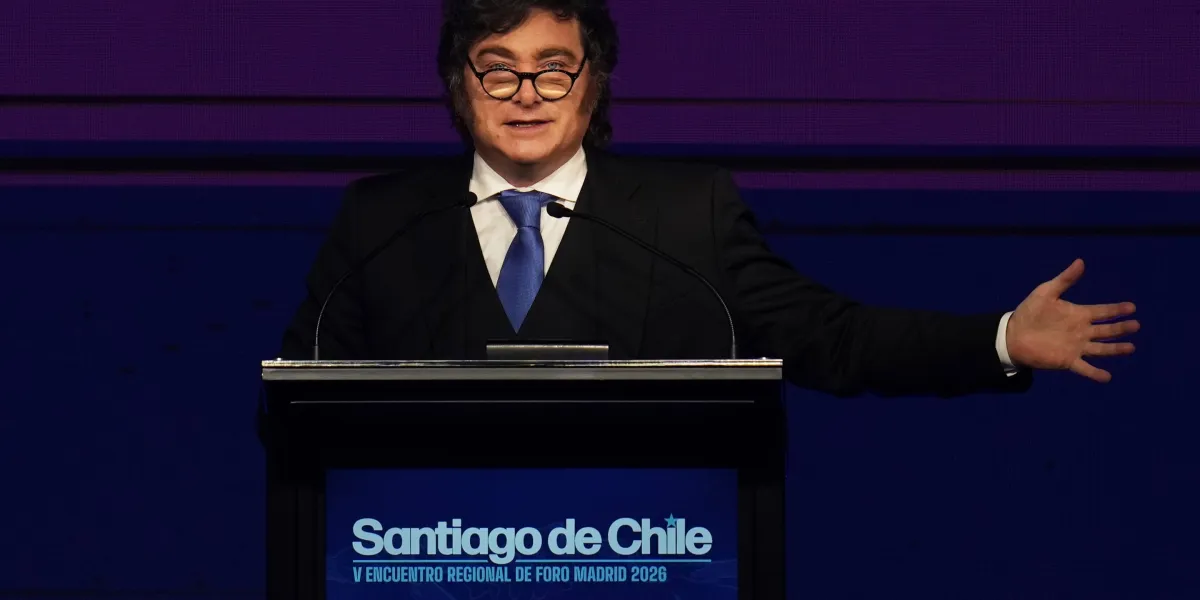
Argentina’s President Javier Milei has threatened fresh sanctions against companies developing an oilfield near the Falkland Islands, while welcoming Donald Trump’s suggestion that the United States could reconsider its long-standing position on the disputed territory.
In a nationally televised address, Mr Milei said Argentina would not accept further activity around the islands, which Buenos Aires calls the Malvinas. He also announced extra funding for a naval base in Tierra del Fuego, in the country’s far south, and plans to strengthen communications infrastructure in the region.
“Argentina will not stand idly by,” Mr Milei said. “Any further advance on the Malvinas Islands will be considered a violation of our national security.”
The measures are aimed at the Sea Lion oil project, about 220 kilometres north of the Falklands. British company Rockhopper Exploration and Israel’s Navitas Petroleum are developing the field, with drilling expected to begin during the current phase of construction and first oil planned for 2028.
Navitas has said the project has secured a final investment decision and will initially involve 11 subsea wells connected to a floating production, storage and offloading vessel. The company expects the first phase to reach peak output of about 50,000 barrels a day.
Argentina regards the development as an illegal exploitation of natural resources in waters it claims as its own. Mr Milei said his government would accelerate penalties against companies involved in offshore oil projects, potentially extending them to suppliers, shareholders and directors.
Companies linked to the developments could also be prevented from operating or signing contracts in Argentina under proposed legislation.
Trump comments raise concern in Britain
Mr Milei presented Mr Trump’s comments as evidence that his close relationship with the US president was producing results, despite criticism from opponents who accuse the Argentine leader of being too deferential towards Washington.
“The United States is considering this change in position because it knows that Argentina has a reliable partner, aligned with Western values, in a strategically important position that can be a valuable ally in the decades to come,” Mr Milei said.
For decades, successive US administrations have maintained neutrality over the competing sovereignty claims, while recognising Britain’s de facto administration of the islands. Mr Trump caused concern in Britain earlier this week when he was asked whether Washington was reviewing its position.
“I always review every position,” he replied. “That’s just one of many.”
In an interview broadcast by GB News, Mr Trump was also asked whether the United States would come to Britain’s aid if another conflict broke out over the Falklands. He did not give a direct answer, instead criticising Britain’s contribution to a US-led bombing campaign against Iran.
“Your country was not there to help me,” Mr Trump said, referring to Keir Starmer, the former prime minister. “It was pretty sad, the whole thing.”
The comments prompted the British Government to reiterate its position. Defence Secretary Wes Streeting said the UK’s commitment to the Falkland Islands was “unshakeable”.
“Milei’s statement overnight tells us more about domestic politics in Argentina than it does about the Falkland Islands,” he wrote on X.
Britain maintains that sovereignty rests with the UK and that the islanders’ right to self-determination is paramount. In a 2013 referendum, residents voted overwhelmingly to remain a British Overseas Territory.
Falklands dispute returns to centre of Argentine politics
Mr Milei’s harder line marks a shift for a president who has faced criticism at home for improving relations with Britain and expressing admiration for Margaret Thatcher, who led the British campaign to retake the islands during the 1982 Falklands War.
The conflict left 649 Argentine troops, 255 British service personnel and three islanders dead. More than four decades later, the sovereignty claim remains embedded in Argentina’s constitution and is widely regarded as a central part of national identity.
With Mr Milei seeking re-election next year amid falling approval ratings and economic difficulties, the Falklands issue offers a cause capable of uniting voters across Argentina’s political divisions.
“We can argue about my style. We can disagree over fiscal or exchange-rate policy,” he said. “But there are causes that rise above any political difference. The Malvinas is one of them.”
Nicolás del Caño, a left-wing opposition lawmaker, accused the president of using the sovereignty dispute to regain political support while helping advance US interests in its disagreements with Britain.
Mr Milei warned that oil production could encourage Britain to deepen its presence around the islands and argued that Argentina needed stronger military capabilities to pursue its claim.
“A poor country without armed forces can hardly make effective progress on its sovereignty claims,” he said.
