


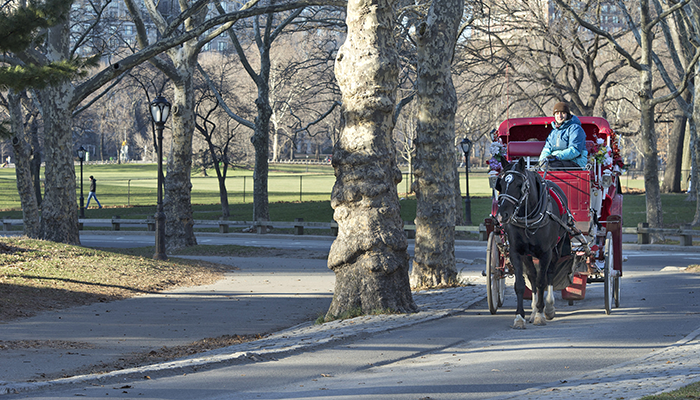
New York City’s horse carriage industry is to be abolished after the City Council voted by 40 votes to seven, with two abstentions, to phase out the tourist attraction by June 2028.
The decision ends decades of political wrangling over the carriages operating around Central Park, but allows about 200 drivers to continue working during the transition period.
Council Speaker Julie Menin made the legislation a priority over the summer, saying the death in June of Romanch Mahajan, an 18-year-old tourist from India, had been “the last straw”. She also pointed to a long history of horses dying on New York’s streets.
“This has been a long time coming,” Ms Menin told reporters before the vote.
Mayor Zohran Mamdani initially withheld his support over concerns about the livelihoods of carriage drivers, but backed the measure earlier this month after changes were made to provide routes into other employment. He has not yet announced when he will sign the bill.
Drivers promised help during horse carriage phase-out
Under the legislation, New York City must establish a workforce transition programme offering drivers career advice and referrals to jobs in the public and private sectors. Potential employers include the Metropolitan Transportation Authority, as well as businesses in hospitality and tourism.
The bill also prevents drivers from sending their horses to slaughter or using them for carriage work in another city where the practice remains legal.
Opposition to the ban remains strong among drivers and their supporters. The Transport Workers Union, which represents carriage drivers, said it would launch a legal challenge, arguing that the legislation breached federal and state law.
The union has particularly objected to the absence of guaranteed compensation for carriage licences, known as medallions, which can be worth hundreds of thousands of dollars. Its lawyers argue that taking away the licences without payment conflicts with the Fifth Amendment’s protection against private property being taken without compensation.
Christina Hansen, who has driven carriages for more than a decade, said she felt “disrespected” by the lack of a compensation guarantee.
“There are people who are owed money on medallions, who have planned families, had children, bought houses, taken out loans,” she said. “What’s going to happen to them?”
Danielle Slot, another driver and a former Mamdani voter, said she felt betrayed by the mayor’s decision to support the bill without mandatory reimbursement.
“You say you’re going after billionaires, but you’re really going after the underdogs,” she said. “These guys are hardworking, every single medallion is its own independent business, and many are immigrant owned. I expected better from Mamdani than to be a puppet.”
Ms Menin said the wording requiring the city to “consider” compensation had been agreed with the mayoral administration. A spokesperson for Mr Mamdani said the administration was “in discussions” about payments to medallion owners.
Long-running dispute over Central Park carriages
President Donald Trump also criticised the vote, saying the industry was ending after more than a century because of one tragic accident. He argued that cars were not barred from Central Park after crashes and described the carriages as “a Great Tradition”.
Dozens of drivers and union representatives protested outside City Hall before the vote. One demonstrator carried a plastic bag of horse manure labelled: “This is horse sh*t.”
Supporters of the ban held their own rally in City Hall Park, joined by members of Mr Mahajan’s family. His uncle, Gaurav Mahajan, said the horses did not belong on “congested asphalt” and should instead be allowed to live in “peaceful, green pastures”.
Attempts to outlaw the industry have been made by successive mayors and council speakers since at least 2007. Previous efforts failed amid political pressure from the Transport Workers Union and arguments from industry supporters that safety standards could be improved without imposing a ban.
Council member Jim Gennaro opposed the legislation and said an alternative proposal would have introduced tighter safety rules. He also accused Ms Menin of being influenced by NYCLASS, an animal rights group that has campaigned for the industry to be ended.
Mr Gennaro tried to amend the bill to extend the phase-out deadline to 2030, but the proposal was rejected.
