


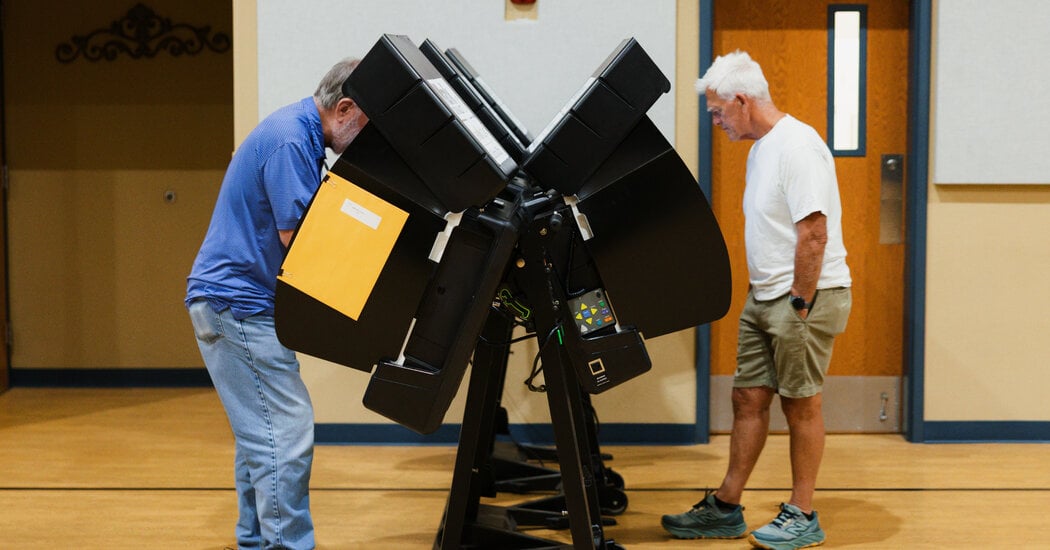
Homeland Security Secretary Markwayne Mullin has asked the US Justice Department to investigate whether ballot-marking devices provide a trustworthy paper record of votes, in the latest move by the Trump administration to question electronic voting systems.
In a letter sent on Wednesday, September 2, to Attorney General Todd Blanche, Mr Mullin also urged an inquiry into the Electronic Registration Information Center (ERIC), a multistate system used to help detect duplicate registrations and identify people who have died.
Mr Mullin asked the Justice Department to establish whether machines that record votes through bar codes or QR codes produce a “reliable record for a manual audit” and comply with federal law.
The request comes less than two months before the November midterm elections and could fuel claims that votes cast or counted electronically should not be accepted. No evidence has been presented that ballot-marking devices have been manipulated to alter the result of a US election.
Questions over ballot-marking devices
Ballot-marking devices allow voters to make selections on a touch-screen computer before printing a paper ballot. The document normally displays the choices in written form alongside a bar code or QR code, which is then read by a separate counting machine.
Critics say the electronic code could theoretically be changed without being detected by a voter. Election security specialists, however, say there are no known examples of such an attack changing the outcome of an election.
The machines are subject to testing and certification by federal and state authorities, local election offices and private laboratories. They are widely used in states including Georgia and South Carolina, both of which were won by Donald Trump.
The White House has placed Mr Mullin’s letter within a wider election-integrity initiative. The administration has released documents alleging vulnerabilities in voting infrastructure and has argued that foreign-made components and digitally connected systems could create security risks.
President Trump has repeatedly attacked electronic voting, falsely claiming that voting machines were used to rig the 2020 presidential election against him. In a prime-time address two months ago, he described the systems as vulnerable and easily compromised.
Mr Trump has also cited declassified intelligence concerning Smartmatic, a voting technology company with links to Venezuela. But one CIA assessment said that although the Venezuelan government had some ability to manipulate electronic voting systems, neither it nor Smartmatic could alter an election result outside Venezuela.
ERIC investigation also requested
Mr Mullin’s letter separately raises concerns about ERIC, which allows participating states to compare voter information and identify people who may be registered in more than one state.
The system was once regarded as a bipartisan administrative initiative. It has since become a target for election conspiracy theorists, who have alleged without substantiation that it was influenced by liberal organisations and used to promote voter-registration drives.
Nine Republican-led states withdrew from ERIC after pressure from conservative activists in the aftermath of the 2020 election. Nearly 30 states continue to use it, and election officials regard it as an important tool for identifying duplicate registrations and deceased voters.
Mr Mullin suggested that ERIC-related data, including information from state motor vehicle departments, may have been shared with the Center for Election Innovation and Research, a non-profit organisation led by David Becker. The White House said the material could include sensitive details such as Social Security numbers and driving licence numbers.
Mr Mullin asked the Justice Department to consider whether the sharing of such information breached federal privacy laws. The allegation has not been established.
Mr Becker said the claim appeared to concern research carried out more than five years ago and rejected the suggestion that his organisation had received motor vehicle or voter data on an ongoing basis. He said the centre had not been contacted by Homeland Security for information or clarification before the letter was issued.
The letter indicated that the matters had originally been referred to the Justice Department during the tenure of Mr Mullin’s predecessor, Kristi Noem, who was removed from office in March. Mr Mullin’s appeal to Mr Blanche appears intended to press the department to act before the midterm vote.
