


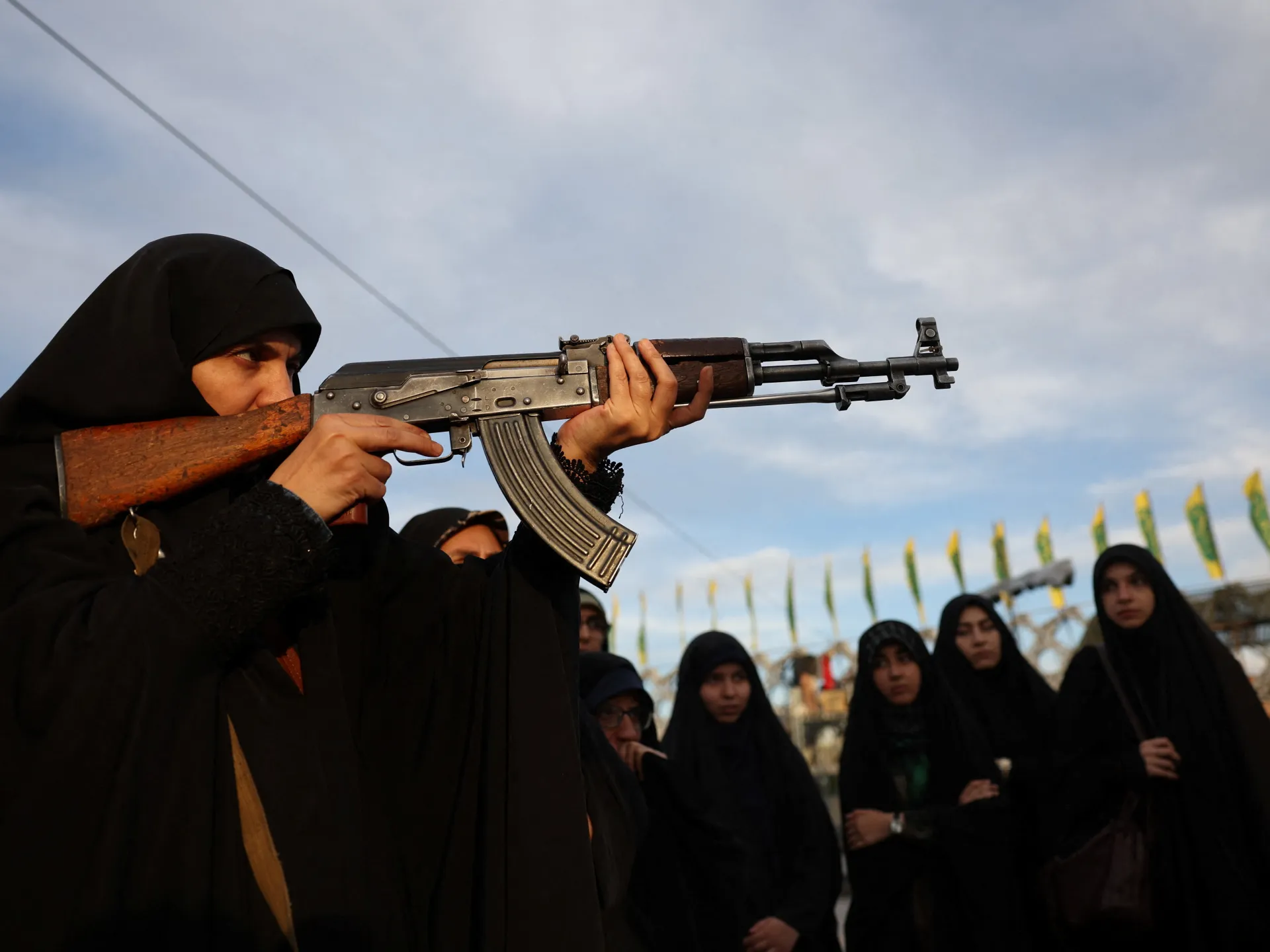
Iranian authorities are expanding a nationwide campaign to arm and train civilians for the state security apparatus, amid fears that fighting with the United States and Israel could resume.
The initiative, known as Janfada – meaning “those who sacrifice their life” – began in late March at the height of the war. It is now operating across much of Iran, recruiting volunteers of all ages while placing particular emphasis on young people.
Representatives of the Basij militia, part of the Islamic Revolutionary Guard Corps (IRGC), and other state bodies have established booths and training stations in towns and cities. Volunteers are being shown how to use weapons and other equipment to defend the government and its “revolutionary” values.
Events connected to the campaign have been held in Tehran, Isfahan, Zanjan, Shiraz, Kerman, Mashhad, Bojnord and Ahvaz, among other locations across Iran’s 31 provinces.
Ali Kowsari, the Basij’s deputy for training, said this month that the IRGC wanted at least 14 main squares in Tehran to serve as Janfada training and equipment stations. He said the aim was also to use between one and three squares in the capital city of every province.
The campaign has included daytime rallies and motorcades followed by state-organised events at night. A resident of northern Gilan province said stations were regularly visible in larger and smaller towns during people’s daily commutes.
“Sometimes they hold competitions to win some small prizes. They bring in live bullets, teach people how to load them into magazines, how to arm pistols and assault rifles, and how to aim and fire,” the resident said, speaking anonymously for security reasons.
“The organisers are mostly old men. Since the start of the war, they’ve gathered around the main square almost every night, also often playing revolutionary tunes and chanting from loudspeakers.”
In the Gilan city of Rasht, residents objected on October 15 to noise and the closure of a street during a pro-government gathering. Videos circulated on social media appeared to show a confrontation developing into a brawl, although authorities did not comment.
Residents in Karaj, near Tehran, were warned on Saturday to expect explosions and loud noises during one of the Janfada exercises.
Janfada campaign deepens Iran’s ‘siege mentality’
The mobilisation has also reached Kurdistan province in north-western Iran, which borders Iraq. An IRGC-linked news agency described a procession in the provincial capital, Sanandaj, as an exercise in unity between Shia and Sunni Muslims.
Foreign-based Iranian human rights groups, however, have described the armed mobilisation efforts as intimidation campaigns. They come months after nationwide protests in January, during which thousands of civilians, including many young people, were killed by gunshots and stab wounds, according to the groups.
The government has acknowledged protests in more than 400 counties across all provinces, but has characterised them as a coup attempt orchestrated entirely by the US and Israel. It has also rejected the findings of an independent United Nations fact-finding mission that said authorities committed crimes against humanity during the crackdown.
Mehran Kamrava, a professor of government at Georgetown University in Qatar, said the war had created an opportunity for Iran’s more revolutionary elements.
“Revolutions are like riding a bicycle. To avoid a nasty fall, you must pedal hard. And this is precisely what the Janfadas and their leaders are trying to do – to remain relevant,” he said.
He added that Janfada training allowed figures within the Iranian leadership to stage displays of political and ideological loyalty to the revolution and its principles.
The government says 33 million people have registered on the campaign’s website, but has provided no evidence for the figure. That would represent more than a third of Iran’s population, or more than half of those aged over 12.
Foreign-based activists who accessed the website’s source code earlier this year said it showed fewer than four million registrations. Registration required only a telephone number and not a national identification number.
Nematollah Bagheri, the IRGC commander for Lorestan province, said the campaign was intended to demonstrate public support for the Islamic Republic.
“The aim is to show that, just as the government supports the people, the people support the Islamic Republic and the Islamic revolution,” he said.
Organisers say volunteers could later assist with rescue operations, social services, media work and financial support. They have also asked participants to reduce their consumption of fuel, electricity and other resources to ease pressure from the US war, naval blockade and sanctions.
Schools are increasingly involved, with Education Minister Alireza Kazemi saying the Basij was registering “student Janfadas” and planning further mobilisation and ceremonies involving children.
Professor Kamrava said the campaign might not expand the state’s legitimacy across wider society, but could strengthen support among those already aligned with the government and reinforce the revolutionary leadership’s sense of being under siege.
