


Israel has retaliated against Britain’s sanctions on West Bank settlements by ordering the closure of the UK consulate in East Jerusalem, removing British personnel from a Gaza ceasefire coordination centre and banning 12 British politicians and activists from entering the country.
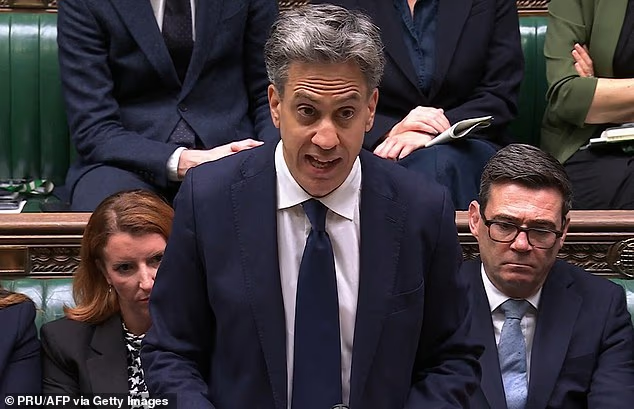
Israeli Foreign Minister Gideon Sa’ar said the measures were taken after Foreign Secretary Ed Miliband announced a ban on goods produced in Israeli settlements and wider restrictions on companies providing services linked to settlement expansion.
Mr Sa’ar accused the Labour Government of acting systematically against Israel and branded Mr Miliband’s parliamentary statement “outrageous lies”. He said he had consulted Prime Minister Benjamin Netanyahu before announcing the response.
“Unfortunately, a hostile Labour Government is in office, systematically acting against the State of Israel and it has left us with no choice but to finally respond to its hostile actions,” he said.
The British military will no longer work alongside American and Israeli forces at the joint centre overseeing ceasefire and peacebuilding operations in Gaza. Israel has also ended British training for Palestinian Authority security forces in the West Bank.
The East Jerusalem consulate is one of Britain’s principal diplomatic missions dealing with the Palestinians. Its closure leaves the UK embassy in Tel Aviv as its main diplomatic base in Israel.
British politicians barred from Israel
The 12 people barred from entering Israel include former Labour leader Jeremy Corbyn, Your Party co-founder Zarah Sultana, Diane Abbott, John McDonnell, Naz Shah and Richard Burgon.
The list also includes Green MPs Hannah Spencer, Carla Denyer, Sian Berry, Ellie Chowns and Adrian Ramsay, as well as Fahad Ansari, director of the campaign group Riverway to the Sea.
Israel said those targeted were involved in “antisemitic and anti-Israel activity”, or denied the existence of the State of Israel. The Foreign Ministry did not set out individual allegations against each person.
Ms Sultana said the ban would not intimidate her, while Mr Ansari described it as a “badge of honour”.
Mr Sa’ar said Britain’s policy amounted to interference in Israel’s affairs and electoral process, with parliamentary elections due later this year. He also accused the UK of adopting a “morally distorted” position.
Israeli opposition leader Yair Lapid said the British measures were a serious mistake which could strengthen extremist voices in Israel and encourage Hamas and other terrorist organisations.
“It is a wrong and dangerous policy, at the wrong time and for the wrong reasons,” he said.
UK sanctions target settlement activity
Britain’s measures were announced in coordination with France and Canada, with the three countries saying settlement expansion and settler violence posed an urgent threat to the prospect of a two-state solution.
Denmark, Finland, Iceland, Poland, Portugal and Sweden have also indicated that they support trade restrictions, while Ireland, Spain, the Netherlands, Norway and Belgium have already taken steps or are preparing similar action.
Mr Miliband told MPs that the UK would ban imports from illegal Israeli settlements and take action against companies and individuals involved in construction, infrastructure, financing, real estate and advertising connected to settlement expansion.
The new British sanctions regime is expected to come into force within six to nine months. The Foreign Secretary said it would target settlements and settlement activity, rather than Israel as a whole, and that normal trade with Israel within the Green Line would continue.
He also announced that Britain regarded Israel’s occupation of the West Bank as unlawful, arguing that the position should be reflected in the country’s economic relationship with the occupied territories.
In a joint statement, British Prime Minister Andy Burnham, French President Emmanuel Macron and Canadian Prime Minister Mark Carney said they remained committed to Israel’s security but insisted that it must exist alongside a “safe and secure Palestine”.
The three leaders are due to co-chair a meeting at the United Nations General Assembly later this month, as relations between Britain and Israel face their most serious crisis in decades.
