


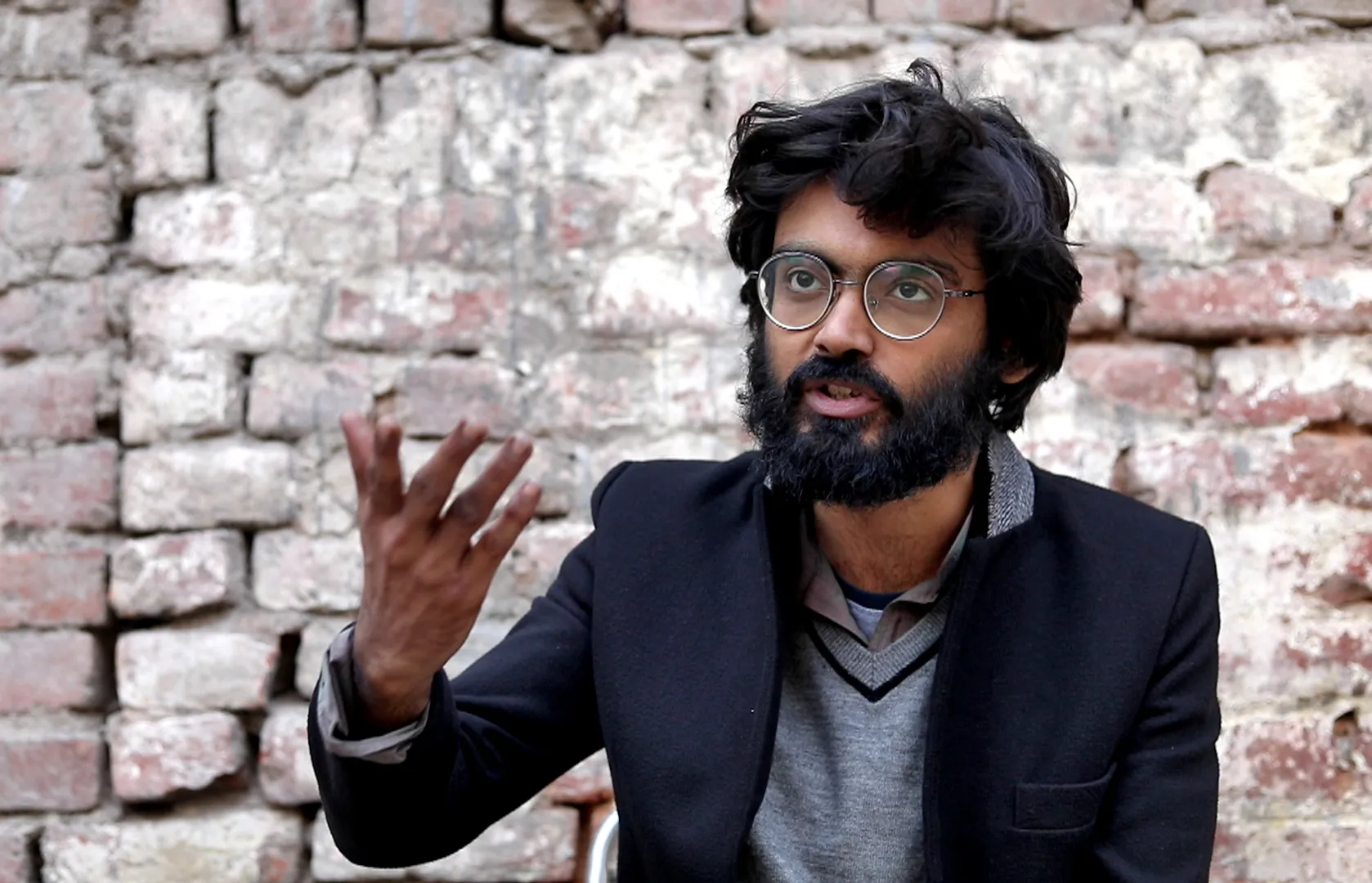
A prison interview with Muslim scholar Sharjeel Imam has fuelled a polarising debate over whether India’s democracy has failed its Muslim minority, amid claims that the community has been denied political representation and that dissenting voices are being suppressed.
Imam, 38, spoke to the Indian news website The Quint from his cell in New Delhi on September 29. His remarks questioned the country’s constitutional settlement, its model of secularism and the treatment of Muslims, who make up roughly 14 per cent of India’s population.
“There are around 210 million Muslims in India – one of the biggest Muslim groups in the world, with practically zero say in this democracy,” he said.
Imam argued that the Indian constitution had an “enshrined centralisation” of power and described the country’s secularism as “particularly Islamophobic and parochial”. He said democracy had become a means of denying Muslims political rights and representation.
Why Sharjeel Imam is in prison
Imam, from Jahanabad district in Bihar, studied computer science at the Indian Institute of Technology Bombay and worked as a software engineer before returning to academia. He later became a doctoral student researching the political history of India’s Muslims at Jawaharlal Nehru University.
He emerged as one of the leading organisers of protests against the Citizenship Amendment Act, passed by Narendra Modi’s Hindu nationalist government in 2019. The law created an expedited route to Indian citizenship for non-Muslim refugees from neighbouring countries, and the United Nations described it as “fundamentally discriminatory” against Muslims.
The legislation prompted nationwide demonstrations, including a weeks-long sit-in at Shaheen Bagh in south-east New Delhi that was led largely by Muslim women. Imam was arrested in January 2020 and accused of inciting violence through speeches made during the protests.
He was already in custody when violence broke out the following month in north-east Delhi, where anti-citizenship law demonstrations in Muslim neighbourhoods were attacked by mobs. The source material says the attacks followed hate speech by leaders from the governing Bharatiya Janata Party.
Despite his arrest predating the violence, Imam was charged with rioting, murder, attempted murder, sedition and promoting enmity on religious grounds under several laws, including a stringent anti-terror statute.
Nearly a dozen Muslim students and activists were also arrested and accused of conspiring in the 2020 Delhi riots. They include fellow JNU scholar Umar Khalid. They remain in prison without trial and have repeatedly been denied bail, according to rights groups, which have described the continued detention as a “gross abuse of power”.
Imam’s supporters say the cases demonstrate a wider pattern in which Muslims are treated as guilty before being proved innocent. His critics dispute his political conclusions and accuse him of advancing an Islamist agenda.
Dispute over India’s secular tradition
In the interview, Imam attacked both the Hindu nationalist right and India’s pro-secular liberals. He called Mahatma Gandhi a “fascist”, arguing that Gandhi helped make the Congress party “essentially Hindu” and endorsed ideas now associated with the BJP and its ideological parent, the Rashtriya Swayamsevak Sangh.
Imam also accused India’s first prime minister, Jawaharlal Nehru, of “falsehood and mythmaking” for presenting the country as an ancient and uniquely tolerant civilisation.
He said the country’s secular and Hindu nationalist traditions shared “the myth of uniformity, centralisation and denial of sharing of power”. Hindutva is the movement promoted by the RSS and BJP to transform constitutionally secular India into an ethnic Hindu state.
Legal scholar Mohd Zeeshan Ahmad said Imam had raised serious historical and ideological questions, but rejected his attempt to equate secularism with Hindutva. He warned that Imam’s language risked portraying Muslims as a single political bloc and overlooking differences of caste, class, gender, region and ideology.
“Where are the Pasmanda [less privileged castes] Muslims in this political imagination?” Ahmad wrote. “Where is the question of gender justice, including the rights of women within Muslim communities? Who gets to speak for the ‘Qaum’ [community], and whose experiences are rendered invisible when a singular political voice claims to represent it?”
However, Irfan Ahmad, a professor of anthropology and sociology at Ibn Khaldun University in Istanbul, said Imam was right to question the distinction between the Congress’s secular nationalism and the BJP’s Hindu nationalism.
He argued that Congress had contained figures linked to Hindu nationalist politics and said the difference between the major parties was not sufficient to address the political marginalisation of Muslims.
“If a democracy routinely makes a community, Muslims in this case, invisible in terms of representation in legislatures, then there is something fundamentally wrong with this democracy,” he said.
Calls for greater Muslim political power
Imam has called for a system of “constitutional republicanism” with more decentralised power and community rights. He supports proportional representation rather than India’s first-past-the-post electoral system, arguing that the existing arrangement leaves Muslims permanently marginalised.
He has also praised Pakistan’s founder, Muhammad Ali Jinnah, and the poet-philosopher Muhammad Iqbal. Citing Iqbal’s vision of a “Muslim India within India”, Imam has argued for a faith-based distribution of power while rejecting the idea that Muslims should be politically absorbed into a single national identity.
His position has drawn fierce criticism. A columnist writing under the name Ibn-e-Khaldun Bharati accused Imam of pursuing “an Islamist agenda” that sought the status of a nation within India. The columnist said a minority required constitutional guarantees, while a nation required its own state.
Political analyst Asim Ali said Imam’s prosecution raised serious questions, noting that he had been imprisoned for years over a speech advocating a “chakka jam”, or road blockade, which did not include a call for violence. Ali also questioned how Imam could be accused of conspiring to incite riots that occurred a month after his arrest.
Ali said Imam’s views on Gandhi, Jinnah and the history of partition were distorted, but argued that there was still room for him in a democratic movement seeking equality and liberty. He described Imam as attempting to develop a new intellectual leadership for middle-class Muslim activists.
Sharjeel Imam and Umar Khalid
The debate has also highlighted the contrasting treatment of Imam and Umar Khalid, who are both imprisoned in Delhi and accused of being masterminds behind the 2020 riots.
Khalid, 39, is a left-wing activist who has not rejected the constitution or India’s model of democracy and secularism as directly as Imam. He has also referred frequently to Gandhi and non-violent resistance.
Indian Marxists and liberals have portrayed Khalid as a “model Muslim” punished for opposing BJP hate politics. International figures and rights groups have called for his release, including New York mayor Zohran Mamdani, who questioned his imprisonment during a speech at the Nelson Mandela Global Leadership Forum.
Khalid was also named the 2026 recipient of the Award for Human Rights Defenders at Risk by Ireland-based organisation Front Line Defenders.
Imam has not attracted comparable international support, which has largely come from India’s Muslim community. Irfan Ahmad said the contrast exposed the limits of liberal solidarity when Muslim political arguments were expressed in explicitly Islamic language.
“The eloquence of liberals about Khalid and their silence about Imam is a sign of intellectual confusion, if not moral cowardice,” he said.
With Imam having spent nearly seven years in prison, the dispute over his interview has become part of a broader argument about the meaning of Indian secularism, the political future of Muslims and the treatment of dissent under Narendra Modi’s government.
