


Republican redistricting efforts intended to protect the party’s control of the US House appear to have backfired, as Democrats took control of the chamber and were on course to win the districts targeted by the GOP.
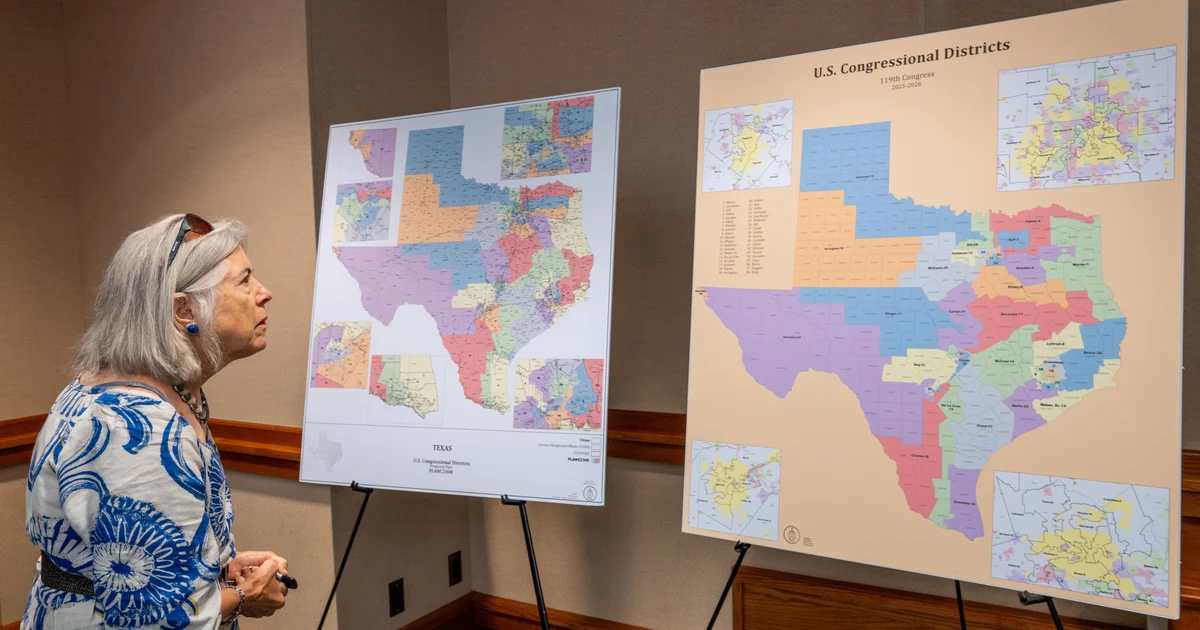
The campaign to redraw congressional boundaries during the decade was unusually extensive. It began after Donald Trump urged Texas lawmakers to redraw their map in the hope of gaining as many as five Republican seats.
Democrats were projected to finish with between 251 and 268 of the House’s 435 seats. The result has raised the prospect of a “dummymander” – an attempt to engineer electoral boundaries for political advantage that instead benefits the opposing party.
Texas and Ohio redistricting efforts backfire
Texas Republicans entered election day with 24 seats, compared with 13 held by Democrats and one vacant seat in a Republican-leaning district. Their new map sought to capitalise on Mr Trump’s gains in South Texas.
Republicans nevertheless won 24 seats, while Democrats won 14, leaving the party with no net gain and making Texas an example of a dummymander.
In Ohio, a mainly Republican commission redrew the map with the aim of securing two additional seats. Democratic representatives Marcy Kaptur and Greg Landsman were among those targeted.
Republicans had previously held 10 of Ohio’s seats and Democrats five. Seven Democrats, including Ms Kaptur and Mr Landsman, won on Tuesday, with another district considered likely to fall to the party. Republicans had won only seven seats.
North Carolina Republicans also used their veto-proof majority in the state legislature to approve a map aimed at removing Democratic representative Don Davis. Four Democrats had won by Wednesday, while five more races were regarded as likely to go to them.
No Republican had yet won a race under the new map. One was considered likely to be Republican and four remained too close to call, meaning the state would become another dummymander if Democrats prevailed in any of those contests.
Southern states face uncertain outcomes
Louisiana redrew its districts after a Supreme Court ruling in June said compliance with Section 2 of the Voting Rights Act could not justify the use of race in drawing its House boundaries. The new map sought to remove one of the majority-Black districts represented by Democrats.
Republicans had won three Louisiana seats and Democrats one. One race remained a toss-up and the state’s 5th District was heading for a runoff; a Democratic victory in either would leave the map having failed to deliver the intended Republican advantage.
In Alabama, Republicans had sought to eliminate two majority-Black districts, both represented by Democrats. Both incumbents were re-elected, leaving the party with the five seats it already controlled and no additional gain.
Tennessee lawmakers redrew their map to target the state’s sole Democratic district in Nashville. Republicans had held eight seats to the Democrats’ one, but had won six by Wednesday, with two races, including the newly drawn 9th District, set for runoffs.
If Democrats won one or both of those contests, Tennessee would also qualify as a dummymander.
Florida Republicans, led by Governor Ron DeSantis, had sought up to four additional seats through a new map. Instead, Republicans had won 16 districts, Democrats seven and five remained toss-ups, with any Democratic gain producing the same outcome.
Missouri’s proposed map was not used after legal challenges and repeated intervention by the Supreme Court. The state therefore voted under its previous boundaries, and Democrats gained a seat to hold three, compared with five for Republicans.
Trump-backed maps fail elsewhere
Mr Trump had pressed Indiana lawmakers to produce a map that would have removed the state’s two Democratic representatives and created an all-Republican delegation. The Republican-led state Senate rejected the proposal.
Under the existing boundaries, Democrats retained their two seats and captured a third, leaving Indiana with six Republicans and three Democrats.
South Carolina Republicans likewise sought to redraw the map to defeat Democratic representative Jim Clyburn and create a seven-seat Republican delegation. The proposal failed in the state Senate, and Mr Clyburn was re-elected. Two other contests remained toss-ups.
Democrats gain from countermeasures
California voters approved a measure put forward by Democratic Governor Gavin Newsom in response to the Texas redistricting drive. The new boundaries were designed to give Democrats five additional seats.
Democrats had won 42 of the state’s districts by Wednesday, with six more considered likely to go to them. Republicans had won two and were favoured in two others, making California a successful Democratic gerrymander.
In Utah, a court rejected a Republican-backed map and selected boundaries that created a Democratic-leaning district in Salt Lake City. Democrat Ben McAdams won the 1st District by 47 points.
Virginia voters had approved a measure intended to redraw the map in favour of Democrats in 10 districts and Republicans in one. The Virginia Supreme Court later rejected that map, restoring the boundaries drawn in 2021.
Using those boundaries, Democrats won seven seats and Republicans two, with two races still considered toss-ups. Before the election, the parties had held six and five seats respectively.
Maryland voters also approved Question 3, a measure removing constitutional requirements that congressional districts be compact and connected. The result is expected to allow Democratic lawmakers to redraw the map in an effort to unseat the state’s sole Republican representative.
