


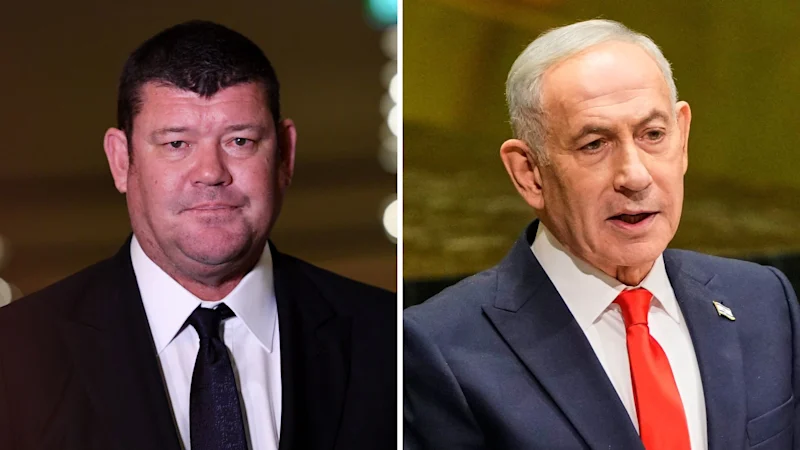
Australian billionaire James Packer has agreed to give evidence remotely in Benjamin Netanyahu’s corruption trial, but has refused to return to Israel to testify in person.
Packer, along with his former associates Ben Tilley and Guy Jalland, has said the three men would appear by audiovisual link if ordered to give evidence under oath. They have cited concerns about the conduct of Israeli authorities and the protection of their legal rights.
The decision follows a formal request from Netanyahu’s defence team for Packer to travel to Israel and testify. The defence believes evidence from the businessman and the two Australians could support its argument that the charges against the Israeli prime minister are flawed and baseless.
However, appearing as a witness would also leave Packer open to cross-examination by prosecutors in the long-running case, which centres on allegations that Netanyahu improperly accepted champagne and cigars from wealthy supporters, including Packer, between 2014 and 2016.
Packer has not been accused of wrongdoing. He and Netanyahu were once neighbours in the exclusive Israeli town of Caesarea and regularly visited each other’s homes before becoming estranged after the allegations emerged.
Payments to Netanyahu’s legal firm under scrutiny
The request for Packer’s evidence has raised further questions about payments made by one of his companies to the law firm defending Netanyahu.
At least US$1.25 million (£970,000) has been paid to Hadad Roth Shenhar, with monthly transfers of US$50,000 continuing for the past two years from a bank account controlled by Packer’s company.
Netanyahu’s principal defence lawyer, Amit Hadad, is the senior lawyer at the firm. Hadad has said the firm’s work for Packer and his companies is unrelated to the prime minister’s trial.
A source familiar with the payments has called for an urgent investigation into whether the arrangement amounts to an undisclosed benefit for Netanyahu. There is no confirmation that the prime minister has benefited from the money.
If the payments were found to have benefited Netanyahu directly or indirectly, they could raise fresh questions under Israeli laws governing financial support for politicians. Israeli authorities have repeatedly blocked the prime minister from receiving funds from wealthy supporters to pay for his defence.
Asked about the payments, Packer did not deny the monthly transfers but declined to comment. A source close to him said the money was for services provided to Packer, including “deal finding” in Israel, where he has business interests, and had nothing to do with Netanyahu’s legal case.
Hadad was questioned about the payments as he entered court in Israel but did not answer. In his written request for Packer to testify, he said his firm represented companies controlled by the businessman “on issues that have no connection to the ongoing trial”. He did not provide further details.
A spokesman for Netanyahu, asked about the allegations, said: “I couldn’t give a monkey’s about your questions.”
Packer’s relationship with Netanyahu came under investigation after the businessman gave the prime minister champagne and cigars. Australian Federal Police officers interviewed Packer on behalf of their Israeli counterparts in late 2017 and stressed that he was a witness rather than a suspect. He co-operated with the interview.
The two men are understood to have renewed their friendship around the time Netanyahu addressed the US Congress in July 2024, when Packer attended as a special guest. They later shared a Shabbat dinner.
The first payment from Packer to the prime minister’s law firm was made eight weeks after their relationship was rekindled.
Packer and former executives will give evidence remotely
Jalland, who previously served as chief executive of Consolidated Press Holdings and worked for both Packer and his late father Kerry Packer, wrote on behalf of the three men in a letter filed with the court.
He said they would not travel to Israel because they wanted to ensure that future proceedings were “handled in a way that assures that our rights will be fully protected, according to the laws of our respective places of residence”.
“Mr Packer was very fond of Israel,” Jalland wrote. “As is well known, he intended to spend a good part of his time there. Mr Packer is deeply disappointed by the treatment he has received from the Israeli authorities.
“He was shocked to learn that the Israeli investigators violated his privacy and took his private documents and private information without his knowledge or consent, with no due process procedure.”
Jalland said the three men were law-abiding citizens who would respect any order issued by a court in the country where they lived.
“If such an order were given requiring us to testify under oath and to answer questions put by counsel for both the defence and the prosecution, we would comply,” he wrote.
The location from which Packer might give evidence has not been disclosed. He is currently in Argentina, spends substantial periods in the United States and frequently visits Sydney.
The payments were made by Consolidated Press International, one of several private investment vehicles operated by Packer. His Australian-based company, Consolidated Press Holdings, is now run by Sydney businessman Lawrence Myers. Neither Myers nor the company responded to requests for comment.
