


Labour has been accused of creating a “massive new quango” while promising to streamline the state and shift power away from Whitehall.
Louise Haigh, the First Secretary of State, announced the creation of the OneGov Delivery Agency as part of plans to “rewire” government, alongside three new taskforces focused on the cost of living, essential services and community renewal.
But Alex Burghart, the Conservative deputy leader, said the new agency risked leaving ministers accountable for important services while stripping them of control over how they were run.
“It is unfortunate that the First Secretary of State has today announced the creation of a massive new quango in OneGov Delivery Agency,” he told MPs during a Commons statement on Wednesday.
The agency will operate at arm’s length within the Cabinet Office family and oversee functions including government recruitment, civil service pensions, shared services, the Government Car Service and security vetting.
Mr Burghart said it would also control significant amounts of public money, warning that ministers would “retain responsibility for those services, but they will lose power over them”.
OneGov Delivery Agency criticised by Conservatives
Ms Haigh defended the wider restructuring, arguing that the central civil service was expected to shrink as the Government transferred powers and resources to regions and local authorities.
She said the aim was to create a smaller, more efficient centre of government, remove unnecessary bureaucracy and strengthen the capacity of local government, which she said had suffered during a decade of austerity.
“We do want it to be more streamlined, more efficient,” she told the Commons, adding that devolution would mean “fewer civil servants at the centre”.
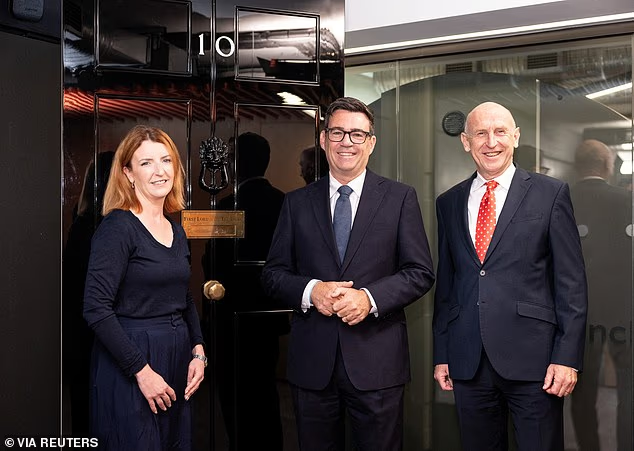
The Conservative criticism came as Mr Burghart also challenged the role of No10 North, the Government’s new base in Manchester, which has been established as a centre for regional growth and devolution.
He said he had expected Ms Haigh to curb the influence of the Treasury, after she previously described it as an “imperial finance department”. Instead, he argued, the authority of No11 had been preserved and the original plans for No10 North to take control of growth had been diluted.
“The real power remains within Number 11 South,” he said, referring to the Treasury led by Chancellor John Healey.
Ms Haigh rejected the suggestion that No10 North lacked influence, saying responsibility for local economic growth and devolution strategy had been moved there from the Ministry of Housing, Communities and Local Government and the Treasury.
She described the changes as “a little bit of a chip in its empire” and said No10 North was being funded from existing Cabinet Office budgets.
The Government has said the Manchester operation will bring together ministers, regional mayors and officials to drive economic growth outside Westminster. It has also announced plans to second between five and ten civil servants to each mayoral authority for six to nine months from the autumn.
Ms Haigh’s Commons statement also set out three cross-government taskforces. The first will examine long-term pressures on household finances; the second will consider greater public control of housing, water, energy and transport; and the third will focus on renewing local communities and struggling high streets.
She said the taskforces would work with regional mayors as ministers pursued their devolution agenda, insisting that the Government was committed to transferring power while reducing the size of the central state.
