


Means-testing disability benefits could save the Government an initial £8.2 billion a year, while further restrictions on claims by under-30s could cut spending by up to £2.2 billion, a report by the Institute for Fiscal Studies has found.
The proposals would focus support more closely on people with the most severe disabilities or those on the lowest incomes. They come as the Government prepares to consider reforms to Personal Independence Payment (PIP) ahead of the autumn review by social security minister Sir Stephen Timms and October’s Budget.
The IFS said PIP spending could be reduced by around a third if the benefit were incorporated into Universal Credit, which is means-tested. However, it warned that the saving could diminish over time as more people sought Universal Credit in order to retain access to PIP.
Despite the potential change in behaviour, the think tank said there would still be “a large saving”.
Eduin Latimer, a senior research economist at the IFS, said any reforms would create “losers as well as winners” and that the Government needed to decide what PIP was intended to provide.
“If it is to help disabled people in the greatest need, there is a case for targeting support on those with the most severe disabilities or on the lowest incomes,” he said.
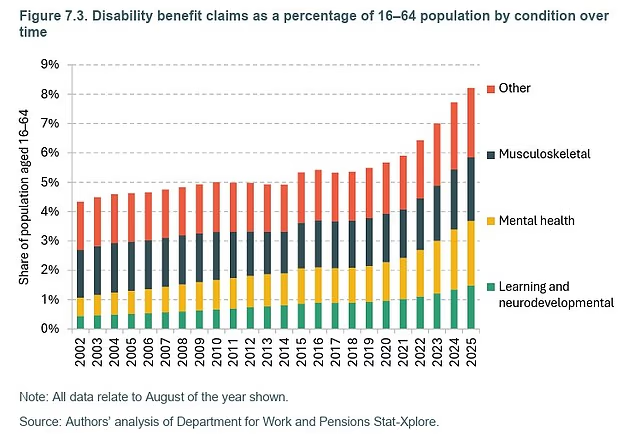
The proposals follow figures from the Department for Work and Pensions showing that more than four million people are now receiving PIP, with the number of claimants reaching a record high under Labour.
Spending on the benefit has risen from £14 billion in 2019-20 to £25 billion in 2025-26. Official forecasts suggest it could reach £34 billion by 2030-31.
The IFS examined the possibility of stopping all PIP claims by the 689,000 people aged under 30, which it calculated would save £5.5 billion a year. But it warned that many of those affected have severe disabilities.
Instead, it suggested limiting support for under-30s to those with the most serious conditions, which could still deliver annual savings of up to £2.2 billion.
Labour abandoned plans last year to reduce the disability benefits bill by £5 billion after a major rebellion by backbench MPs. The Government subsequently launched the Timms review.
A separate report by the Re:State think tank said 7.8 per cent of Britain’s working-age population claimed extra-cost benefits because of a medical condition in 2024, a 50 per cent increase since 2016.
It compared that figure with 0.2 per cent in Denmark, 0.6 per cent in France and 2.5 per cent in Norway for equivalent benefits.
There are eight possible PIP award levels, with the average claimant receiving £7,420 a year. Around 37 per cent receive enhanced elements, taking the maximum total award to £10,120 annually.
Re:State described the payments as generous by international standards and said Britain was unusual in providing unconditional cash without requiring claimants to show that it had been spent on costs related to their condition.
Charlotte Pickles, the think tank’s chief executive, said Britain had “confused cash with compassion” and that the Government had “broken the welfare state”.
