


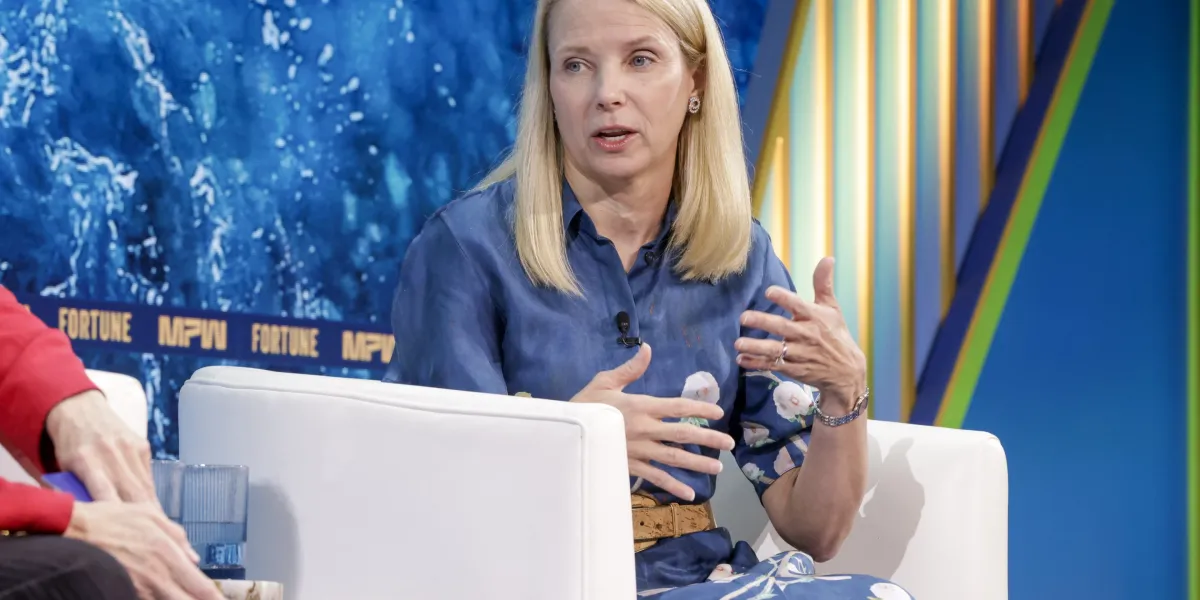
Marissa Mayer has warned that nobody can say with certainty how artificial intelligence will develop, while arguing that the chances of a damaging outcome remain below 50 per cent.
The former Google executive and Yahoo chief executive said AI represented “a new form of intelligence” during a discussion with Diane Brady at the annual Most Powerful Women Summit in California.
“Anyone who says they know how this is going to play out is either lying or arrogant or both,” Mayer said when asked about the debate surrounding frontier AI laboratories.
She said the uncertainty applied in both directions, acknowledging that “there is a possibility that things won’t go well”. But she put the likelihood of a negative outcome at “well less than 50%”, adding: “What that really means is the odds are in our favor.”
Mayer pointed to possible advances in medicine and science, as well as the prospect of technology freeing people to spend their time as they choose. She described herself as an optimist, while backing discussions on regulation and greater collaboration between leading AI companies.
She also accepted that public opinion in the United States had turned against AI and said the industry might share responsibility. The technology had initially been presented in a way that was “perhaps too cavalier”, she said, leaving people concerned about the effect of widespread adoption on jobs, families and children’s futures.
“I personally think it can make all three of those things better,” Mayer told Brady.
Marissa Mayer turns to personal AI assistant
Mayer has spent much of her career at the centre of the technology industry. She joined Google as an early engineer before becoming one of its best-known executives, and took over as Yahoo’s chief executive in 2012.
She left Yahoo after its core assets and real estate were sold to Verizon for 4.8 billion dollars in 2017. She later founded Sunshine, a contacts and photo-sharing start-up, which was wound down in 2025, with its assets sold to Dazzle AI.
Dazzle formally launched on September 29 this year after raising 8 million dollars in seed funding at a 35 million-dollar valuation in 2025. Mayer said its personal AI assistant learns from photographs stored on a user’s phone and can turn information in them into tasks.
She said roughly 60 per cent of a typical camera roll consisted of images worth sharing, while the remainder included practical reminders such as appointment cards or photographs of children’s shoes that needed replacing.
Dazzle combines that information with human and AI agents, creating what Mayer described as a to-do list “that gets itself done”. The service is currently available by invitation, with plans for subscription charges, transaction fees or both, alongside a free tier.
Mayer said users would be able to choose whether Dazzle had full, partial or no access to their photographs, while sensitive images would be discarded immediately.
She said early adopters had mainly been men, but hoped more women would use the product and play a role in shaping the future of AI. “I think it’s really important for us to have a voice in how AI develops,” she said.
