


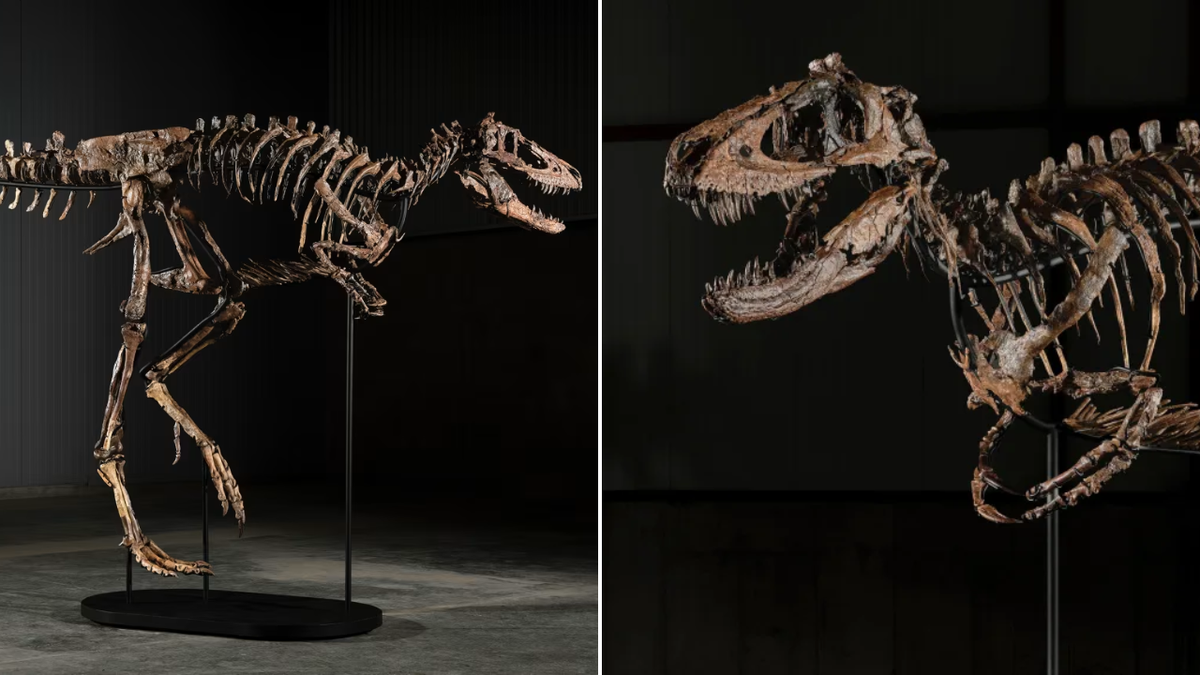
A rare Nanotyrannus skeleton has sold for US$47.3 million (£36.6 million) at Sotheby’s in New York, making it the second-most valuable fossil ever sold at auction.
Named Jodi, the specimen was bought after a 12-minute bidding contest involving six contenders. Its final price far exceeded the pre-sale estimate of US$6 million to US$9 million.
The sale narrowly missed the fossil auction record, set in July when an exceptional Tyrannosaurus rex skeleton known as Gus sold for US$50.1 million. Jodi is just over half the length of Gus, measuring 19.6ft (5.9 metres) long and 9.6ft (2.9 metres) tall.
Nanotyrannus skeleton among only three known
Jodi is one of only three relatively complete Nanotyrannus skeletons known to science. Sotheby’s said it contains 191 bone elements, including a “virtually complete” skull, and is exceptionally well preserved.
The skeleton was found in Montana in 2019 by rancher Jodi Pierson, after whom it was named. It was excavated by Clayton Phipps, a commercial palaeontologist known as the “Dinosaur Cowboy”.
Nanotyrannus remains a contentious species in palaeontology. Researchers have only recently shifted towards recognising it as a distinct dinosaur rather than a juvenile T. rex, while Sotheby’s said the size and development of Jodi’s bones indicated it was an adult.
The specimen came from the Hell Creek Formation, which stretches across Montana, Wyoming and the Dakotas and has produced several important dinosaur fossils. The other known Nanotyrannus skeletons include Jane, held by the Burpee Museum of Natural History in Rockford, Illinois, and a smaller tyrannosaur identified as Nanotyrannus in the so-called Dueling Dinosaurs fossil at the North Carolina Museum of Natural Sciences.
Some missing bones in Jodi have been replaced with custom 3D-printed and sculpted elements. It was sold with “full rights”, allowing its new owner, whose identity has not been disclosed, to create and sell replicas to museums or collectors.
Scientists warn fossil may leave public view
High-value dinosaur fossil sales have drawn criticism from scientists who say important specimens can be removed from public collections and made unavailable for research.
Steve Brusatte, professor of palaeontology and evolution at the University of Edinburgh, said: “We’ve really just found out that Nanotyrannus is real, and now one of the best skeletons is about to be sold to the highest bidder.”
“It’s harrowing to think it could disappear into the vaults of a collector rather than displayed on a museum where it can wow and inspire kids and families and the public at large,” he added.
David Hone, a palaeontologist and reader in zoology at Queen Mary University of London, said he was surprised Jodi had sold for so far above its estimate.
“It does feel like this is a bubble of prices on dinosaurs which must burst at some point, they can’t keep rising forever,” he said.
Mr Hone added that the specimen’s scientific value could not be properly assessed without verified expert study. “I’d be very surprised if the specimen ended up in a public collection and available for study, and so until that point it is effectively outside of science,” he said.
