


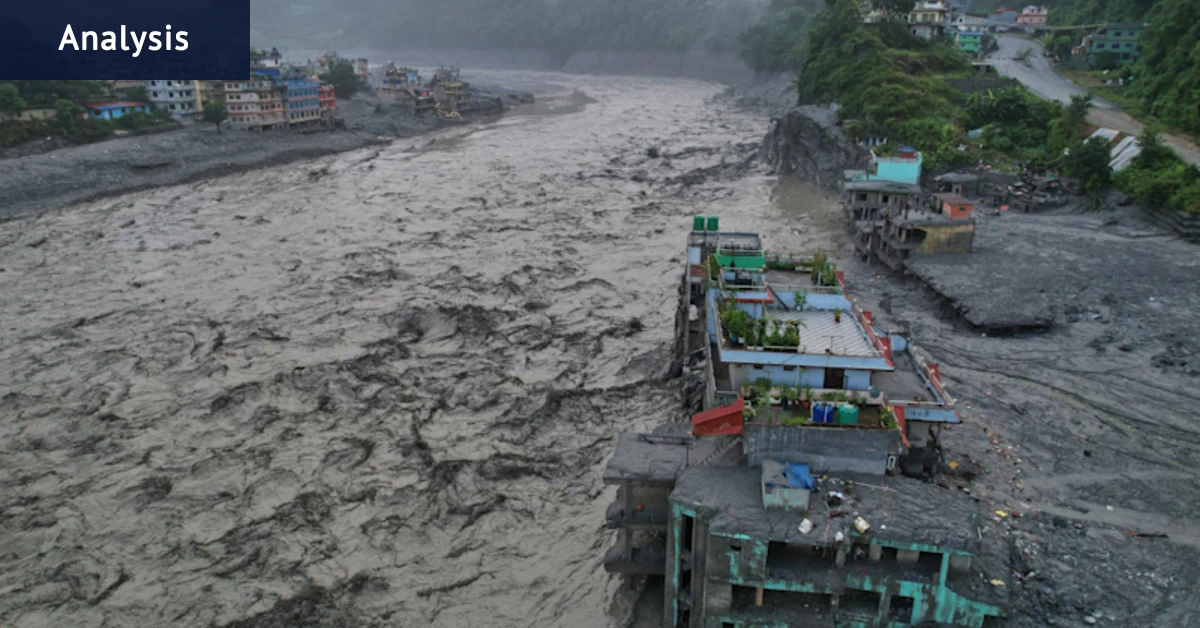
Nepal’s devastating flash floods have exposed the widening divide between countries bearing the brunt of climate change and governments still reluctant to accept responsibility for the crisis, after Australia’s prime minister declined to say whether the world shared blame for the disaster.
Anthony Albanese was speaking in Palau on Tuesday, September 1, where he is attending the Pacific Islands Forum, when he was asked whether the international community had failed Nepal by not doing enough to curb global warming.
“There will be time to examine the science and what has occurred here,” Mr Albanese said. “My thoughts are solely focused, at this point in time, on the families and on the extraordinarily difficult time that we’re going through and offering our support to Nepal.”
His cautious response contrasted with that of Nepal’s prime minister, Balendra Shah, who said the flood was not an ordinary natural disaster. In a social media post, Mr Shah said the torrent in the Bhote Koshi River in Rasuwa had been triggered by “an avalanche of snow and ice in the Himalayan region”.
“The people of Nepal are one of the major victims of the changing climate and its impact,” he said, noting that the country contributes less than 0.01 per cent of global carbon emissions.
The disaster struck on August 26, when a sudden surge of water, mud, sediment and boulders swept through the Bhote Koshi and Trishuli river systems near the Nepal-China border. Villages, roads, bridges, hydropower facilities and border infrastructure were destroyed, while hundreds of people were killed or reported missing.
Australian officials said 43 Australians remained unaccounted for on Tuesday. Mr Albanese said a Royal Australian Air Force C-17A carrying humanitarian supplies had left for Kathmandu, while 18 Australian response personnel were working in the Nepalese capital.
Nepal flash floods highlight mounting Himalayan risks
Scientists from the International Centre for Integrated Mountain Development, or ICIMOD, believe the flood was probably set off by an ice and rock avalanche that temporarily blocked a river before releasing a powerful surge downstream.
The US Geological Survey initially detected what appeared to be an earthquake but later concluded that the seismic signal was consistent with a glacier collapse rather than an earthquake. ICIMOD said river levels rose by as much as nine metres in just 30 minutes.
Researchers have stressed that it is too early to establish a direct link between climate change and this particular collapse. But they say rising temperatures are altering glaciers, snow cover, permafrost and mountain slopes across the Hindu Kush Himalaya, increasing the likelihood of cascading disasters.
Nepal’s glaciers have lost almost a third of their volume over the past three decades, according to United Nations figures. ICIMOD reported in March that glaciers across the Hindu Kush Himalaya have been losing ice at twice the historical rate since 2000.
The consequences extend far beyond the communities living beneath the mountains. The region’s glaciers are often described as the world’s third pole, and their seasonal melt helps sustain agriculture, drinking water supplies and electricity generation for almost two billion people across Asia.
Neera Shrestha Pradhan, who leads ICIMOD’s water and disaster-risk work, has warned that the region could face a period of “peak water” around 2050, as accelerated melting is followed by declining supplies. The disruption could bring economic hardship, displacement and political instability, she said.
The flood has also revived concerns about the lack of effective cross-border warnings. ICIMOD said monitoring stations were damaged or swept away, while officials in Nepal and China continue to investigate the precise cause and assess whether further blockages could produce additional flooding.
For Nepal, the disaster is another reminder that the countries least responsible for global warming are often among the first to suffer its consequences. For leaders meeting in Palau to discuss climate change and regional security, it has also brought the dangers of a warming world directly into the room.
As Nepal’s foreign minister, Shisir Khanal, put it during a briefing in Kathmandu: “Whatever melts in the Himalayas rises in the sea.”
