


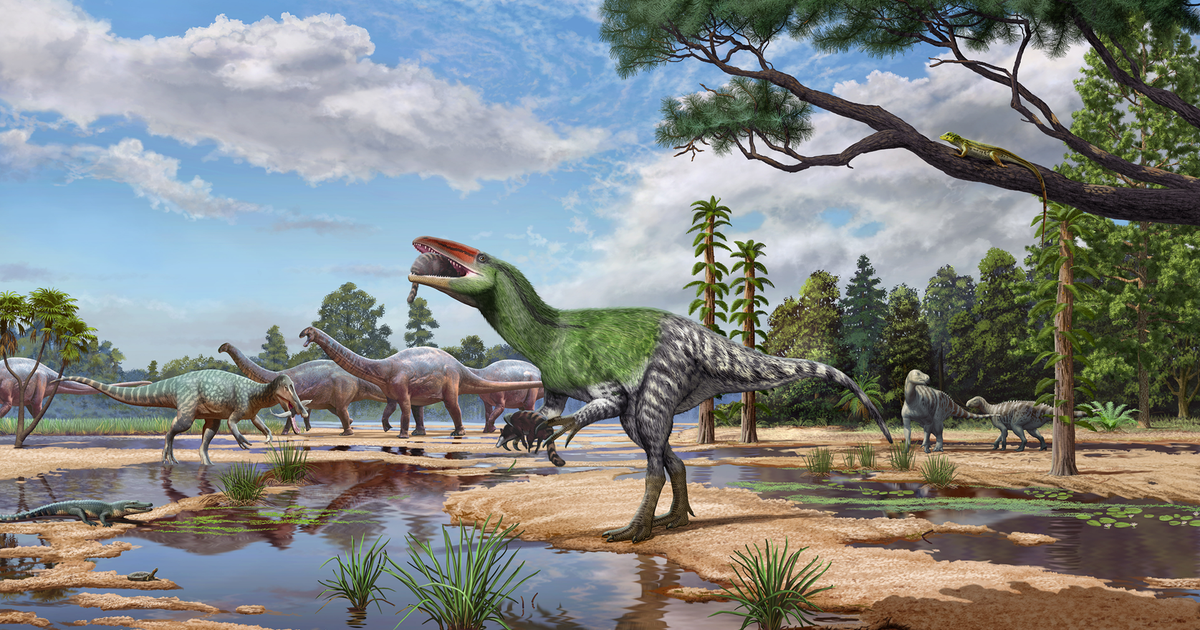
A new dinosaur species, identified from a fossil that spent almost a century in a drawer at London’s Natural History Museum, has been described as a long-clawed predator roughly the size of a tiger and related to Tyrannosaurus rex.
Named Invictibellatrix amberina, the animal was a two-legged carnivore belonging to the megaraptoran group. Unlike T. rex, researchers say it would have relied on powerful arms and large, curved claws to attack its prey.
The dinosaur lived during the Early Cretaceous period, around 120 million years ago. It is among the smallest and earliest known megaraptorans, measuring an estimated 10 to 13 feet long and standing almost five feet tall.
Its body is believed to have been covered in feathers. Researchers think it hunted smaller dinosaurs, lizards and mammals.
Fossil overlooked for nearly 100 years
The fossil is a section of the back of the dinosaur’s skull, known as a braincase. It was found on the Isle of Wight in 1924 by Reginald Walter Tooley, who discovered about 1,000 specimens that were later acquired by the museum.
Dr Cassius Morrison, of University College London and lead author of the study, described the fact that the fossil had remained unidentified for so long as “a real mystery”.
Researchers used a CT scan to create a three-dimensional model of the fossil before comparing it with skulls from other meat-eating dinosaurs, including tyrannosaurs, spinosaurs and raptors. A series of distinctive features led them to conclude that it represented a previously unknown species.
The name Invictibellatrix is Latin for “unconquered female warrior”, while amberina refers to amber found in the rocks where the fossil was discovered.
The researchers said the name was intended to “give hope and strength to all those who are bullied, discriminated, victimized, and oppressed that tomorrow will be theirs and not to give up in the face of such odds.”
Although the dinosaur was not the apex predator of its time, Dr Morrison said it could have posed a serious threat to humans had they lived alongside it.
“We would have been perfectly sized prey, about a third of their body weight,” he said. “They definitely would have chased us. A T. rex would not have bothered, as we would have been too small.”
